
 Stone Cutting Machines
 Stone Polishing Machines
 Bridge Saw Machines
 CNC Stone Wire Saw Machine
 Stone Engraving Machines
 Stone Veneer Saw
 Stone Quarry Machines
 Stone Band Saw Machines
 Stone Edging Beveling Machine
 Other Stone Machines
 Stone Diamond Tools
 Stone Slab Cutting
 Stone Slab Surface Edge Polishing
 Stone Block Slicing
 Stone Quarry Mining
 Stone Horizontal Splitting
 Stone Engraving Applications
 CNC Stone Cutting
 Countertop Cutting Polishing
 Other Applications
When upgrading a stone fabrication shop, the most common dilemma owners face is choosing between a 4-axis and a 5-axis CNC machine. According to a 2025 survey conducted by the MOSCUT marketing department across 120 mid-to-small North American fabrication shops, we discovered a surprising statistic: over 65% of factories that purchased expensive 5-axis machines realize that 90% of their daily orders never actually require true 5-axis simultaneous interpolation.
Last year, a client in Houston, Texas, approached us, ready to take out a $120,000 loan for a top-of-the-line 5-axis CNC. During our initial consultation, we evaluated their business model. Because their core business was fabricating standard quartz kitchen countertops and basic vanity tops, we strongly advised them to invest in a 4-axis monoblock bridge saw instead. By making this shift, the client saved nearly $50,000 on their initial investment, completely bypassed the need for a concrete foundation, and still managed to double their daily production output. Choosing the right machinery isn’t about buying the most expensive option; it’s about matching the technology to your most profitable workflow.


Decoding the 4-Axis CNC Bridge Saw
To understand the difference, you must first understand what the “axes” represent. A standard 3-axis saw moves left/right (X), forward/backward (Y), and up/down (Z). The 4-axis introduces a revolutionary capability that makes it the absolute backbone of modern countertop fabrication.

The Magic of the C-Axis Rotation
The 4th axis (known as the C-Axis) allows the entire cutting head to rotate horizontally a full 360 degrees. On a manual 3-axis saw, if you need to cut a rectangle, you cut the length, stop the machine, and then manually spin the heavy stone 90 degrees to cut the width. A 4-axis machine automatically rotates its blade to make the intersecting cuts, diagonals, and sweeping arcs without human intervention.

Tilting and Milling Capabilities
A true 4-axis machine is a versatile 2.5D processing monster. Not only can the head rotate, but the blade can also incline up to 45 degrees to execute flawless miter cuts for waterfall edges. Furthermore, by removing the blade and attaching a CNC router bit via the 1/2″ gas fitting, the 4-axis machine can automatically plunge and mill out perfect sink and stovetop cutouts directly on the table.
What Makes a True 5-Axis Machine Different?
If a 4-axis machine can already cut 45-degree miters, rotate 360 degrees, and mill sink holes, why do factories spend $100,000+ on a 5-axis? The core differentiator boils down to two words: “Simultaneous Interpolation.”

Simultaneous 3D Sculpting
A 4-axis machine generally moves step-by-step: it rotates, locks into position, and then cuts. A 5-axis machine can move its X, Y, Z, C (rotation), and A (tilt) axes all at the exact same time. This fluid, multi-directional movement allows the cutting tool to sculpt highly complex 3D profiles from solid blocks of stone—such as smooth, bowl-shaped marble bathtubs, spiral Roman columns, or undulating architectural wave walls.

Complex Sweeping Miter Joints
While a 4-axis can easily cut a 45-degree miter on a straight edge, it struggles on curves. Imagine a luxury kitchen island with a sweeping, S-shaped curved edge that requires a seamless waterfall drop-apron. A 5-axis machine can keep the blade tilted at exactly 45 degrees while simultaneously rotating and moving along that curved vector—a physical impossibility for a 4-axis machine.
The Financial ROI: Which Machine Fits Your Shop?
Putting aside the impressive mechanical specifications, let’s look at the business reality. The right machine is the one that aligns with your order catalog and returns your capital investment the fastest.
When the 4-Axis is Your Best Investment
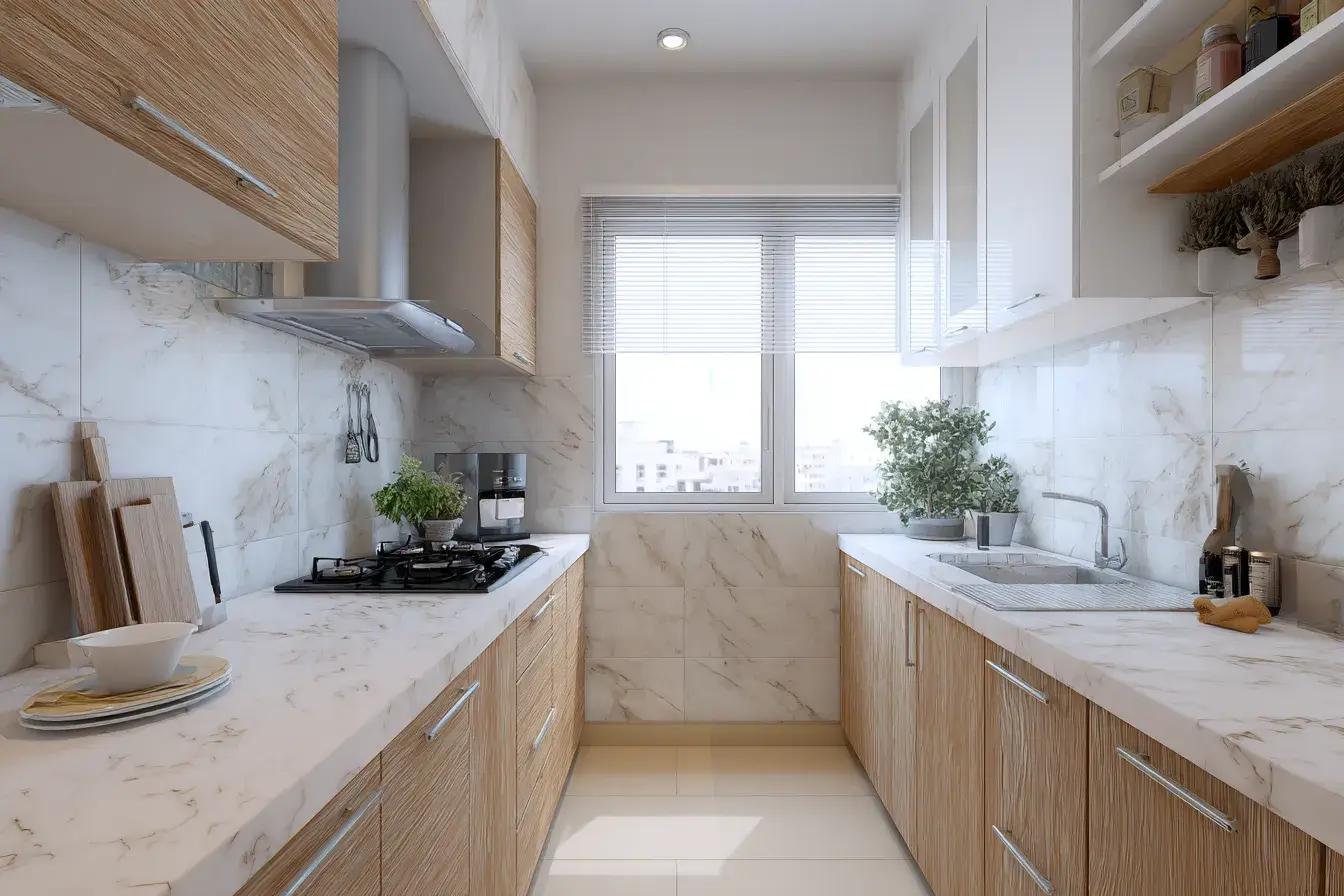
If 80% to 90% of your business consists of standard quartz and granite countertops, flat bathroom vanities, straight backsplashes, and commercial wall cladding, the 4-axis machine is your ultimate workhorse. It performs these flat-panel tasks just as fast as a 5-axis, but costs half the price, requires significantly less software training, and boasts a much faster ROI.

When You Must Upgrade to a 5-Axis
If your factory caters to high-end interior designers and wealthy residential clients, you need a 5-axis. When clients request solid stone carved sinks, highly intricate 3D bas-reliefs, or extremely complex sintered stone (Dekton) assemblies with curving miter joints, a 5-axis machine is the only way to secure these lucrative, high-margin bespoke contracts.
Maximize Your Factory’s Profitability Today
Purchasing industrial CNC equipment should not be driven by a desire for the most expensive technology on the market; it is a mathematical equation. By accurately matching a machine’s capabilities to your factory’s actual daily output requirements, you eliminate wasted capital and maximize your profit per cut. If you are ready to automate your high-volume countertop production without breaking the bank, the solution is clear.
Discover the Ultimate 4-Axis Workhorse
Explore the MOSCUT HTQ350E 4-Axis Monoblock CNC Bridge Saw. Delivering 360° automation, integrated sink milling, and plug-and-play installation at an unbeatable price point.
View 4-Axis Machine DetailsTop 10 FAQ: 4-Axis vs. 5-Axis CNC Saws
1. Is a 5-axis machine faster at cutting straight lines than a 4-axis?
No. When cutting standard straight rectangles (X and Y axis movements), both machines operate at roughly the same speed, as they are limited primarily by the cutting resistance of the stone and the quality of the diamond blade, not the number of axes.
2. Can a 4-axis machine create a waterfall island?
Yes! A modern 4-axis machine can incline its blade up to 45 degrees to execute perfectly straight miter cuts. As long as your waterfall edges consist of straight lines, a 4-axis will handle them flawlessly.
3. Are the diamond blades and tools the same for both machines?
For standard cutting and sink routing, yes. However, a 5-axis machine performing 3D sculptures will require a specialized arsenal of thick finger bits and ball-nose routers designed specifically for deep multi-directional milling.
4. Is the software harder to learn on a 5-axis?
Yes. While an operator can learn to program 2D flat cuts on both machines in a few days, programming complex 3D profiles for a 5-axis requires dedicated CAM software training (like Alphacam or Pegasus) and a solid understanding of 3D geometry.
5. Can I cut a circle with a 4-axis saw?
Yes. Because the 4-axis has a rotating C-axis, it can continuously turn the blade while moving in a circular path, allowing it to easily cut out round dining tables or oval vanity tops.
6. Why are 5-axis machines so much heavier?
Simultaneous 5-axis movement generates immense, multi-directional torque and twisting forces. To prevent microscopic vibrations from ruining a 3D carving, the frame of a 5-axis machine must be built with significantly more cast iron and heavy steel.
7. Do both machines require an overhead camera system?
Neither strictly “requires” it, but an overhead camera for digital slab nesting and vein matching is a highly recommended option for both 4-axis and 5-axis machines, as it drastically reduces material waste.
8. Does a 4-axis require a concrete foundation?
Most advanced 4-axis machines (like the MOSCUT HTQ350E) feature a “Monoblock” design, meaning they are built on a single steel frame and require zero concrete pouring. High-end 5-axis machines often require robust concrete walls for maximum stability.
9. Can a 4-axis cut Sintered Stone (Dekton)?
Yes. The machine’s rigidity and precise servo controls allow it to cut brittle sintered stone effectively, provided you use the correct high-speed blades and adjust the step-cutting parameters in the software.
10. How much price difference is there between the two?
While prices vary by spindle power and brand, a true 5-axis CNC machining center is generally 60% to 100% more expensive than a premium 4-axis monoblock bridge saw.