
 Stone Cutting Machines
 Stone Polishing Machines
 Bridge Saw Machines
 CNC Stone Wire Saw Machine
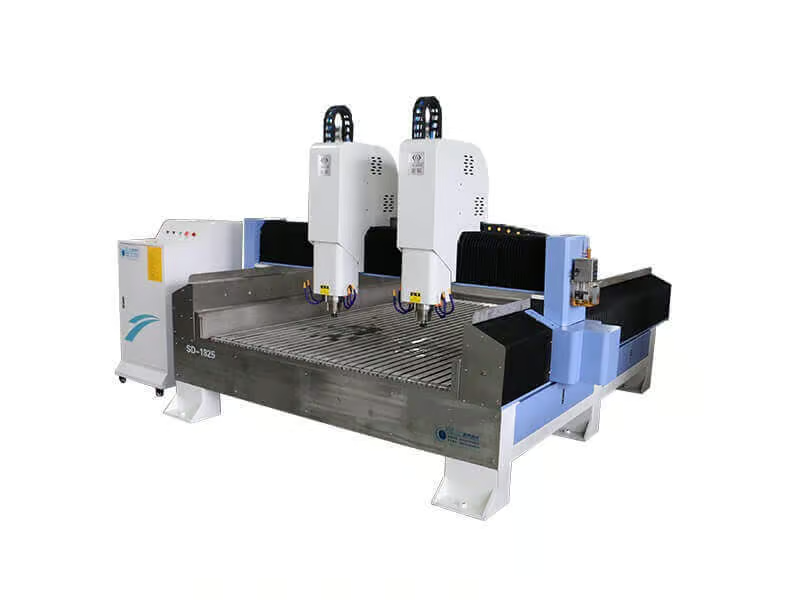 Stone Engraving Machines
 Stone Veneer Saw
 Stone Quarry Machines
 Stone Band Saw Machines
 Stone Edging Beveling Machine
 Other Stone Machines
 Stone Diamond Tools
 Stone Slab Cutting
 Stone Slab Surface Edge Polishing
 Stone Block Slicing
 Stone Quarry Mining
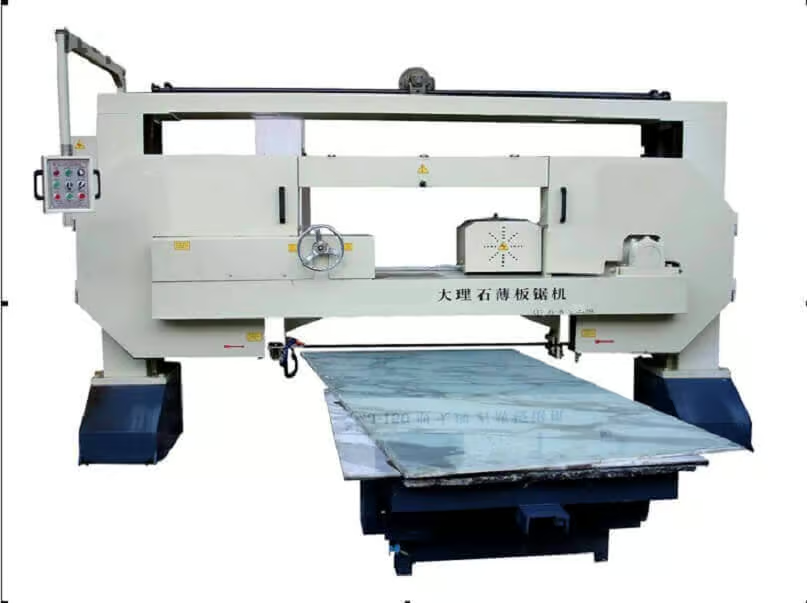 Stone Horizontal Splitting
 Stone Engraving Applications
 CNC Stone Cutting
 Countertop Cutting Polishing
 Other Applications
In the global stone processing industry, choosing the right 45-degree cutting technology is more than just a technical decision—it is a strategic investment in your shop’s ROI. In MOSCUT’s 2026 global after-sales data statistics, we found an interesting phenomenon: nearly 30% of clients who purchased expensive 5-axis rotating head machines never actually use that complex functionality for their daily orders, resulting in unnecessary maintenance costs and overkill for their specific needs.
Last year, a high-volume countertop workshop in Curitiba, Brazil, invested heavily in a 5-axis machine thinking “more features equals better”. However, since 95% of their orders are straight waterfall islands, the rotating head was redundant and added complexity they didn’t need. Conversely, a luxury furniture studio in Florence, Italy, absolutely requires the rotating head to execute complex 3D mitered joints for high-end sculptures. Meanwhile, in Dubai, UAE, major commercial projects often favor the sheer rigidity of beam-tilting designs for mass-producing identical panels. The key is matching the machine to your actual daily workflow.


The Mechanics Explained: How They Actually Work
Understanding the physical differences between these two designs is essential for selecting a machine that balances stability with flexibility.

Beam/Blade Tilting Design
In this classic design, the bridge or the spindle tilts as a whole to 45 degrees. The cutting head moves in a straight line along the X-axis. This structure is incredibly robust because it has fewer moving joints, providing maximum rigidity for deep, heavy cuts. To miter the other side of a slab, you either rotate the work table or manually reposition the stone.

Head Rotating Design
Found on advanced 4-axis and 5-axis CNC machines, this design allows the entire motor head to rotate 360 degrees while also tilting to 45 degrees. The stone remains perfectly still on the table while the machine rotates to miter all four sides of the panel automatically. It offers unparalleled flexibility for complex geometric shapes and intricate architectural work.
Head-to-Head Comparison: Rigidity vs. Flexibility
Which design wins in a real workshop environment? Both machines operate on a reliable 3-axis system, but they utilize entirely different mechanical paths to achieve cross-cuts and miters. Here is a direct breakdown based on global fabrication standards.
| Performance Metric / Spec | Beam Tilting Design (3-Axis) | Head Rotating Design (3-Axis) |
|---|---|---|
| Max Blade Diameter | 625 mm | 500 mm |
| Max Cutting Thickness | ~200 mm | ~140 mm |
| Horizontal Rotation | Cutting head is fixed (0°); Worktable rotates 360° | Cutting head rotates 90°; Worktable is fixed Or can make 90° |
| 45° Miter Mechanism | The entire spindle box tilts 45° around the main beam | The cutting head tilts 45° independently |
| Primary Advantage | Extreme Rigidity & Deep Stability | Fast Cross-Cutting Flexibility |
| Waterfall Islands (1-2 sides) | Fast, flawless, zero-chipping | Same speed, higher setup complexity |
| 4-Sided Mitered Boxes | Slower (requires 360° table rotation) | Faster (head automatically rotates 90°) |
| Structural Complexity | Simple, durable, fewer moving parts | Highly complex (rotation mechanics) |
| Maintenance Requirements | Low (standard industrial maintenance) | Higher (requires precise alignment) |
| Typical ROI | Excellent for high-volume thick slabs | Best for high-margin custom shops |
Workflow Match: Which One is Right for Your Factory?
Do not buy based on vanity; buy based on your daily output and your team’s technical capability.
The High-Volume Countertop Shop
If your factory in Brazil, the Middle East, or North America processes hundreds of standard L-shaped kitchens and straight waterfall islands per month, the Beam Tilting design is your best friend. Its “tank-like” rigidity ensures you can plow through hard quartzite and brittle sintered stone 24/7 with zero vibration and minimal downtime. It is a workhorse that delivers the fastest ROI for volume-based businesses.

The Luxury Custom Furniture Studio
If you are a boutique fabricator in Europe or the UAE creating 3D stone sinks, four-sided mitered coffee tables, or complex architectural facades, the Head Rotating design is non-negotiable. The ability to cut 45-degree miters in any direction without moving the slab is vital for maintaining perfect vein matching and handling intricate multi-sided joints where precision is measured in microns.

The Hidden Truth About Maintenance and Longevity
A rotating head involves high-precision gears, intricate wiring, and specialized dust-proof slip rings. In a demanding stone shop environment—where water and abrasive mud are everywhere—these components require meticulous maintenance. If your team isn’t prepared for the upkeep of a 5-axis system, the simpler, more rigid Beam Tilting structure will actually provide more profitable uptime over its 10-20 year lifespan.
Match Your Machine to Your Ambition
Whether you are expanding a mass-production facility or opening a specialized custom studio, choosing the right mechanical foundation is the key to your success. Do not pay for features you will never use, but do not let a basic machine limit your creative potential.
Still unsure which configuration fits your daily output?
Explore the engineering specifications and see why fabricators worldwide trust MOSCUT for their 45-degree miter needs. Our team can help you map out the perfect workflow for your factory’s specific goals.
Explore the 45° Miter Bridge Saw SpecsTop 10 FAQ: Beam Tilting and Head Rotating Bridge Saws
1. Is a rotating head machine less stable than a beam tilting one?
Generally, yes. Because a rotating head has more mechanical joints, it is inherently more susceptible to micro-vibrations unless it is built to extreme industrial standards. For pure 45-degree straight-line stability, beam tilting is the king.
2. How do I miter four sides with a beam tilting machine?
You use a rotating work table. You cut one side at 45°, then rotate the table exactly 90° to cut the next side. It takes slightly longer but achieves the same result with higher structural rigidity.
3. Can a rotating head machine also do sink cutouts?
Yes. If it is a 5-axis system, it can rotate and tilt to follow any path, making it perfect for undermount sink holes, arcs, and even decorative carvings.
4. What is the price difference between these two designs?
A full 5-axis head-rotating machine can be 30% to 100% more expensive than a heavy-duty beam-tilting model, depending on the software and control system (e.g., ESA or Pegasus).
5. Which design is better for cutting thin sintered stone like Dekton?
For long straight miters on Dekton, the stability of a beam-tilting machine is actually preferred by many global shops to prevent edge blowout caused by vibration.
6. Can I upgrade a beam tilting machine to a rotating head later?
No. The entire bridge and spindle assembly is fundamentally different. It is much better to choose the right platform from day one based on your long-term business goals.
7. Does head rotation allow for vein matching on waterfall edges?
Yes. By not moving the slab, you eliminate the risk of slight misalignment when rotating the stone, making vein matching across four-sided furniture much easier.
8. How often does a rotating head need re-calibration?
Depending on usage, we recommend checking the rotational alignment every 6 months to ensure that the 360-degree cuts remain perfectly square with your X and Y axes.
9. Is it harder to find operators for 5-axis rotating head machines?
The software is slightly more complex, but modern CNC interfaces are very intuitive. We provide comprehensive training to ensure your staff can handle the rotation features safely.
10. Which machine is better for my shop’s electricity consumption?
A beam tilting machine generally uses fewer servos and has a simpler control loop, resulting in slightly lower power consumption and lower long-term spare parts costs.