
 Stone Cutting Machines
 Stone Polishing Machines
 Bridge Saw Machines
 Stone Engraving Machines
 Stone Veneer Saw
 Stone Quarry Machines
 Stone Band Saw Machines
 Stone Edging Beveling Machine
 Other Stone Machines
 Stone Diamond Tools
 Stone Slab Cutting
 Stone Slab Surface Edge Polishing
 Stone Block Slicing
 Stone Quarry Mining
 Stone Horizontal Splitting
 Stone Engraving Applications
 CNC Stone Cutting
 Countertop Cutting Polishing
 Other Applications
Choosing the right processing equipment is the most critical financial decision a stone fabrication shop can make. Investing in the wrong technology can cripple your production speed and drain your profits through high maintenance costs. Whether you need the artistic finesse of a 5-axis waterjet or the relentless, high-volume production speed of a heavy-duty laser stone cutting machine, understanding the true capabilities of each method is the key to scaling your business successfully.
1. Defining the Technologies: What Does Each Machine Actually Do?
To make an informed decision, we first need to clarify what these terms mean in the context of heavy-duty stone processing—especially the term “laser,” which is frequently misunderstood.
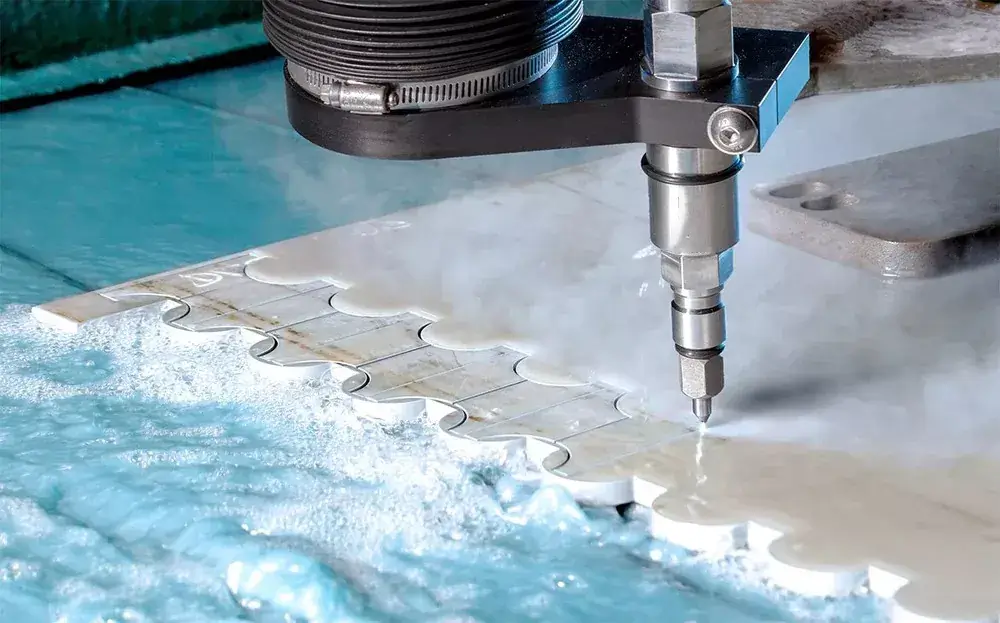
- Waterjet: Uses an ultra-high-pressure stream of water mixed with abrasive garnet sand to physically erode and cut through the stone.
- CNC Stone Center: A computer-controlled, multi-axis machine that uses various diamond milling bits and routers to carve, profile edges, and drill into the stone.
- Laser-Guided Stone Saw: It does not use a thermal laser beam to burn stone. Instead, it utilizes an advanced infrared laser reticle for zero-error optical positioning, while a heavy-duty 15KW motor and diamond blade execute the actual high-speed cut.
2. Waterjet Cutting: The Master of Intricate Curves
Waterjet technology is unparalleled when it comes to cutting complex geometric shapes and extremely tight internal corners without applying heat or mechanical stress to the slab.
The Reality: While it is the perfect machine for creating high-end floor medallions, intricate inlays, and processing extremely brittle materials, it comes with a severe downside. Waterjet cutting is incredibly slow compared to a bridge saw. Furthermore, the operational costs are staggering. You must constantly purchase abrasive garnet sand, and the ultra-high-pressure pumps require frequent, expensive maintenance.
3. CNC Stone Fabrication: The 3D Profiling Expert
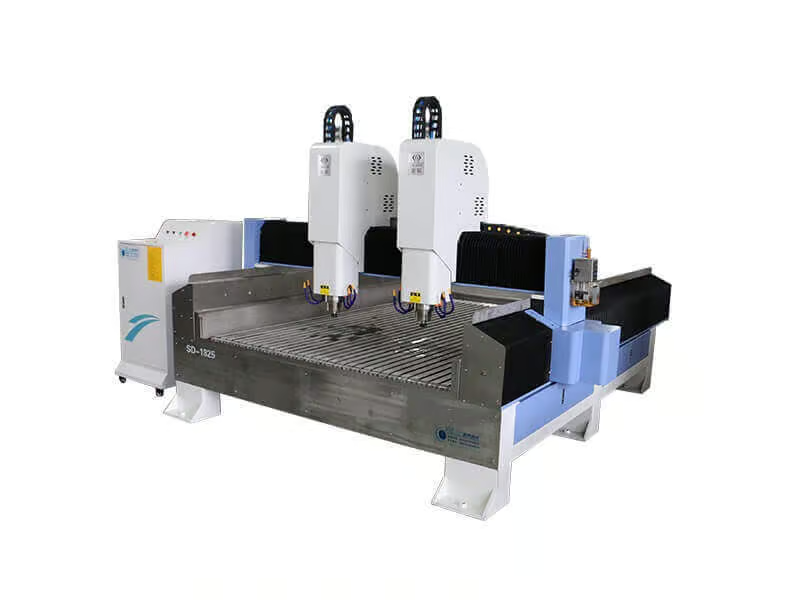
A 5-axis CNC machining center is a versatile powerhouse. Once the stone is loaded, the CNC can automatically switch tools to cut, route sink holes, polish edges, and even carve 3D reliefs (like tombstones or architectural columns).
The Reality: CNC machines require a highly skilled operator who is proficient in CAD/CAM programming. The initial purchase price is very high. While they are amazing for edge profiling and custom bowl routing, using a $150,000 CNC machining center simply to cut straight slabs for standard countertops is a massive waste of its capabilities and your time.

4. Laser Stone Cutting: The King of High-Volume Production
This is the workhorse of the modern fabrication shop. A laser-guided bridge saw is designed for one primary purpose: processing high volumes of “cut-to-size” slabs, countertops, and architectural panels as fast and accurately as possible.
The Reality: The optical laser alignment allows the operator to instantly position the stone, perfectly matching natural veins in seconds. The heavy-duty diamond blade then slices through thick granite at speeds up to 15 ㎡/h. It requires no expensive abrasive sand, no complex CAD programming, and the maintenance is minimal. It is the most profitable machine for straight-line slab processing.

5. How to Choose the Right Machine for Your Shop
Your choice depends entirely on your primary business model:
- Choose Waterjet if: Your core business is luxury custom inlays, complex artistic floor medallions, or working with highly fragile, thin materials where blade pressure would shatter the piece.
- Choose CNC if: You are producing fully finished custom kitchen islands with complex edge profiles, under-mount sink cutouts, and 3D architectural carvings.
- Choose Laser-Guided Saws if: Your main revenue comes from processing large volumes of slabs into countertops, wall cladding, and flooring. For shops focused on maximum daily output and minimal material waste, explore the specs of our heavy-duty granite laser cutting machine.
6. Multi-Dimensional Pros & Cons Summary Matrix
To help you visualize the operational differences, we have summarized the strengths and weaknesses of each technology across key factory dimensions.
| Dimension | Waterjet Cutting | CNC Machining Center | Laser-Guided Bridge Saw |
|---|---|---|---|
| Primary Strengths (Pros) | ✔ No heat-affected zone ✔ Can cut any complex shape or tight curve ✔ Zero tool pressure on slab | ✔ Multi-functional (Cut, route, polish) ✔ Fully automated 3D profiling ✔ Perfect for sink cutouts | ✔ Extremely fast cutting speed ✔ Visual laser for instant vein matching ✔ Lowest cost per square meter |
| Primary Weaknesses (Cons) | ✘ Extremely slow cutting speed ✘ Very messy (water and abrasive sand) ✘ Cannot polish edges or route | ✘ Slower at basic straight cuts than a saw ✘ Requires highly skilled CAD operator ✘ High initial equipment investment | ✘ Cannot cut tight internal curves ✘ Limited to straight lines & 45° miters ✘ Cannot perform surface 3D carving |
| Operational & Consumable Cost | Very High (Requires constant supply of abrasive garnet, water, and expensive pump seals) | Medium-High (Requires specialized diamond milling bits and router tooling) | Low (Only requires electricity, water, and standard diamond saw blades) |
| Production Speed (Straight Cuts) | Slow | Medium | Extremely Fast (Up to 15 ㎡/h) |
| Ideal Application in Workshop | Luxury floor medallions, intricate inlays, waterjet mosaics. | Complex edge profiling, 3D carving, finished custom vanity tops. | High-volume slab cut-to-size, straight kitchen countertops, rock slab processing. |
7. Top 10 Technical FAQ: Waterjet vs CNC vs Laser
Expert answers to the most common questions from fabricators planning a machine upgrade.
1. Is waterjet cutting slower than laser guided stone cutting?
Yes, significantly. A waterjet eroding stone with sand is a slow process. For straight lines, a laser stone cutting machine using a diamond blade is exponentially faster and more efficient.
2. Which machine has the lowest maintenance cost for a stone shop?
The laser-guided bridge saw has the lowest maintenance cost. It relies on standard mechanical bearings and a durable blade, avoiding the highly pressurized components of a waterjet or the delicate electronic spindles of a 5-axis CNC.
3. Do I need a CNC machine just to cut straight countertops?
No. Using a CNC purely for straight cuts is inefficient and wears out expensive router bits. A granite laser cutting machine is the correct tool for rapid, straight countertop blank production.
4. Can a laser-guided saw cut a sink hole?
A bridge saw can cut the straight rectangular edges of a drop-in sink. However, for oval under-mount sink holes with polished inside edges, a CNC router is required.
5. Why is “vein matching” easier on a laser-guided saw?
The optical laser projects a highly visible red line directly across the slab. The operator can physically see exactly how the cut will align with the stone’s natural pattern before starting the motor.
6. Can waterjets process thick granite blocks?
While waterjets can cut thick materials, the water stream begins to lose focus (taper) at greater depths, causing angled edges. A diamond blade on a laser saw guarantees a perfectly straight 90-degree cut on thick blocks.
7. What is the learning curve for a CNC compared to a laser saw?
A CNC requires an operator trained in CAD/CAM software to program tool paths. A laser-guided saw is highly intuitive; operators use visual alignment and basic touchscreen inputs, making it much faster to master.
8. Does a laser-guided machine require abrasive sand?
No. Unlike a waterjet, a laser stone cutting machine only uses standard tap water to cool the diamond blade, eliminating the cost and mess of garnet sand.
9. If I have a waterjet, do I still need a bridge saw?
Yes. Almost all professional shops use a bridge saw (laser-guided) to quickly break down raw slabs into smaller, workable blanks, which are then moved to the waterjet or CNC for intricate detailing.
10. Can a laser-guided saw perform 45-degree miter cuts?
Yes. High-quality laser bridge saws feature tilting heads (usually 0° to 45°), allowing them to execute perfect mitered edges for seamless waterfall countertops.
Ready to Maximize Your Factory’s Output?
Stop guessing which technology fits your production line. Connect with the MOSCUT engineering team to find the perfect equipment combination for your fabrication goals.
View Laser Bridge Saw Specs