
 Stone Cutting Machines
 Stone Polishing Machines
 Bridge Saw Machines
 CNC Stone Wire Saw Machine
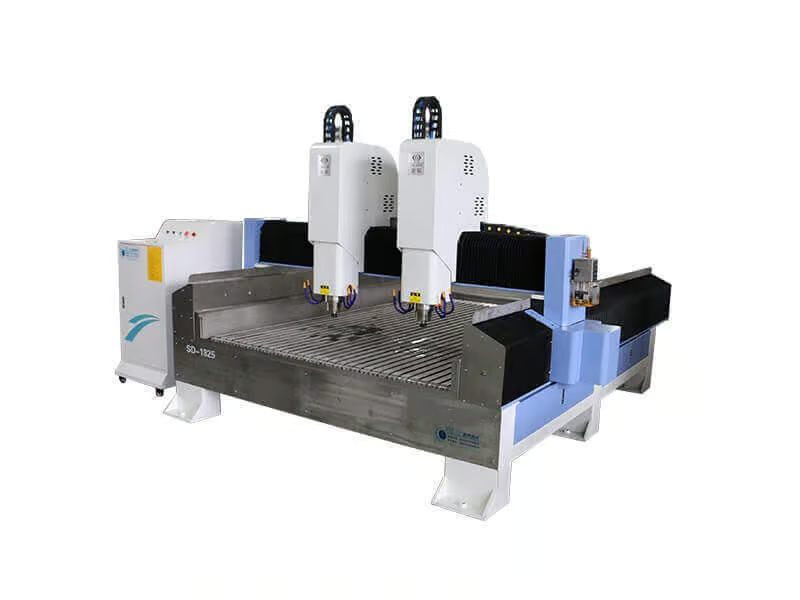 Stone Engraving Machines
 Stone Veneer Saw
 Stone Quarry Machines
 Stone Band Saw Machines
 Stone Edging Beveling Machine
 Other Stone Machines
 Stone Diamond Tools
 Stone Slab Cutting
 Stone Slab Surface Edge Polishing
 Stone Block Slicing
 Stone Quarry Mining
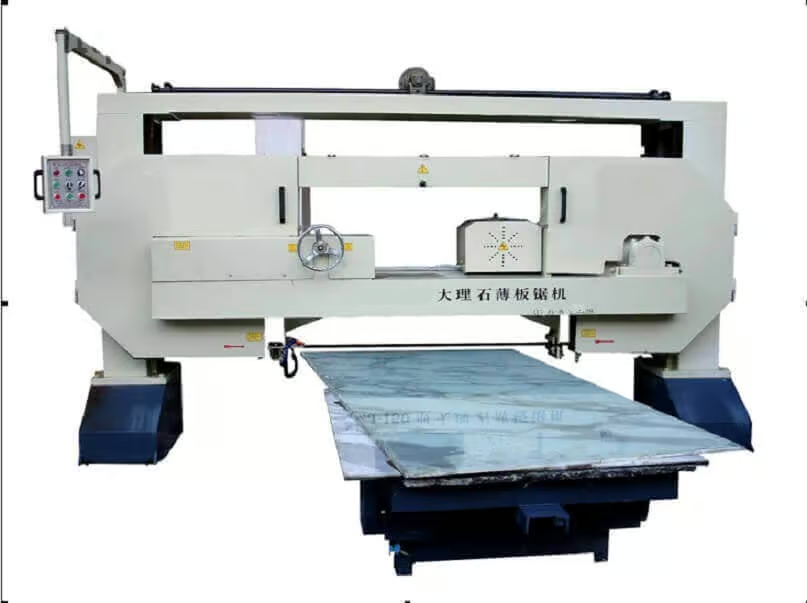 Stone Horizontal Splitting
 Stone Engraving Applications
 CNC Stone Cutting
 Countertop Cutting Polishing
 Other Applications
Modern municipal infrastructure and chemical transport rely heavily on two dominant materials: High-Density Polyethylene (HDPE) and Glass Reinforced Plastic (GRP). According to industry reports from the Plastics Pipe Institute (PPI), the adoption of massive thermoplastic and composite piping systems is growing exponentially due to their longevity and corrosion resistance.
While these materials excel in the field, fabricating them in the workshop is incredibly challenging. GRP is a thermosetting composite, meaning it is tough, abrasive, and shatters easily. HDPE is a thermoplastic, meaning it is flexible and melts under heat. The problem for most fabrication shops is trying to process both of these radically different materials with the same outdated cutting equipment.

The Unique Challenges of Cutting GRP Pipes
GRP and FRP pipes are manufactured by binding tough glass fibers with industrial resin. Processing this material is notoriously harsh on tooling and workers.
- Extreme Abrasiveness: The glass fibers act like sandpaper against cutting tools. Traditional metal band saw blades become dull incredibly fast, forcing shops into a cycle of constant, expensive blade replacements.
- Toxic Airborne Dust: Dry cutting composite pipes releases clouds of hazardous microscopic glass fibers. This dust is dangerous to inhale and highly irritating to the skin.
- Delamination Risks: Because standard saw blades use large teeth to tear through material, they often rip the fiberglass layers apart rather than slicing them cleanly. This delamination ruins the structural integrity of the pipe joint.
The Unique Challenges of Cutting HDPE Pipes
HDPE presents the exact opposite problem. It is not abrasive, but its thermoplastic nature makes it highly sensitive to friction.
- Friction Melting: High-speed metal blades generate intense friction heat. This heat instantly melts the plastic along the cut line.
- Gumming Up the Blade: As the HDPE melts, the hot, sticky plastic fills the gaps between the saw teeth. The blade quickly becomes “gummed up” and useless, often causing the saw motor to overheat and jam.
- Ruined Welding Edges: HDPE pipes are typically joined using Butt Fusion Welding. This process requires an absolutely perfect, flat, and unmelted edge to ensure a leak-proof seal. A melted or deformed cut guarantees a failed weld.
Head-to-Head Comparison: Material Properties
| Fabrication Factor | HDPE (Thermoplastic) | GRP / FRP (Composite) |
|---|---|---|
| Reaction to Heat | Melts and deforms easily | Resin burns, releasing toxic fumes |
| Tool Wear Rate | Low (but gums up blades) | Extremely High (highly abrasive) |
| Primary Cutting Hazard | Friction melting & blade jamming | Toxic dust & layer delamination |
| Joint Prep Requirement | Perfectly flat for Butt Fusion | Smooth and un-delaminated for flanges |
Why a Water-Cooled CNC Wire Saw Masters Both Materials
To eliminate the need for multiple specialized machines, modern fabrication shops use a heavy-duty CNC wire saw. This technology effortlessly adapts to the drastically different physical properties of both HDPE and GRP.
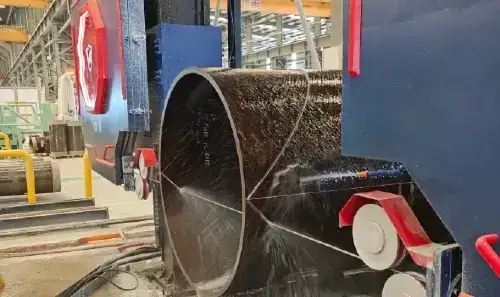
Cold Cutting Technology
The integrated continuous water-cooling system is the ultimate solution for HDPE. By flooding the cutting kerf with water, the diamond wire and the plastic remain completely cold. This prevents friction heat from ever building up, ensuring the HDPE never melts, deforms, or gums up the cutting tool.

Smooth Abrasive Slicing
For GRP pipes, the machine abandons the tearing action of toothed blades. Instead, it utilizes high-speed abrasive slicing. This smoothly grinds through the tough glass fibers without pulling or tearing them, completely eliminating the risk of edge delamination and preserving the joint integrity.

Adjustable CNC Feed Rates
An intelligent CNC control panel allows operators to adjust the cutting parameters instantly. You can set a faster, aggressive feed rate for dense composites, and then switch to a highly controlled, optimized speed for thick-walled thermoplastic pipes, removing human error from the equation.

Specialized Diamond Wire Rope
The secret weapon is the Diamond Wire Rope itself. Unlike traditional metal blades that dull rapidly on composites, our diamond beads are incredibly durable, offering a massive lifespan. Furthermore, the wire creates a very thin kerf (cut width), which is extremely friendly to the pipe structure. It minimizes material waste and prevents violent vibrations, ensuring a dust-free and surgically precise cut across all materials.
Streamline Your Fabrication Floor
You do not need to clutter your workshop with different saws for different materials. Whether you are prepping thick HDPE pipes for flawless butt fusion welding, or slicing massive GRP pipes for chemical transport, a single, highly capable machine is all you need.
Ready for the Ultimate All-in-One Cutting Solution?
Discover how our heavy-duty CNC systems can transform your fabrication process across all industrial pipe materials.
Explore the CNC Wire Saw for GRP & Plastic PipesTop 10 FAQ: Cutting HDPE vs. GRP Pipes
HDPE & Plastic Pipe Fabrication
1. Will a diamond wire saw leave a finish suitable for HDPE Butt Fusion?
Yes. Because the water-cooled diamond wire prevents melting and produces a perfectly 90-degree flat cut, the HDPE pipe end is usually ready for the facing tool and subsequent butt fusion welding immediately.
2. Why does my band saw keep jamming when cutting HDPE?
Band saws generate excessive friction heat without adequate cooling. The HDPE melts, cools, and solidifies inside the gullets of the saw teeth, completely gumming up the blade and halting the cut.
3. Can I cut PVC and other plastics with the wire saw?
Absolutely. The cold-cutting technology of the water-cooled CNC wire saw is highly effective on PVC, PP, and all other thick-walled industrial thermoplastics.
4. Do I need to change the diamond wire when switching from GRP to HDPE?
Generally, a high-quality multi-purpose diamond wire can cut both materials effectively. However, for continuous, high-volume production of a single material, we offer specialized beads optimized specifically for either plastics or dense composites.
5. Is water cooling strictly necessary for cutting plastic?
Yes. Water cooling is the only guaranteed way to remove friction heat instantly from the cut zone, which is the key to preventing the thermoplastic from melting and deforming.
GRP/FRP & Equipment Operation
6. How does the machine handle the mix of plastic shavings and fiberglass slurry?
The continuous water system washes both the heavy plastic shavings and the fine fiberglass dust down into a collection trench beneath the machine. The solid waste separates from the water in a settling tank for easy disposal.
7. How long does a diamond wire rope last?
Diamond wire ropes are exceptionally durable. While the exact lifespan depends on the diameter and abrasiveness of the pipes, a single wire can often outlast dozens of traditional large-diameter band saw blades.
8. Can the CNC system save different cutting profiles?
Yes. The smart HMI allows operators to save specific feed rates and cutting speeds as presets. You can have one preset optimized for 2-meter GRP pipes and another for 1-meter HDPE pipes.
9. Is the V-shape worktable safe for both materials?
Yes. The heavy-duty V-shape worktable securely cradles both rigid composite pipes and slightly more flexible thermoplastic pipes, ensuring neither material rolls or shifts during the cut.
10. Does cutting different materials require different machine maintenance?
The machine maintenance remains largely the same: greasing the linear guide rails, checking the pneumatic/hydraulic wire tensioners, and clearing the water settling tank of accumulated plastic and fiberglass slurry.