
 Stone Cutting Machines
 Stone Polishing Machines
 Bridge Saw Machines
 CNC Stone Wire Saw Machine
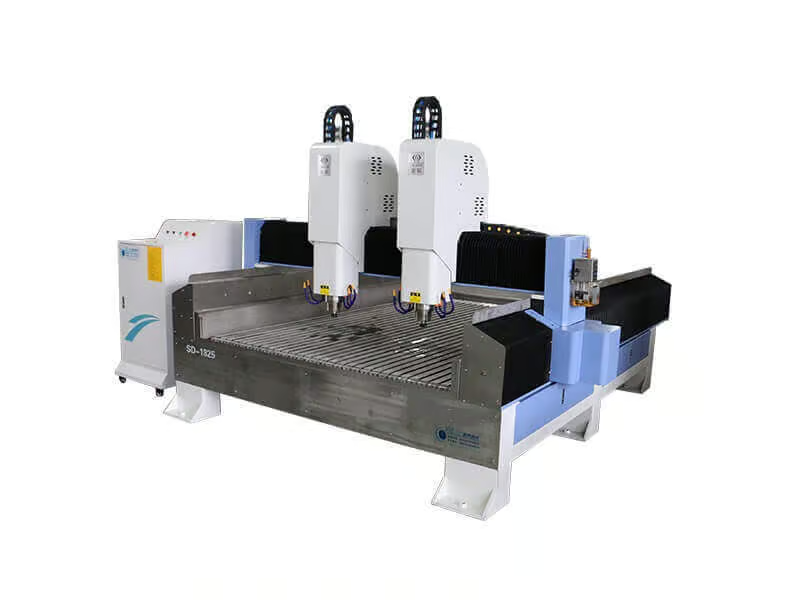 Stone Engraving Machines
 Stone Veneer Saw
 Stone Quarry Machines
 Stone Band Saw Machines
 Stone Edging Beveling Machine
 Other Stone Machines
 Stone Diamond Tools
 Stone Slab Cutting
 Stone Slab Surface Edge Polishing
 Stone Block Slicing
 Stone Quarry Mining
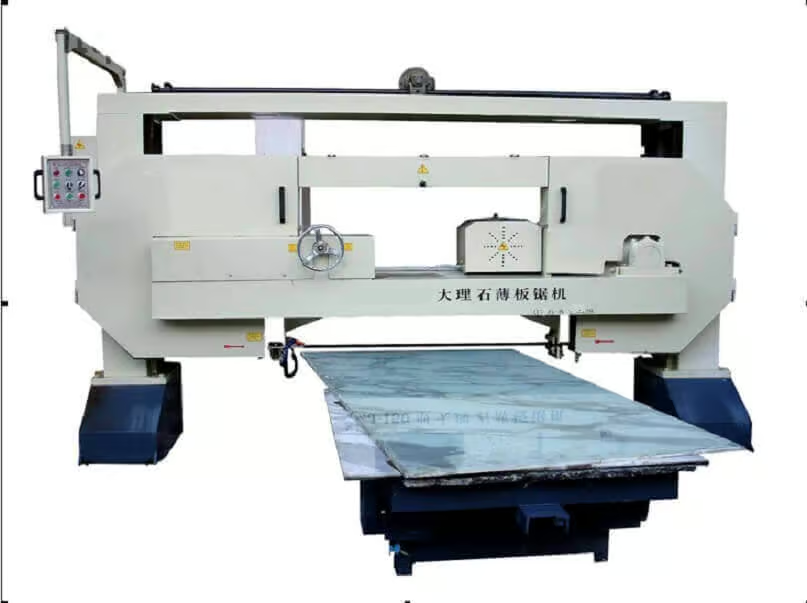 Stone Horizontal Splitting
 Stone Engraving Applications
 CNC Stone Cutting
 Countertop Cutting Polishing
 Other Applications
According to MOSCUT’s Q1 2026 North American market research, over 65% of newly built luxury kitchens specify sintered stone (like Dekton) or natural quartzite for seamless waterfall islands. However, a shocking 40% of traditional fabrication shops are actively rejecting these high-profit orders due to the terrifyingly high scrap rate caused by edge chipping.
In February of this year, a high-end fabrication shop in Houston, Texas, attempted to cut a 45-degree miter on ultra-compact Dekton using their aging, standard bridge saw. The slight vibration from the tilted cutting head shattered three consecutive slabs—costing them over $4,500 in ruined material and delaying a major project. It was only after they urgently installed the heavy-duty MOSCUT 45° Miter Bridge Saw that they achieved zero-chipping cuts, successfully securing orders for 15 more luxury kitchens in the same development. Sintered stone is notoriously difficult to cut, but the real culprit is rarely the operator’s skill—it is almost always the rigidity of your machinery.
The Brutal Reality of Ultra-Compact Surfaces
Understanding why materials like sintered stone and quartzite fail during processing is the first step to conquering them. It is not about the operator; it is about physics.

Internal Tension and the “Pop” Effect
Sintered stone is manufactured under extreme heat and pressure, leaving the finished slab packed with internal tension. When a diamond blade cuts into it, any microscopic vibration or localized heat buildup can cause the tension to release suddenly. This “pop” effect instantly blows out the edge of the material, turning an expensive slab into scrap.

Why Your Standard Bridge Saw Fails at 45°
Many standard bridge saws perform adequately when cutting straight down at 90 degrees. However, when you tilt the motor head to 45 degrees, the center of gravity shifts. The lateral force exerted on the blade causes lightweight spindles and rails to flex. For brittle materials like sintered stone, even 0.1mm of blade deflection is a disaster waiting to happen.
The 3 Mechanical Pillars of a Flawless Miter Cut
To successfully process the hardest materials on the market without chipping, your equipment must provide absolute stability. Our 45° Miter Bridge Saw is engineered around three non-negotiable mechanical pillars.

Pillar 1: Absolute Spindle Rigidity
We utilize a heavy-duty, stress-relieved cast iron main beam and a precision-locking tilt mechanism. When the motor head is engaged at 45 degrees, it becomes a single, immovable block. Regardless of the extreme lateral resistance from cutting quartzite, the blade maintains an absolutely perfectly straight path with zero deflection.
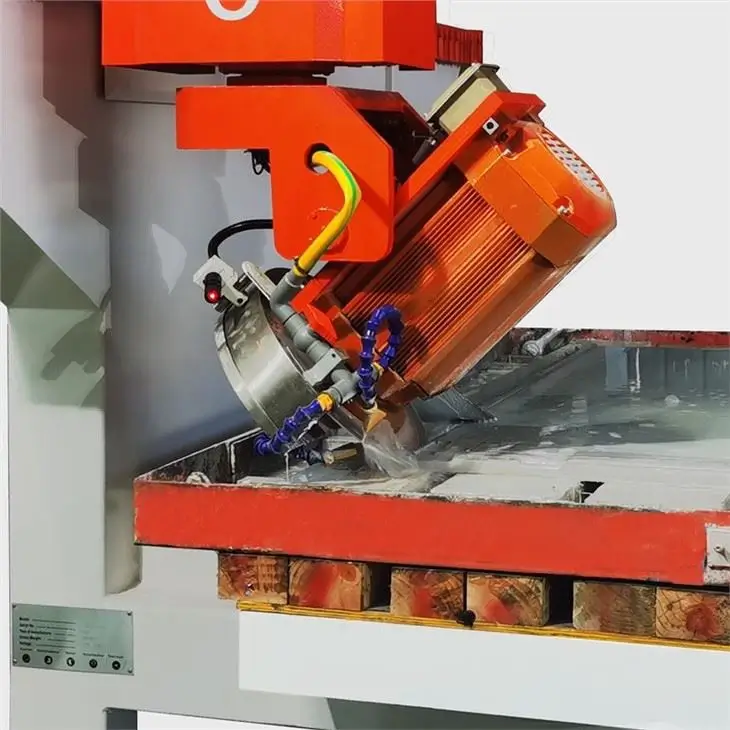
Pillar 2: Motorized Constant Feed
Cutting sintered stone requires a feed rate that does not fluctuate. Our machines utilize industrial-grade servo motors and gear racks to drive the cutting head. This delivers an absolutely constant, stutter-free feed rate. By eliminating human error and mechanical hesitation, the blade glides through the material smoothly without catching or binding.

Pillar 3: Targeted High-Volume Water Cooling
Heat is the enemy of ultra-compact surfaces. As the diamond segments grind through the stone, massive friction is generated. Our Miter Bridge Saw features a multi-directional, high-volume water cooling system that precisely targets the exact point of contact. This instant heat dissipation prevents thermal shock, stopping the stone from cracking and dramatically extending blade life.
The Hidden Labor Cost of “Hiding” Bad Cuts

When a machine lacks the rigidity to make a clean cut, the financial bleed doesn’t stop at the saw table. If a 45-degree edge has minor chipping, fabricators are forced to spend hours “hiding” the mistakes. This involves meticulously mixing color-matched epoxy, filling the chips, and hand-polishing the edge with multiple grits of diamond pads.
Not only are you paying exorbitant wages for this tedious salvage operation, but the final result is often subpar. Discerning luxury homeowners can spot thick glue lines and inconsistent polishing, leading to costly rejects and ruined reputations. A machine that cuts perfectly the first time eliminates the need for post-cut damage control.
Stop Rejecting High-Profit Luxury Orders
The demand for sintered stone and quartzite waterfall islands is only going to grow. Do not let outdated, lightweight equipment force you to turn down the most lucrative jobs in the market. By investing in the right mechanical foundation, you can transform these “difficult” materials into your highest margin products.
Ready to Conquer Sintered Stone?
Equip your shop with the ultimate heavy-duty solution for flawless waterfall edges. See the specs, features, and unparalleled rigidity of our equipment.
Discover the 45° Miter Bridge SawTop 10 FAQ: Cutting Sintered Stone and Quartzite
1. Do I need a special blade to cut sintered stone like Dekton?
Yes, absolutely. Sintered stone requires continuous-rim or closely-spaced segmented diamond blades specifically engineered for ultra-compact surfaces. Using a standard granite blade will instantly cause severe chipping.
2. What is the optimal RPM for cutting sintered stone?
For most sintered materials, a higher RPM (typically between 2000 to 2800 RPM depending on the blade diameter) is recommended to ensure a clean, slicing action rather than a grinding action. Our machines feature adjustable inverters to dial in the perfect speed.
3. Should I cut sintered stone faster or slower than granite?
Slower. The feed rate for sintered stone is generally significantly slower (e.g., 0.5 to 1.5 meters per minute) than granite to prevent tension buildup and thermal shock. The motorized feed on our bridge saw allows for this slow, consistent pacing.
4. How does the machine handle tension release at the end of the cut?
Sintered stone is notorious for cracking exactly as the blade exits the material. The absolute rigidity of our cast-iron beam prevents the blade from twisting at the exit point, and operators are trained to slow the feed rate slightly at the final inch to prevent blowout.
5. Can the 45° Miter Bridge Saw cut a 45-degree bevel on thin 12mm porcelain?
Yes. The machine is incredibly stable. When properly supported on the cutting table, even fragile 12mm porcelain panels can be mitered cleanly for seamless edge build-ups.
6. Is a laser guide included for aligning patterns on waterfall islands?
Yes, our machines come equipped with a high-visibility laser alignment guide. This is crucial for vein-matching (waterfalling the pattern) from the countertop down the side panel.
7. Do I need to relieve tension by cutting the edges of the slab first?
Many fabricators recommend doing a “trim cut” (shaving off 1-2 cm from all four sides of a sintered slab) to release factory tension before making the main cuts. Our automated saw makes this trimming process fast and effortless.
8. How do I assemble the 45-degree cuts once they are off the machine?
Because our machine produces a razor-sharp, perfectly straight edge, fabricators use the “Tape-and-Fold” method. You align the pieces flat, tape the face, apply specialized flowing epoxy in the V-groove, and fold it to 90 degrees for a nearly invisible seam.
9. Can this machine also process natural Quartzite (e.g., Taj Mahal)?
Yes. Natural quartzite is extremely dense and abrasive. The heavy-duty 15kW+ spindle motor and cast iron frame provide the necessary torque and vibration dampening to cut quartzite without bogging down.
10. What table surface is best for cutting these brittle materials?
A perfectly level, solid surface is required so the slab does not flex during the cut. Our machines feature reinforced cutting tables topped with durable, high-density materials to fully support the stone.