
 Stone Cutting Machines
 Stone Polishing Machines
 Bridge Saw Machines
 CNC Stone Wire Saw Machine
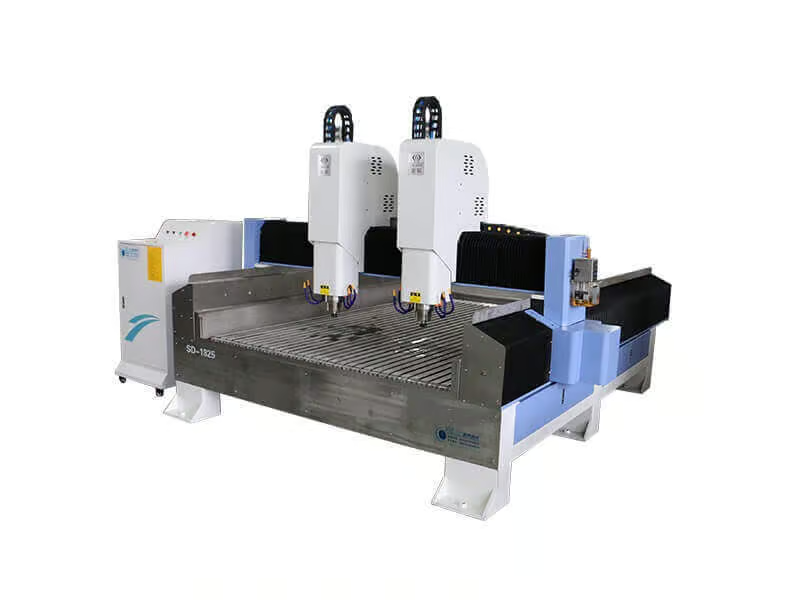 Stone Engraving Machines
 Stone Veneer Saw
 Stone Quarry Machines
 Stone Band Saw Machines
 Stone Edging Beveling Machine
 Other Stone Machines
 Stone Diamond Tools
 Stone Slab Cutting
 Stone Slab Surface Edge Polishing
 Stone Block Slicing
 Stone Quarry Mining
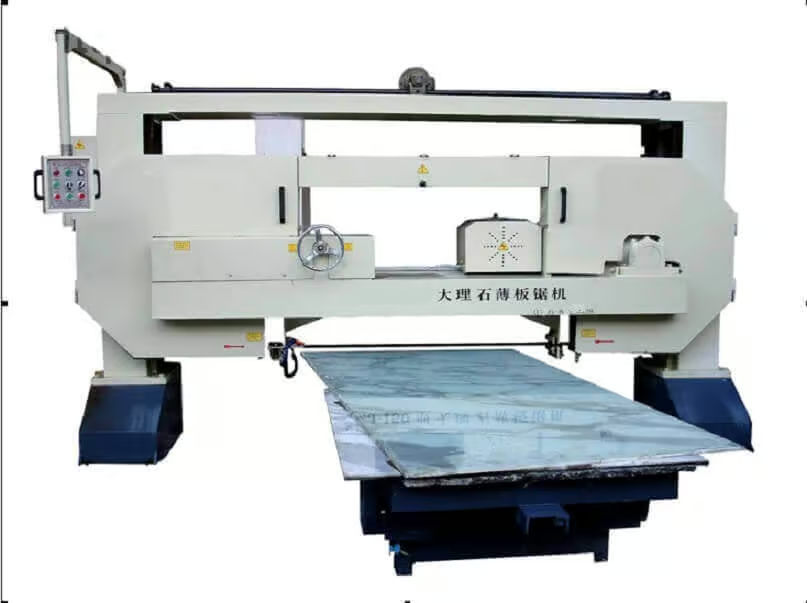 Stone Horizontal Splitting
 Stone Engraving Applications
 CNC Stone Cutting
 Countertop Cutting Polishing
 Other Applications
For decades, cutting sink holes was the most dreaded job in the fabrication shop. According to a 2025 field study conducted by the MOSCUT Customer Success Team across 60 mid-sized countertop factories, operators using manual angle grinders and hand-held routers take an average of 45 to 60 minutes to cut a standard double-bowl sink. Worse yet, due to the severe vibrations of manual grinding, roughly 8% of expensive quartz slabs cracked at the inner corners, resulting in complete material failure.
Last year, we visited a client’s workshop in California where two workers wore heavy respirators all day long, stationed in a wet, dusty corner doing nothing but cutting sink holes. After upgrading to our 4-axis monoblock equipped with a CNC milling spindle, their entire workflow transformed. Now, the operator simply imports a digital DXF file, the machine automatically swaps to a router bit, and the entire rough-out process is perfectly completed in under 12 minutes—dust-free. Those two workers were immediately reassigned to high-value edge polishing and quality control, instantly unlocking the factory’s true production capacity. Here is exactly how your 4-axis CNC bridge saw executes this game-changing process.


The Hardware: Swapping the Blade for a Router Bit
A modern 4-axis bridge saw is not just a saw—it is a heavy-duty stone router. To mill a sink, the machine must physically transition from cutting straight lines to plunging into solid stone.

The 1/2″ Gas Fitting Spindle
At the center of the main spindle shaft (where the diamond blade is attached) lies a specialized threaded hole known as a 1/2″ Gas fitting. Once the large diamond blade has finished sizing the rectangular countertops, the operator (or the automatic tool changer) removes the blade and threads a diamond “finger bit” directly into the center of the motor. This turns the 15kW spindle motor into a massive, high-torque CNC router.

Choosing the Right CNC Finger Bit
You cannot use the same bit for every material. Sintered stone (Dekton) requires a continuous rim or tightly segmented bit, while abrasive granite requires aggressive, widely spaced diamond segments to clear the slurry. Crucially, the spindle must support center-water feed—pumping high-pressure water directly down through the hollow center of the finger bit to prevent the tool from overheating and melting inside the stone cavity.
The Software: From CAD to Machine Code
Many shop owners hesitate to automate because they fear complex programming. However, modern CNC interfaces like Pegasus or ESA are designed specifically for stone workers, not computer scientists.

Importing Digital DXF Templates
If your field technician uses a digital laser templator at the customer’s house, they generate a precise 2D drawing (DXF file). You simply load this file into the machine via USB or Wi-Fi. The software instantly recognizes the sink outline. You just click on the line, assign the “Milling” toolpath, and the software automatically calculates the exact coordinates for the spindle to follow.

Utilizing Built-In Shape Macros
What if you don’t have a CAD file? No problem. The CNC system comes pre-loaded with “Shape Macros.” The operator simply taps the “Rectangle with Rounded Corners” or “Oval” icon on the touchscreen, punches in the length and width from a paper template, and the machine instantly writes its own G-code to mill that exact shape perfectly.
The Milling Process: Step-by-Step Execution
Once you hit “Start,” the machine takes over. Understanding the physical mechanics of this process highlights the intelligent safety features built into the CNC algorithms.

Plunging and Step-Cutting
A router bit cannot plunge all the way through 3cm (1.25 inches) of solid quartz in one go; it would snap instantly. The software commands the machine to use “Step-Cutting.” The bit plunges 2mm into the stone, traces the entire sink outline, then drops another 2mm, tracing it again. It continues this looping process at roughly 4,500 to 6,000 RPM until it pierces entirely through the bottom of the slab.

Managing the Core Drop
The most critical moment is when the bottom is finally cut through. If the heavy center piece of stone (the core) falls unevenly, it can jam against the spinning bit, breaking a $100 tool or cracking the countertop. The CAM software intelligently leaves two tiny, uncut “tabs” (small bridges of stone) holding the core in place. Once the machine finishes, the operator safely taps the tabs with a rubber mallet, and the core drops perfectly into the trash.
Elevate Your Countertop Production Efficiency
Stop paying skilled fabricators to do the grueling, dangerous work of manual routing. By leveraging the integrated milling capabilities of a modern CNC bridge saw, you guarantee that every undermount sink hole is perfectly dimensioned, smoothly cut, and completely stress-free. It is time to let the machine handle the heavy lifting so your team can focus on finishing and installation.
Ready to Automate Your Sink Cutouts?
Discover how the integrated 1/2″ spindle on the MOSCUT HTQ350E effortlessly transitions from blade cutting to precision CNC routing.
Explore the 4-Axis MonoblockBrowse All Bridge Saw Series
Top 10 FAQ: CNC Sink Routing on a Bridge Saw
1. What RPM should the spindle run at for milling sinks?
Typically, diamond finger bits require the spindle to spin much faster than a saw blade. Most tooling manufacturers recommend running between 4,500 and 6,500 RPM, depending on the bit diameter and stone hardness.
2. Can the finger bit cut perfectly sharp 90-degree inner corners?
No. Because a finger bit is cylindrical (usually 20mm or 22mm in diameter), it will always leave a radius in the corners equal to half the tool’s diameter. For a true 90-degree sharp corner, the operator must square it off manually with a small hand tool.
3. Can the 4-axis machine also polish the inside of the sink hole?
Technically yes, if you purchase a set of CNC polishing wheels and program the toolpaths. However, because bridge saws do not usually have Automatic Tool Changers (ATC), manually swapping 5 to 7 different polishing grits takes too much time. Most shops use the CNC to cut the shape perfectly, and have a worker finish the edge by hand.
4. Is center-water feed really better than external water nozzles?
Absolutely. External nozzles often spray water everywhere except the deep, narrow groove where the bit is actually cutting. Center-water feed forces water directly through the tool to the cutting face, drastically extending tool life and washing out the abrasive slurry.
5. Can the machine use a core drill before routing?
Yes. Many operators program the machine to plunge a 35mm core drill bit into the center of the sink area to create a starting hole, and then switch to a finger bit to route out the rest. This relieves initial plunge pressure on the finger bit.
6. How long does a diamond finger bit last?
Lifespan varies by material. Cutting soft marbles, a high-quality bit can last months. If you are constantly routing dense quartzites or sintered stones, expect to replace the bit much more frequently. Using correct RPMs and abundant water maximizes their life.
7. What happens if the DXF file has overlapping lines?
Advanced CAM software (like Pegasus) will usually flag “open vectors” or overlapping lines as an error before it generates the toolpath, prompting you to clean up the drawing to prevent the machine from making erratic cuts.
8. Can I route a sink hole while the slab is tilted on the table?
No. The hydraulic table must be completely flat and locked at 0 degrees before the machine begins any milling operations to ensure the spindle remains perfectly perpendicular to the stone surface.
9. Do I need to clamp the slab down while routing?
Generally, the weight of a full kitchen slab is enough to keep it stationary during milling. However, if you are routing a small vanity piece, it must be secured with vacuum suction pods or physical clamps, as the torque of the bit can spin a small piece off the table.
10. Can the machine mill out the recess for a flush-mount stove?
Yes. You can program a “pocketing” toolpath. The machine will use a flat-bottomed stubbing wheel to mill down just a few millimeters into the surface of the stone, creating a perfect recessed ledge for the stovetop glass to sit flush.