
 Stone Cutting Machines
 Stone Polishing Machines
 Bridge Saw Machines
 CNC Stone Wire Saw Machine
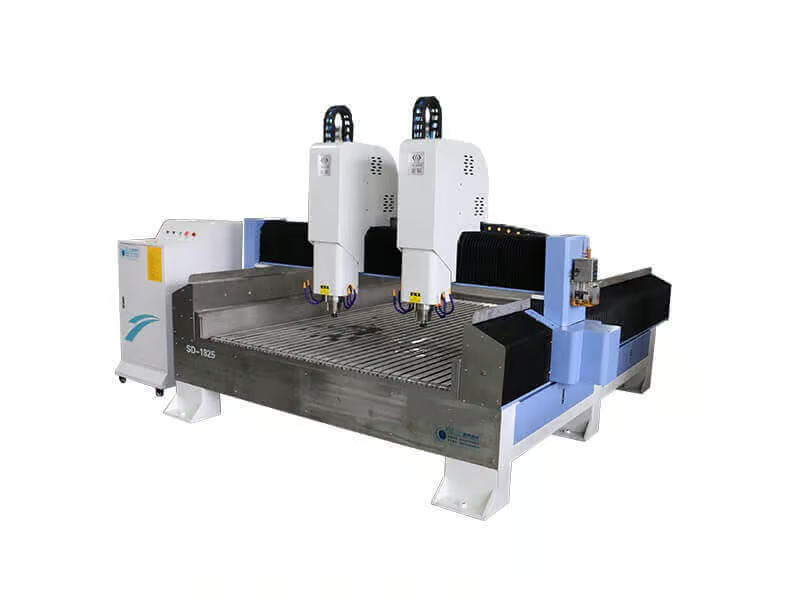 Stone Engraving Machines
 Stone Veneer Saw
 Stone Quarry Machines
 Stone Band Saw Machines
 Stone Edging Beveling Machine
 Other Stone Machines
 Stone Diamond Tools
 Stone Slab Cutting
 Stone Slab Surface Edge Polishing
 Stone Block Slicing
 Stone Quarry Mining
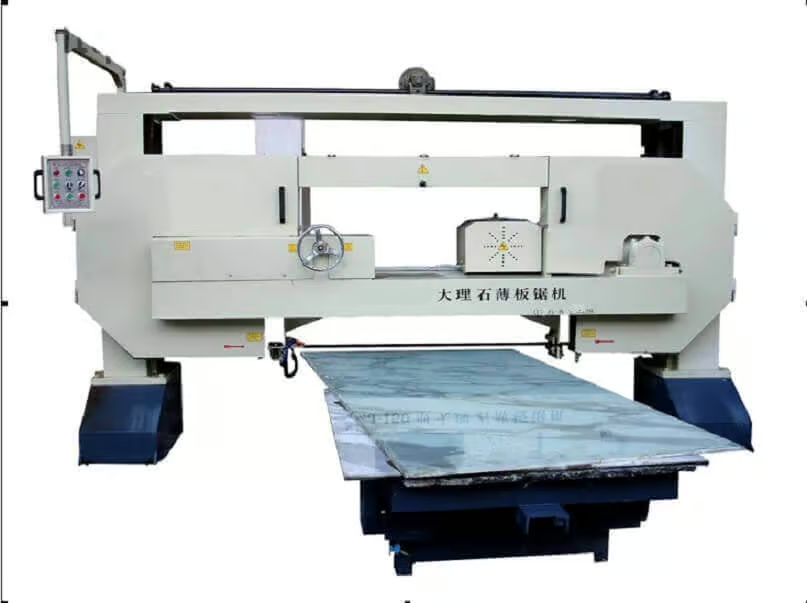 Stone Horizontal Splitting
 Stone Engraving Applications
 CNC Stone Cutting
 Countertop Cutting Polishing
 Other Applications
Engineered quartz dominates the modern countertop market, making up over 70% of the daily cuts for most residential fabrication shops. However, according to an early 2026 performance audit conducted by the MOSCUT R&D center across 90 North American quartz fabrication shops, a staggering 45% of factories artificially slow down their machine’s feed rate out of fear of chipping the stone. This over-caution wastes an average of 2 hours of production time daily and, ironically, reduces diamond blade lifespan by up to 30% due to overheating.
Last year, a client in Toronto, Canada, contacted our support team in total frustration. They were scrapping one expensive white quartz slab every single week due to scorched, yellowed cut lines, and they were burning through expensive diamond blades at an alarming rate. After our engineers conducted a remote video audit, we optimized their 4-axis monoblock’s RPM, drastically pushed their feed rates higher, and adjusted the water flow angles. The result? They completely eliminated edge scorching, increased their daily countertop output by exactly 30%, and saved $1,200 a month on blade costs alone. The secret to fast, flawless quartz cutting isn’t magic; it is a strict adherence to material physics combined with unyielding machine rigidity.

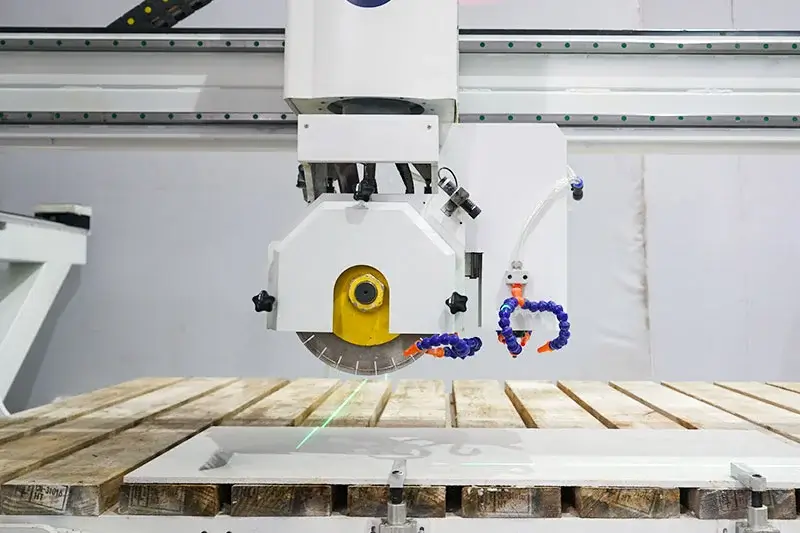
The Physics of Cutting Quartz
To cut quartz faster, you must first understand its composition. Engineered quartz is fundamentally different from natural granite, and treating them the same is a costly mistake.

The Resin Factor and Scorching
Engineered stone consists of roughly 90-93% crushed quartz aggregate and 7-10% polymer resin binders. When a diamond blade cuts through the stone, it generates massive friction. If the blade moves too slowly, that heat builds up instantly, melting the polymer resin. This melted resin burns, leaving ugly yellow or brown scorch marks along the edge of white or light-colored slabs.

Diamond Blade Glazing
Another symptom of cutting too slowly is “glazing.” The melted resin coats the diamond segments on your blade, preventing the diamonds from actively fracturing the stone. A glazed blade acts like a dull butter knife—it starts bouncing against the stone instead of slicing it, leading to severe edge chipping and premature blade death.
Optimizing CNC Machine Parameters
Shatter the myth that “slower is safer.” The golden rule of high-speed quartz fabrication is finding the perfect balance between Spindle RPM and Machine Feed Rate.

Finding the Sweet Spot for RPM
The speed of the blade (RPM) determines how many times the diamond segments impact the stone per second. For a standard 14-inch (350mm) quartz-specific diamond blade, running the spindle between 1,800 and 2,200 RPM is typically the sweet spot. Setting the RPM too high generates unnecessary heat; setting it too low pulls and tears the stone rather than cutting it cleanly.

Bravely Pushing the Feed Rate
This is where shops gain their 30% productivity boost. You must push your feed rate! When you cut at a faster pace (e.g., 2 to 3 meters per minute for 20mm quartz), the blade actively ejects the chips and the heat away from the cut line. The blade is constantly biting into fresh, cool stone, preventing resin melt. However, pushing high feed rates requires a heavily rigid cast iron bridge saw to prevent the machine head from vibrating under pressure.
Coolant Management: The Unsung Hero
Even if your RPM and Feed Rate are perfectly dialed in, inadequate water supply will ruin a $200 diamond blade in less than ten minutes.

High-Volume Directed Water Flow
Merely splashing water onto the surface of the slab is not enough. You need high-volume water lines aimed precisely at the leading edge of the blade, directly into the cut groove. The water serves two critical purposes: it cools the steel core of the blade to prevent warping, and it rapidly flushes the sticky quartz slurry out of the trench before it can re-adhere to the blade.

Keeping the Table Clean
Quartz slurry dries like cement and acts like a harsh abrasive paste. If you do not wash the table between slabs, the residual slurry will scratch the highly polished back of the next expensive quartz slab you load. Furthermore, a buildup of slurry forces the blade to cut through dense mud, creating unnecessary drag on the spindle motor.
Leveraging 4-Axis Automation for Throughput
The actual time the blade spends cutting stone is only a fraction of your shift. To truly maximize ROI, you must eliminate the “downtime” between the cuts.

Continuous 360° Rotation
On a manual saw, finishing a length cut means stopping the machine, lifting the slab, manually rotating it 90 degrees, and realigning the laser. A 4-axis monoblock utilizes C-axis automation to rotate the cutting head 360° instantly. This simple feature saves an average of 15 to 20 minutes per slab, allowing you to squeeze an extra kitchen job into every single shift.

Intelligent Nesting Software
Advanced CNC CAM software acts as an efficiency expert. Before the blade even touches the stone, the software calculates the absolute shortest path for the spindle to travel. By minimizing “air travel” (the time the blade spends moving across the table without cutting), the software squeezes every last drop of productivity out of your machine.
Skyrocket Your Factory’s Daily Output
In the highly competitive residential countertop market, your profitability is directly tied to how many linear feet of flawless quartz you can produce in an 8-hour shift. By optimizing your parameters and relying on the heavy-duty automation of a premium CNC bridge saw, you can stop fighting the material and start dominating your production schedule. Don’t let an outdated, vibrating machine force you to cut slowly.
Experience Unmatched Cutting Rigidity
A fast feed rate requires a heavy, stable machine. Explore how the solid steel chassis and absolute servo motors of the MOSCUT 4-Axis Monoblock guarantee smooth, high-speed quartz fabrication.
View the 4-Axis Monoblock CNCExplore All Bridge Saw Models
Top 10 FAQ: High-Speed Quartz Fabrication
1. Do I need a special diamond blade for engineered quartz?
Yes. Never use a granite or marble blade on quartz. Quartz-specific blades feature a unique diamond matrix designed to fracture the hard aggregate while clearing the sticky resin effectively without glazing.
2. Why does my blade make a loud screeching sound when cutting quartz?
A high-pitched screeching sound usually indicates that the blade is glazed (dull) or the RPM is set too high, causing the steel core to vibrate and resonate. Try lowering the RPM slightly or dressing the blade with a sharpening block.
3. Should I reduce the feed rate when cutting a 45-degree miter?
Yes. Miter cuts expose a much larger surface area of the blade to the stone, increasing friction significantly. You should generally reduce your feed rate by 30% to 50% during miter cuts to ensure a clean, chip-free edge.
4. Is “step-cutting” recommended for 20mm or 3cm quartz?
Usually, no. For standard 20mm or 3cm quartz, a rigid CNC machine with a good blade should easily perform a full-depth cut in a single pass. Step-cutting is generally reserved for ultra-compact sintered stone (Dekton) to relieve material tension.
5. How can I fix a glazed diamond blade?
You must “dress” the blade to expose fresh diamonds. You can do this by running the blade through a soft, abrasive dressing stone (like a silicone carbide block or even an asphalt brick) for several passes until the resin is ground away.
6. Does the direction of the cut matter on a CNC saw?
Yes. CNC software optimizes the cutting direction so the blade always rotates into the cut (climb milling/cutting). This forces the material down into the table, reducing vibration and preventing the slab from shifting.
7. What is the ideal water pressure for cooling the blade?
Volume is often more important than high PSI. You want a steady, high-volume flood of water (usually 3 to 4 cubic meters per hour) enveloping the front and sides of the blade to flush away the thick slurry instantly.
8. Why does the quartz chip out at the very end of the cut?
This is called “blowout.” It happens when the material is not fully supported underneath, or if the feed rate is too fast right as the blade exits the stone. Good CAM software automatically slows the feed rate by 50% for the last inch of the cut to prevent this.
9. Can I cut quartz dry if I have a dust extraction system?
Absolutely not. Cutting engineered quartz dry will immediately melt the resin, destroy the diamond blade in minutes, and release highly dangerous levels of silica dust into your factory air, violating severe OSHA safety regulations.
10. How long should a good quartz blade last?
While longevity depends heavily on the volume of work and the thickness of the stone, a premium 14-inch quartz blade operated at the correct RPM and feed rate should reliably yield between 3,000 to 5,000 linear feet of cutting before requiring replacement.