
 Stone Cutting Machines
 Stone Polishing Machines
 Bridge Saw Machines
 Stone Quarry Cutting Machines
 Stone Block Cutter Machine
 CNC Stone Wire Saw Machine
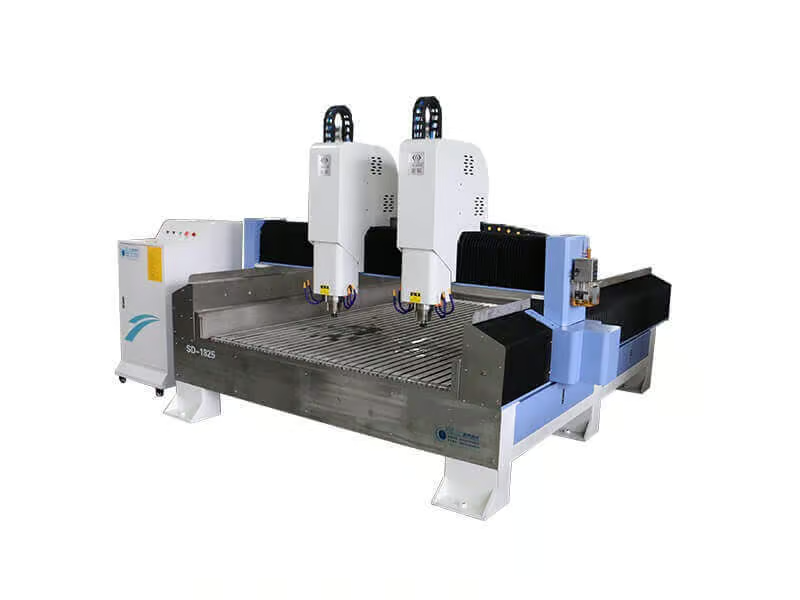 Stone Engraving Machines
 Thin Stone Veneer Saw Machine
 Horizontal Stone Slab Splitting Machine
 Stone Edge Polishing Profiling Machine
 Stone Auxiliary Equipment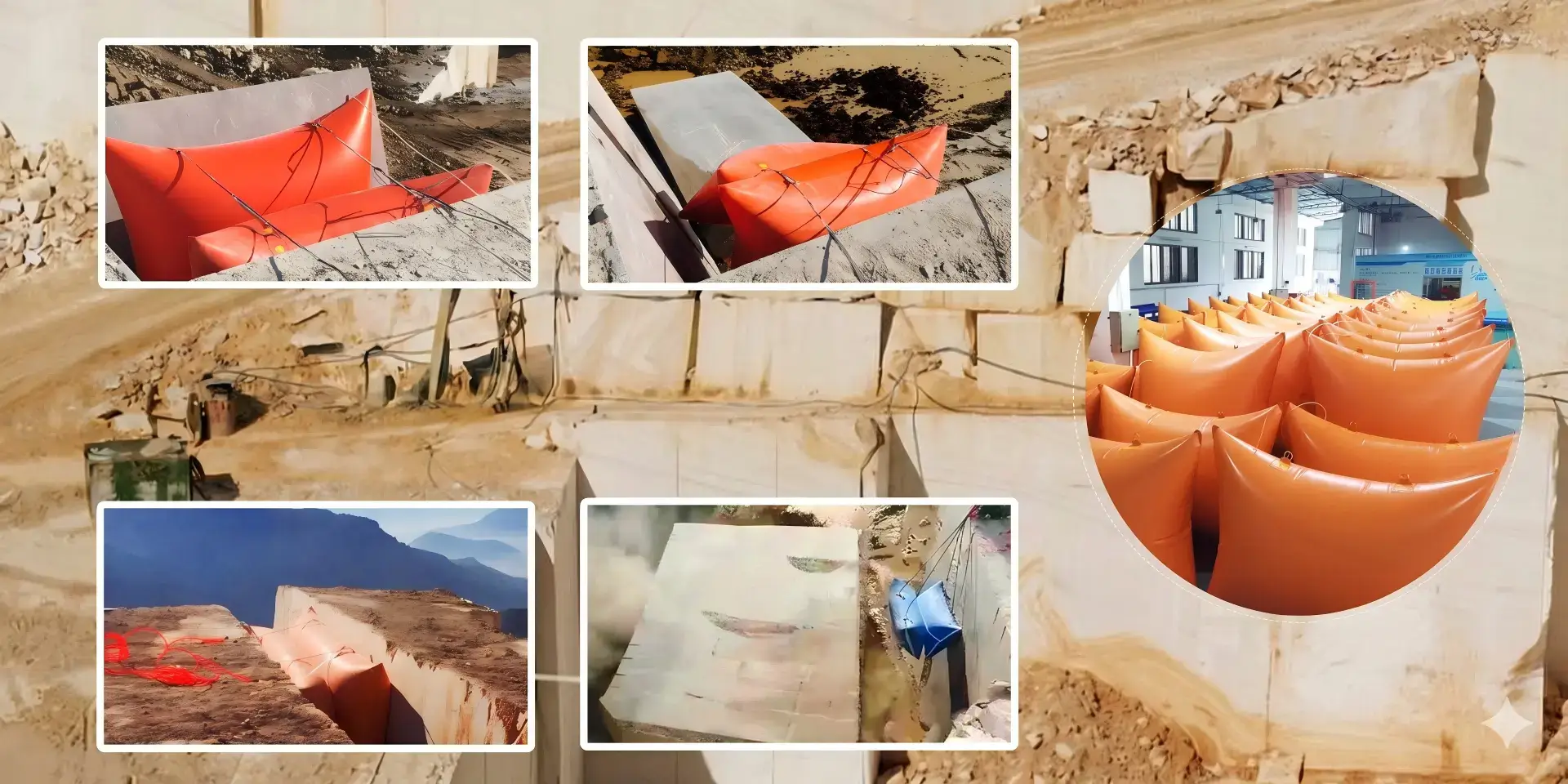
Quarry Air & Hydro Pushing Bags
In dimensional stone quarrying, toppling a massive, separated block from the bedrock is statistically the most hazardous operational phase. Traditional mechanical and hydraulic steel jacks introduce lethal risks, including sudden slippage, point-loading fractures, and equipment blowouts. According to fluid power safety protocols outlined by ISO 4414 (Pneumatic Fluid Power), relying on distributed surface pressure rather than concentrated mechanical points vastly improves workplace safety. MosCut Air & Hydro Pushing Bags eliminate these dangers entirely. By utilizing high-tensile Kevlar reinforcement, our cushions safely distribute up to 450 tons of uniform pushing force across the broad surface of the stone, ensuring a controlled, predictable descent without risking your crew or damaging your valuable harvest.
A premium Statuario marble quarry in Carrara, Italy, traditionally relied on heavy hydraulic steel jacks to tip their 200-ton blocks. This method required them to drill large, wasteful insertion pockets, and the concentrated pressure frequently caused the brittle marble edges to crack, instantly devaluing the stone. By integrating MosCut ultra-thin pneumatic pushing bags, they eliminated the need for secondary drilling. The bags slide directly into the narrow 10mm gap left by the diamond wire saw. The uniform, “soft” pneumatic thrust perfectly preserved the delicate marble edges, and the reusable Kevlar bags reduced their per-ton consumable extraction cost by over 80%.
Solving Critical Toppling Pain Points
Toppling the block is the final, most hazardous step of extraction. Our pushing bags protect both your crew and your profit margins.Zero Edge Damage
Steel jacks apply intense pressure to a single, small point, easily crushing brittle stone edges. Pushing bags offer Surface Pressure Distribution, applying a gentle but overwhelming force across a broad area, keeping high-value blocks perfectly intact.
Ultra-Thin Insertion
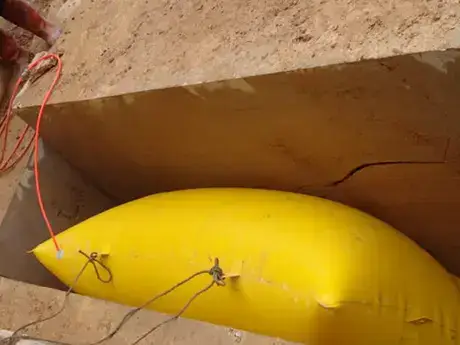
When completely deflated, MosCut pushing bags are less than 10mm thick. They slide effortlessly into the microscopic gaps created by diamond wire saws, eliminating the time-consuming need to drill secondary pockets just to fit a jack.
Massive Thrust Power
Driven by standard quarry air compressors (7-8 Bar) or simple water pumps, a single large MosCut pushing bag leverages surface area physics to generate up to 450 Tons of unstoppable pushing capacity.
Reusable & Deflatable
Constructed from hot-vulcanized rubber layered with Kevlar aramid fibers, these bags are incredibly resistant to punctures and sharp rock friction. Once the block is down, simply open the valve, deflate, and reuse hundreds of times.
Core Technologies: Air vs. Hydro Pushing
Match the expansion medium to the weight of your block and your site’s infrastructure.
Pneumatic Air Bags: Fast, lightweight, and directly compatible with standard quarry air compressors.
💨 Air Pushing Bags (Pneumatic)
Pneumatic bags are the industry standard for daily extraction. They are extremely lightweight, easy for a single operator to carry up steep quarry benches, and plug directly into your existing DTH drilling air compressor network. They inflate rapidly, offering the fastest toppling cycle times for medium to large-sized regular blocks.

Hydrostatic Water Bags: Maximum safety and ultimate power for the most extreme loads.
💧 Hydro Pushing Bags (Hydrostatic)
Filled using a high-pressure water pump, hydrostatic bags are designed for the most extreme loads. Because water is completely incompressible, it provides a much higher pushing force capacity than air. More importantly, it offers the highest safety rating—if the bag is accidentally punctured by a sharp rock under maximum load, water simply leaks out safely, whereas compressed air would release a concussive shockwave. Ideal for super-massive or highly irregular bedrock extraction.

Sub-10mm Clearance: When fully exhausted of air, the cushion flattens out entirely, slipping into the narrowest cuts without the need for secondary drilling.
📏 Paper-Thin Deflation Technology
One of the greatest engineering advantages of MosCut pushing bags is their microscopic footprint before activation. When fully deflated and vacuum-exhausted, the heavy-duty Kevlar cushion flattens out to become virtually as thin as a piece of heavy cardboard (less than 10mm thick). This ultra-thin profile allows operators to slide the bag deep into the impossibly narrow kerf left behind by a diamond wire saw, completely eliminating the time-consuming, expensive, and wasteful process of drilling secondary insertion pockets just to fit a steel jack.

Modular Synchronization: Align bags side-by-side to multiply your pushing tonnage, or stack them vertically to double your expansion distance.
🔗 Multi-Bag Modular Synchronization
Quarry geology is unpredictable, and sometimes a single bag isn’t enough to overcome a super-massive or awkwardly balanced block. MosCut pushing bags are designed for ultimate modular synergy. For extremely long cuts, operators can insert multiple bags side-by-side and inflate them simultaneously via a central control manifold, perfectly distributing hundreds of tons of balanced force. Alternatively, if a block requires a wider push to tip over, you can safely stack two bags directly on top of each other within the same gap. Inflating stacked bags effectively doubles your maximum expansion width and pushing distance.
Versatile Applications Across Quarry Types
Engineered to conquer any geological challenge. Discover how our pushing bags adapt to the world’s most valuable stones.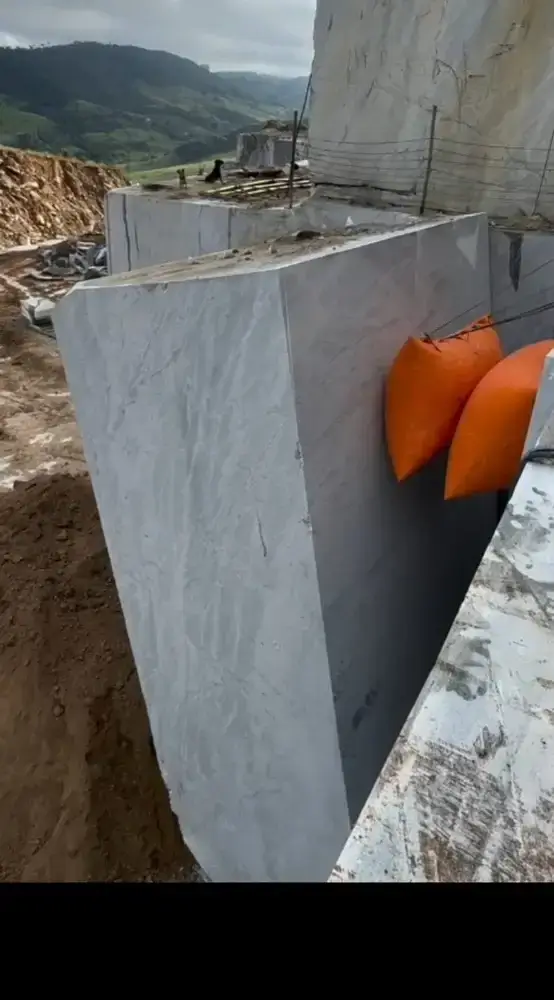
🏛️ Marble Quarrying
Marble is high-value but inherently brittle. The uniform “soft thrust” provided by the expanding cushion ensures that premium grades, like Statuario or Calacatta, are tipped over without shattering or chipping the delicate edges, preserving the block’s maximum auction value.
⛰️ Granite Quarrying
Granite is incredibly dense, heavy, and leaves razor-sharp edges when cut. Pushing hundreds of tons of granite puts immense strain on extraction tools. MosCut bags feature multiple layers of ballistic-grade Kevlar (aramid fiber) to resist puncturing and tearing against these abrasive, knife-like rock surfaces.

🧽 Travertine Quarrying
Travertine is characterized by its naturally porous, honeycomb-like internal structure. Using traditional steel jacks will often simply crush a hole into the rock instead of pushing it. The broad surface area of a pushing bag perfectly mitigates this issue, applying safe leverage across the entire face.
🏜️ Limestone & Sandstone
For these softer sedimentary rocks, controlling the descent is critical to prevent the block from snapping in half upon impact. Pushing bags allow operators to gently and predictably alter the center of gravity, ensuring the block lands safely on the prepared dirt cushion bed.
Technical Specifications
Select the precise dimensions and pushing capacity required for your quarry’s extraction dimensions. Note: Deflated thickness for all models is ≤ 10mm.| Model | Specification (m) | Pushing Capacity (Tons) | Weight (kg) |
|---|---|---|---|
| MCBL1010 | 1.0m × 1.0m | 50 tons | 2.8 |
| MCBL1015 | 1.0m × 1.5m | 75 tons | 4.2 |
| MCBL1020 | 1.0m × 2.0m | 100 tons | 5.6 |
| MCBL1515 | 1.5m × 1.5m | 115 tons | 6.3 |
| MCBL2015 | 2.0m × 1.5m | 150 tons | 8.4 |
| MCBL2020 | 2.0m × 2.0m | 200 tons | 11.2 |
| MCBL3030 | 3.0m × 3.0m | 450 tons | 25.2 |
The Perfect Companion: Quarry Wire Saw Machines
Pushing bags are the critical final step in the wire sawing extraction ecosystem.A Match Made in the Quarry
Diamond wire saw machines are the ultimate tool for cutting massive blocks from the mountain, but they leave behind a microscopically narrow gap—often only 8mm to 11mm wide. An excavator bucket cannot fit inside, and drilling holes for steel jacks ruins the clean cut you just paid to make.
MosCut Pushing Bags are explicitly designed to slide directly into this narrow wire saw cut. They are the essential, unavoidable final tool needed to complete the extraction process safely. When paired together, the wire saw and the pushing bag create a seamless, zero-waste extraction loop.
Explore MosCut Quarry Wire Saw Machines →Standard Operating Procedure: How to Topple Safely
Follow this strict operational protocol to ensure a flawless and safe toppling process every time.1️⃣ Cushion Bed Prep
Before initiating any push, the fall zone must be prepared. Deposit a thick bed of loose gravel, dirt, and small stone debris at the base of the bench. This “cushion bed” absorbs the seismic impact of the 200-ton block, preventing it from snapping when it hits the ground.
2️⃣ Deep Insertion
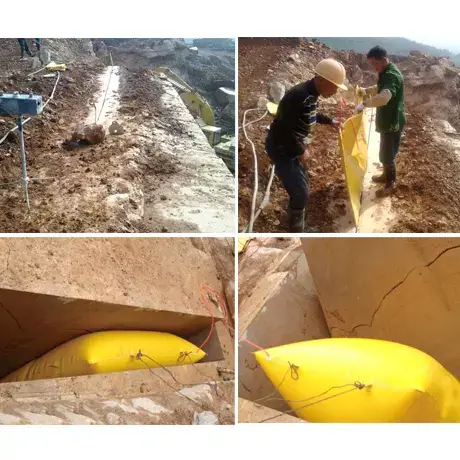
Clean the wire saw gap of any loose debris using an air hose. Insert two or more pushing bags side-by-side. Push the bags as deep down into the cut as physically possible. Placing them near the top creates the highest leverage, but placing them deep provides the safest, most controlled push.
3️⃣ Synchronized Inflation
Connect the bags to a central control manifold. Slowly open the air/water valves to inflate all bags simultaneously. Do not rush. Let the bags slowly find the center of gravity until the block tips over on its own. Immediately shut off valves once the block starts falling.

Machine in Action: Working Video
Watch MosCut Pushing Bags effortlessly topple massive quarry blocks with supreme safety.Global Customer Success Stories
Trusted by top-tier quarries to protect their most valuable assets.
Italy: Premium Carrara Marble
Eliminated all secondary drilling and edge-cracking incidents, preserving the pristine quality of their highest-grade white marble blocks during the tipping phase.

Brazil: Hard Granite Extraction
Leveraged the massive 450-ton capacity of the MCBL3030 models to effortlessly separate and topple ultra-dense granite walls that previously stalled operations.
Turkey: Hydrostatic Safety
Working on a precarious, highly fractured quarry face, the team utilized water-filled hydrostatic bags to ensure maximum safety and zero explosive risk.

India: Reducing Machine Wear
Stopped using their expensive excavators as battering rams. The pneumatic bags handled the heavy pushing, drastically reducing excavator boom fatigue and maintenance.
Related Insights & Toppling Guides
Master the science of safe block extraction with our expert engineering guides.
Steel Jacks vs. Pushing Bags: Safety Analysis
Discover why modern quarries are banning mechanical jacks and transitioning to surface-pressure pneumatic cushions.
Read More
Calculating Thrust: How Many Bags Do You Need?
Learn the simple mathematical formula to calculate the weight of your block and select the correct size and quantity of pushing bags.
Read More
Pneumatic vs. Hydrostatic: The Ultimate Guide
Air is fast; water is safe. Understand exactly when to use an air compressor and when to switch to a high-pressure water pump.
Read More
Preventing Punctures: Cut Prep & Maintenance
Maximize the lifespan of your Kevlar pushing bags by learning how to properly flush wire saw cuts and store your equipment.
Read MoreEquip Your Quarry with the Ultimate Tools
Stop risking your crew and damaging your dimension stone with mechanical jacks. Equip your quarry with the ultimate tools for safety, yield, and efficiency. Explore our complete range of extraction accessories and turn every block into profit.
View All Stone Quarrying Accessories & ToolsFrequently Asked Questions
1. Can a punctured pushing bag be repaired?
Minor pinhole punctures can sometimes be repaired using specialized vulcanizing patch kits, similar to heavy-duty tire repair. However, if the internal Kevlar reinforcing fibers are severed by a sharp rock, the bag has lost its structural integrity and must be replaced to ensure safety.
2. What size air compressor do I need to inflate the bags?
MosCut air pushing bags operate efficiently at a standard pressure of 7 to 8 Bar (approx. 100-115 PSI). Almost any standard industrial air compressor found on a quarry site, including the ones used for your DTH drills, is more than sufficient to inflate them.
3. What should I do if the wire saw gap is too wide for the bag to reach both sides?
If the gap is wider than the bag’s maximum expansion width (e.g., wider than 300mm), you must insert solid, flat wooden planks or heavy steel spacer plates alongside the deflated bag to take up the dead space. Never over-inflate a bag beyond its rated width just to bridge a gap.
4. How many bags should I use to topple a 200-ton block?
Never rely on a single bag for massive blocks. For a 200-ton block, we strongly recommend using at least two, preferably three, MCBL1020 (100-ton capacity) or MCBL2020 (200-ton capacity) bags spread evenly along the cut to ensure balanced leverage and prevent twisting.
5. Do the bags come with the control valves and hoses?
The bags are sold individually, but we highly recommend purchasing the complete MosCut Toppling Kit, which includes the heavy-duty hoses, quick-connect fittings, and a multi-port control manifold that allows you to safely inflate multiple bags simultaneously from a distance.
6. Can I use water in an air-rated pushing bag?
Yes! All MosCut pushing bags are dual-purpose and fully sealed. You can safely fill them with either compressed air or pressurized water depending on your operational requirements and safety protocols.
7. How do I protect the bags from sharp granite edges?
Before insertion, thoroughly flush the wire saw cut with high-pressure water or air to remove sharp rock chips. While MosCut bags are Kevlar-reinforced, operators often slide thin sheets of galvanized steel or heavy conveyor belting on either side of the bag in extremely sharp granite cuts for ultimate protection.
8. How long does it take to fully inflate a large bag?
With a standard quarry air compressor, a large bag like the MCBL2020 takes only 2 to 4 minutes to fully inflate and push the block past its tipping point. Hydrostatic (water) filling takes slightly longer depending on the GPM (gallons per minute) of your water pump.
9. What is the maximum temperature the pushing bags can withstand?
The vulcanized rubber compound is rated for extreme quarry conditions and can safely operate in ambient temperatures up to 80°C (176°F). However, you should never place the bag against a surface that was just subjected to intense heat (like a freshly torched steel wedge).
10. How should the bags be stored when not in use?
Fully deflate the bags, wash off any mud or grit, and let them dry. Store them flat or loosely rolled in a cool, dry place away from direct sunlight, UV rays, and harsh chemicals to prevent the rubber from degrading prematurely.