
 Stone Cutting Machines
 Stone Polishing Machines
 Bridge Saw Machines
 Stone Quarry Cutting Machines
 Stone Block Cutter Machine
 CNC Stone Wire Saw Machine
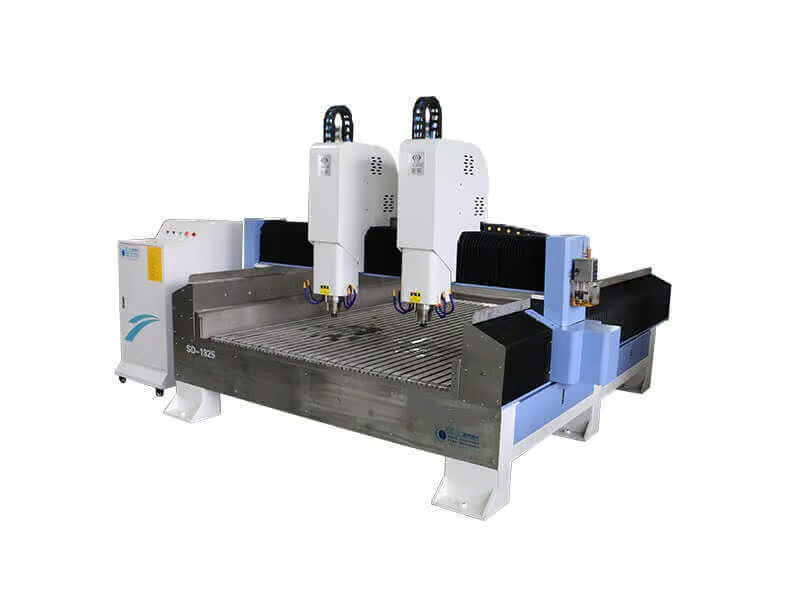 Stone Engraving Machines
 Thin Stone Veneer Saw Machine
 Horizontal Stone Slab Splitting Machine
 Stone Edge Polishing Profiling Machine
 Stone Auxiliary Equipment
In the global dimensional stone industry, the final phase of extraction—toppling the separated block from the quarry face—is statistically the most hazardous moment for both personnel and product. According to safety hazard alerts published by the Mine Safety and Health Administration (MSHA), dealing with “Uncontrolled Energy” from slipping mechanical and hydraulic jacks is a leading cause of severe projectile injuries in mining environments. A heavy steel jack placed under massive angular tension acts as a loaded spring; if the rock face fractures or the angle shifts, the jack can violently eject. MosCut Air and Hydro Pushing Bags eliminate this lethal hazard entirely by abandoning localized mechanical force in favor of broad, stable Surface Pressure Distribution.
A high-end limestone quarry in Spain recently experienced a near-fatal incident that forced a complete overhaul of their operating procedures. While using two 100-ton hydraulic steel jacks to topple a massive block, the localized pressure caused the rock beneath one jack to suddenly crumble. The sudden loss of resistance caused the 80kg steel jack to violently shoot out from the gap like a cannonball, narrowly missing the extraction crew. Following this incident, the quarry management permanently banned all steel jacks and transitioned exclusively to MosCut pneumatic pushing bags. Not only did this switch completely eradicate the projectile hazard, but the elimination of secondary “insertion drilling” reduced their overall block-toppling time by 50%.
The Physics of Failure: Point Loading vs. Surface Pressure
Applying 200 tons of pressure to a 5-inch steel plate is a recipe for fractured stone.The fundamental flaw of the traditional Steel Hydraulic Jack lies in basic physics: Point Loading. A 100-ton hydraulic jack applies its entire immense force through a very small, rigid steel contact pad (often no larger than 5×5 inches). This creates extreme localized stress concentrations. If the applied force exceeds the localized compressive strength of the stone, the rock will instantly crush and crumble at the point of contact, rendering the pushing force completely useless.
Pneumatic Pushing Bags, however, operate on Pascal’s Principle. Instead of forcing 100 tons into a tiny spot, the pushing bag distributes that exact same force evenly across a massive surface area (e.g., a 1m × 1m cushion). This generates an incredibly gentle, yet absolutely unstoppable “soft thrust” that perfectly preserves the structural integrity of the stone while easily achieving the required tipping leverage.

⚠️ Safety First: The Lethal Slippage Hazard
A slipping 100-ton hydraulic jack turns into a lethal projectile. As a massive quarry block begins to tip outward, the angle of the gap constantly changes. A rigid steel jack cannot bend or adapt to this shifting geometry. As the angle opens, the steel pad loses its flat contact and begins to slip. If it violently kicks out, the immense stored hydraulic energy is released instantly, launching the heavy steel jack across the quarry. Conversely, MosCut Pushing Bags are flexible. As they inflate, the heavy-duty vulcanized rubber aggressively grips the rough rock texture. As the block tips and the angle changes, the bag dynamically alters its shape to maintain 100% contact, guaranteeing zero slippage.
Preserving Profit: Eliminating Edge Cracking
Every chipped edge degrades your block from premium export grade to standard domestic grade.For dimensional stone quarries extracting luxury marble, onyx, or premium granite, the geometry of the block dictates its auction value. To maximize profit, a block must yield as many perfect, large-format slabs as possible when sent to the gang saw.
Using steel jacks inevitably crushes and splinters the edges and bottom corners of the block. Quarry operators are routinely forced to trim off 10 to 15 centimeters of damaged, splintered stone before the block can be sold, resulting in thousands of dollars of wasted premium material per cut. By utilizing MosCut pushing bags, the stone’s edges remain 100% pristine and intact. The soft, distributed expansion ensures zero micro-fracturing, allowing you to sell every single cubic centimeter you extracted.

Operational Efficiency: The Wire Saw Synergy
Stop wasting hours drilling holes just to fit your pushing equipment.⏳ The Jacking Penalty
A diamond wire saw leaves a beautifully clean cut, but the gap is only about 10mm wide. A steel jack is physically too thick to fit inside. To use a jack, operators must waste 1 to 2 hours using a rock drill to bore large, destructive “insertion pockets” into the stone just to create space for the tool. This wastes labor, fuel, and ruins the flat face of the stone.
⚡ The Cushion Advantage
MosCut Pushing Bags provide a massive operational shortcut. When fully deflated, the Kevlar bags are less than 10mm thick. They slide directly into the microscopic wire saw cut immediately after the saw finishes. Simply connect the air hose, and within 3 minutes, the block is safely down. Zero secondary drilling, zero wasted time.
Total Cost of Ownership (TCO) Comparison
Evaluate the true cost of your toppling method over a standard extraction season.| Cost & Efficiency Category | Heavy Steel Hydraulic Jacks | MosCut Air Pushing Bags |
|---|---|---|
| Equipment Weight & Handling | Very Heavy (Requires heavy lifting, risk of back injury) | Ultra-Light (Easily carried by a single operator) |
| Preparation Time | High (1-2 hours wasted drilling insertion pockets) | Zero (Slides directly into the wire saw cut) |
| Material Waste (Edge Crushing) | High (Constant chipping and edge fracturing) | Zero (100% preservation of stone edges) |
| Safety Liability (Slippage) | High (Extreme risk of projectile ejection) | Zero (Friction grip eliminates all slippage) |
| Tipping Speed | Slow (Manual pumping or slow hydraulic flow) | Fast (Fills rapidly with standard compressed air) |
| Overall Quarry ROI | Low (High labor, high material waste) | Exceptional (Fast, safe, zero material loss) |
Upgrade Your Quarry Safety Today
Upgrade your quarry safety, protect your workforce, and eliminate expensive material waste. Make the smart switch to MosCut Air & Hydro Pushing Bags and secure your harvest.
Explore MosCut Pushing Bags