
 Stone Cutting Machines
 Stone Polishing Machines
 Bridge Saw Machines
 Stone Quarry Cutting Machines
 Stone Block Cutter Machine
 CNC Stone Wire Saw Machine
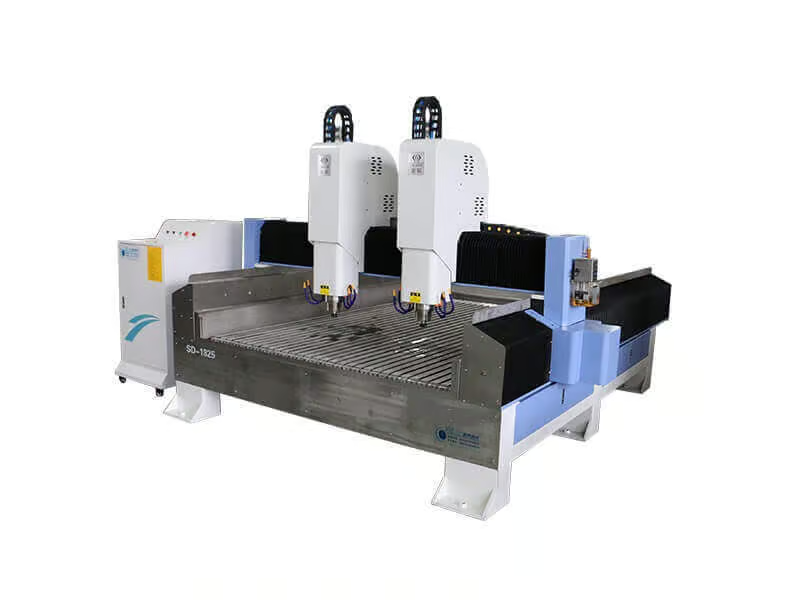 Stone Engraving Machines
 Thin Stone Veneer Saw Machine
 Horizontal Stone Slab Splitting Machine
 Stone Edge Polishing Profiling Machine
 Stone Auxiliary Equipment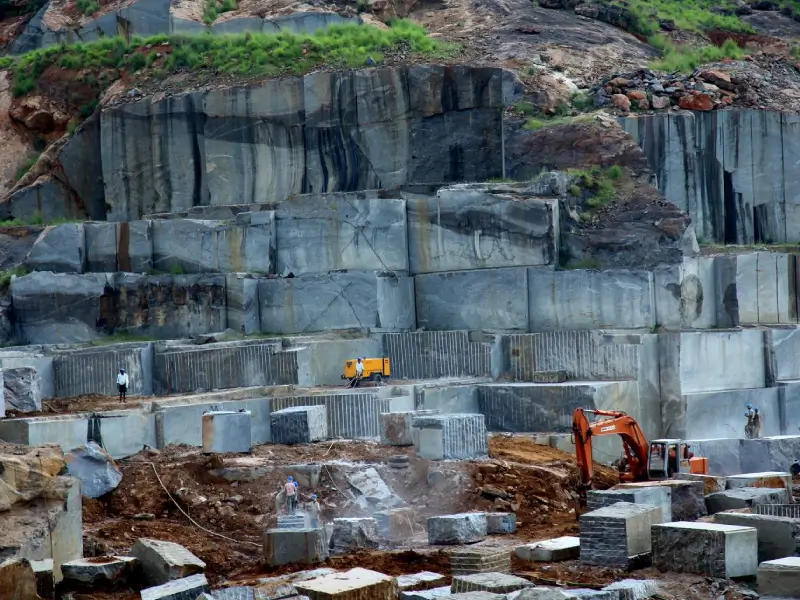
In the quarrying industry, many operators purchase pushing bags based solely on a “gut feeling” or a fundamental misunderstanding of physics, leading to either failed extraction attempts or vastly overspending on unnecessarily massive equipment. According to “Rock Mass Overturning Stability” principles published by the International Society for Rock Mechanics (ISRM), toppling a monolithic stone block is an exercise in Statics and Torque (Moment), not raw lateral displacement. You do not need 300 tons of direct linear force to tip a 300-ton block. You simply need to apply enough leverage to push its Center of Gravity past its tipping point.
A large-scale granite quarry in South Africa recently encountered this exact engineering dilemma. After successfully utilizing a wire saw to separate a colossal 400-ton base block, the management team assumed they needed to purchase two of MosCut’s largest MCBL3030 bags (450 tons each) just to move it. This assumption far exceeded their monthly tool budget. MosCut field engineers intervened and introduced them to the “Tipping Moment Formula.” By mathematically analyzing the block’s geometry, the engineers instructed the crew to position two significantly smaller MCBL1020 bags (100 tons each) much higher up in the wire saw cut, drastically increasing their leverage. The 400-ton block was safely and effortlessly toppled using only an actual applied thrust of 180 tons, saving the quarry 40% on their equipment procurement costs.
The Physics of Toppling
You do not need 300 tons of thrust to push a 300-ton block. You only need to manipulate leverage.Imagine trying to tip over a tall, heavy refrigerator. If you place your hands at the very bottom near the floor and push, it takes an immense amount of strength. However, if you place your hands at the very top of the refrigerator and push, it tips over with minimal effort. This is the law of the lever.
The exact same physics apply to a 10-meter-tall marble block. The stone pivots on its bottom front edge (the fulcrum). The higher you place your MosCut pneumatic pushing bag within the wire saw cut, the longer your “lever arm” becomes, and the less actual tonnage you need to overcome the block’s weight. Therefore, the required capacity of your pushing bags is entirely dependent on where you place them.

Step 1: Calculate the Block Weight
Before you can move the mountain, you must know exactly what it weighs.To determine the weight of the separated block, you must multiply its volume by the specific density of the geological material. Use the following formula:
Where:
- $W$ = Total Weight of the block (in Tons)
- $L$ = Length of the block (in Meters)
- $B$ = Breadth/Thickness of the block (in Meters – depth from front face to the back cut)
- $H$ = Height of the block (in Meters)
- $rho$ = Density of the rock (in Tons per Cubic Meter)
| Geological Material | Average Density ($rho$) |
|---|---|
| Sandstone / Travertine | 2.3 – 2.4 t/m³ |
| Limestone | 2.5 – 2.6 t/m³ |
| Marble | 2.6 – 2.7 t/m³ |
| Granite / Quartzite | 2.8 – 3.0 t/m³ |
| Basalt / Gabbro | 2.9 – 3.1 t/m³ |
Step 2: The Tipping Moment Formula
Leverage is your ultimate weapon. Where you place the bag dictates how much power you need.Once you have calculated the block’s total weight ($W$), you can determine the exact amount of pushing force required to tip it over based on where you place your pushing bag. We use the static equilibrium formula:
Where:
- $F_{required}$ = The absolute minimum thrust required to tip the block (in Tons).
- $B / 2$ = Half the breadth/thickness of the block (this is the distance from the pivot edge to the block’s center of gravity).
- $H_{bag}$ = The height from the bottom of the block to the center of the pushing bag.
You have a Marble block weighing 200 Tons ($W = 200$). The block is 2 meters thick ($B = 2$). You insert the pushing bag 1 meter off the quarry floor ($H_{bag} = 1$).
$$F_{required} = frac{200 times (2 / 2)}{1} = 200 text{ Tons of thrust required.}$$ However, if you slide the exact same bag higher up the cut, to 2 meters off the floor ($H_{bag} = 2$):
$$F_{required} = frac{200 times (2 / 2)}{2} = 100 text{ Tons of thrust required.}$$ Conclusion: By placing the bag higher, you cut the required pushing force in half!
Step 3: Sizing the Bags & The Expansion Drop-off
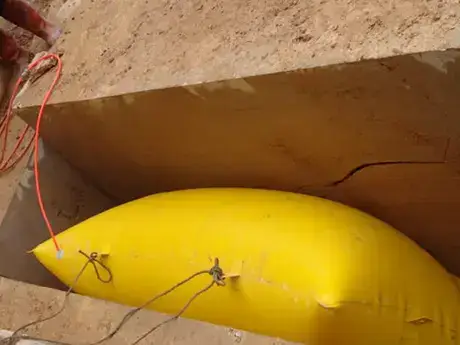
Bag capacity is not static. It is a calculation of surface area multiplied by internal air pressure.When you look at a MosCut MCBL1020 bag rated for 100 Tons, that rating is based on the bag being inflated at an optimal 7-8 Bar of air pressure while completely flat. However, as the bag inflates to push the stone, it begins to take on a rounded, “balloon-like” shape.
The Expansion Drop-off: As the bag becomes rounder, the actual surface area making physical contact with the flat rock face decreases. Because $Thrust = Area times Pressure$, less contact area means less pushing force. Therefore, you must never buy a bag that exactly matches your $F_{required}$. You must always add a 20% to 30% Safety Margin to account for thrust decay during the expansion stroke. If your formula dictates you need 150 tons of force, you should equip your operation with at least 200 tons of rated bag capacity.
⚠️ The “Rule of Two”: Why Multiple Bags are Mandatory
Even if you calculate that a single MosCut MCBL2020 (200-ton capacity) bag provides more than enough force to tip your block, you must never use a single bag placed in the center of the block. A single point of pressure creates a central pivot point. If the block has hidden fractures, uneven density, or if the floor is slightly sloped, the block will not fall straight forward. Instead, it will undergo a catastrophic “Twisting” or “Spinning” motion as it falls sideways off the pivot point. This unpredictable spin can destroy the block, damage neighboring stone, and crush personnel. You must always adhere to the Rule of Two: Utilize a minimum of two identical pushing bags placed symmetrically (roughly 1/4 of the total length inward from each edge). This provides two synchronized points of leverage, forcing the block to tip forward in a perfectly straight, controlled line.
Equip Your Quarry with Engineered Precision
Now that you understand the mechanics of safe block toppling, equip your crew with the industry’s most reliable tools. View MosCut’s full range of Kevlar-reinforced pushing bags to match your exact extraction parameters.
View MosCut Pushing Bags