
 Stone Cutting Machines
 Stone Polishing Machines
 Bridge Saw Machines
 CNC Stone Wire Saw Machine
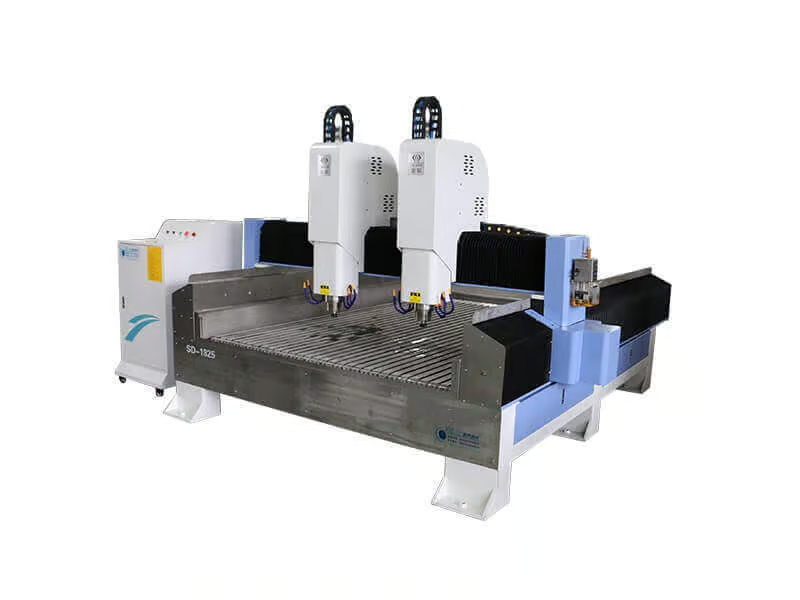 Stone Engraving Machines
 Stone Veneer Saw
 Stone Quarry Machines
 Stone Band Saw Machines
 Stone Edging Beveling Machine
 Other Stone Machines
 Stone Diamond Tools
 Stone Slab Cutting
 Stone Slab Surface Edge Polishing
 Stone Block Slicing
 Stone Quarry Mining
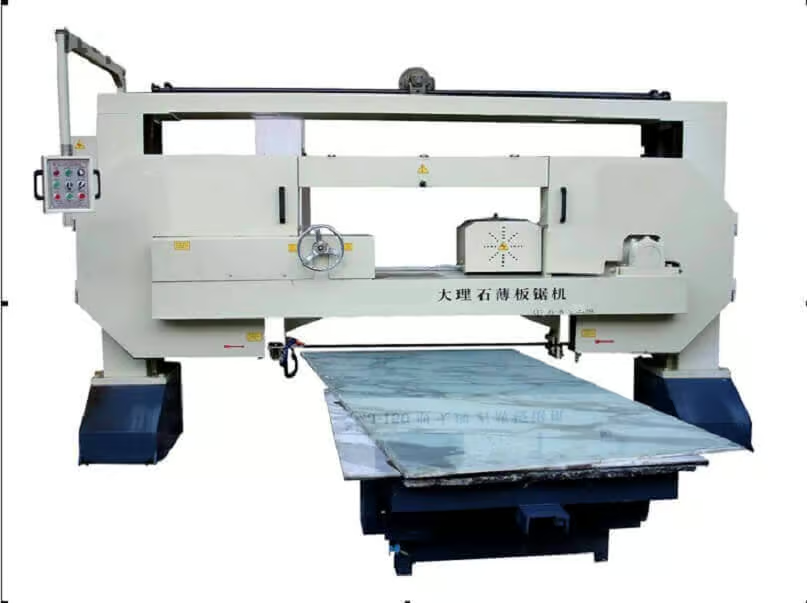 Stone Horizontal Splitting
 Stone Engraving Applications
 CNC Stone Cutting
 Countertop Cutting Polishing
 Other Applications
Raw marble and premium granite blocks are arguably the most expensive investments in any architectural stone fabrication shop. When a client orders a massive, solid stone cylinder, you are faced with a harsh reality: turning a square block into a round column inherently means losing a significant portion of the material.
In fact, according to sustainability and fabrication efficiency guidelines discussed by authoritative bodies like the Natural Stone Institute, traditional block profiling and carving can result in massive material waste—often turning 20% to 30% of a premium block into worthless slurry. But what if you didn't have to destroy the corners of your block? What if you could sell that "waste" for a premium price?

The Financial Drain of Traditional Block Cutting
If your factory is using a traditional blade-style stone lathe or heavy block cutter to profile columns, you are literally grinding your profits into dust. These outdated machines work by scraping or smashing away the four corners of the square block until only the inner cylinder remains.
This method creates a massive financial drain in two ways:
- Lost Material Value: The exquisite marble or granite on the outer edges is completely destroyed. You paid for that stone, but you cannot sell it.
- High Disposal Costs: You are forced to spend time, electricity, and money managing and disposing of the tons of heavy stone slurry and crushed chips generated by the lathe.
What is Stone Column Coring?
Stone column coring is an advanced fabrication technique made possible exclusively by heavy-duty CNC stone wire saw machines.
Instead of grinding the outside of the block, a highly tensioned diamond wire acts like a precision cookie cutter. The CNC system interpolates the wire and the rotary axis to slice a perfect circular path directly *through* the block. This separates the inner solid column from the outer stone shell. The result? You get your perfect architectural column, and you preserve the four thick, arc-shaped corner pieces completely intact.
3 Ways to Profit from Curved Stone Offcuts
Once you extract the inner column, you are left with four magnificent, thick pieces of curved stone. Here is how top fabricators turn these into massive profits:
- 1. Luxury Exterior Wall Cladding: Curved architectural facades are highly sought after in modern commercial building and luxury hotel designs. These thick, arc-shaped offcuts are perfect for dry-hang exterior wall cladding, offering a premium wave-like aesthetic.
- 2. Custom Architectural Arches: The perfectly smooth inner radius of your offcut is the exact shape needed for bespoke doorways, window arches, and vaulted ceiling accents in high-end residential projects.
- 3. Bespoke Landscaping Features: Premium landscaping architects constantly look for massive curved stones to build high-end retaining walls, circular fire pit enclosures, and elegant water fountain borders.
Why Coring Demands a Heavy-Duty CNC Wire Saw
You cannot perform precise stone column coring with standard equipment. Extracting the core while keeping the heavy outer shell perfectly intact requires extreme mechanical stability.
- Unmatched Stability for the Outer Shell: As the diamond wire separates the core from the shell, the remaining pieces become unstable. Our Discovery 5 machine features an incredibly robust 20-ton payload rotary worktable that secures the entire mass effortlessly, preventing any shifting that could crack the valuable offcuts.
- Zero-Vibration Cutting: If the machine vibrates, the thin kerf of the cut will widen, potentially snapping the wire or damaging the stone. Our massive gantry structure ensures absolute rigidity during the entire coring process.
- Precision CNC Pathing: The sophisticated control system automatically calculates the safest entry and exit paths for the diamond wire, ensuring both the column and the inner face of the curved cladding have a glass-smooth finish.
Conclusion & Maximize Your Material ROI
In the competitive architectural stone industry, efficiency isn't just about cutting faster; it's about maximizing the yield of every single block you purchase. By adopting stone column coring technology, you eliminate waste disposal costs and instantly double your product output from a single raw material investment.
Stop Wasting Stone. Start Coring.
Discover how the Discovery 5 Heavy-Duty CNC Wire Saw allows you to fabricate flawless columns while preserving high-value curved slabs for maximum profit.
Explore the Discovery 5 CNC Wire Saw for ColumnsTop 10 FAQ: Stone Column Coring & Curved Cladding
1. What exactly does "coring" a stone block mean?
Coring is the process of using a CNC wire saw to cut a perfect circular cylinder out of the center of a square stone block, leaving the outer corner pieces completely intact rather than grinding them into dust.
2. Why can't I use a traditional lathe to core a block?
A traditional lathe works by scraping the outside of the stone inward. It physically destroys the outer layers of the block. Only a wire saw can slice through the block to separate the core from the shell.
3. Can I core both marble and granite blocks?
Yes. A heavy-duty CNC wire saw equipped with the correct diamond wire beads can effortlessly core both soft marbles and extremely dense granites.
4. What do I do with the curved offcuts?
The preserved corner pieces feature a perfect inner arc. They are highly valuable and can be sold as luxury curved wall cladding, architectural arches, or premium landscaping borders.
5. Is there a risk of the outer shell collapsing during the cut?
This is why heavy-duty machinery is required. Our machines utilize specialized clamping on a 20-ton capacity rotary worktable to ensure all parts of the block remain absolutely stable until the cut is finished.
6. How smooth is the surface of the core and the offcut?
Because the diamond wire is held under high tension and guided by precise CNC interpolation, both the resulting column and the curved slab have a remarkably smooth finish, requiring minimal secondary polishing.
7. How much material waste does coring actually save?
Instead of losing 20% to 30% of your block volume to crushed waste and slurry, coring allows you to save almost 100% of that volume as usable, sellable curved architectural slabs.
8. Does coring take longer than standard column profiling?
Actually, it is often faster. Slicing a single continuous path through the block with a wire saw is vastly more efficient than a lathe taking hundreds of slow scraping passes to remove the same amount of material.
9. Can I core complex shapes, or only perfect circles?
With our advanced 5-axis CNC operating system, you can program the wire to cut perfect circles, ovals, or even complex 3D wave profiles, preserving the exact negative shape in the outer offcut.
10. Is it difficult to program a coring operation on the machine?
Not at all. The intuitive HMI features customized architectural algorithms. Operators simply input the block dimensions and the desired column diameter, and the software automatically calculates the optimal wire entry and coring path.