
 Stone Cutting Machines
 Stone Polishing Machines
 Bridge Saw Machines
 CNC Stone Wire Saw Machine
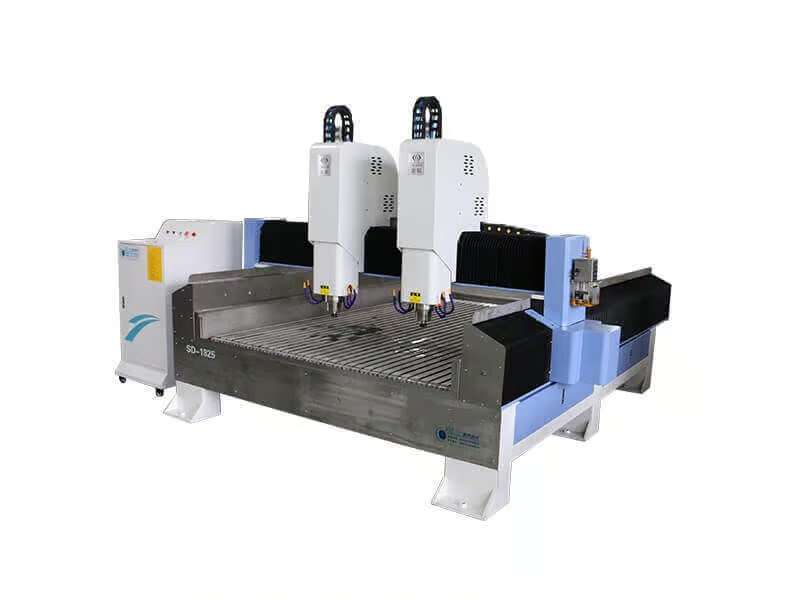 Stone Engraving Machines
 Stone Veneer Saw
 Stone Quarry Machines
 Stone Band Saw Machines
 Stone Edging Beveling Machine
 Other Stone Machines
 Stone Diamond Tools
 Stone Slab Cutting
 Stone Slab Surface Edge Polishing
 Stone Block Slicing
 Stone Quarry Mining
 Stone Horizontal Splitting
 Stone Engraving Applications
 CNC Stone Cutting
 Countertop Cutting Polishing
 Other Applications
If you are stepping into the stone fabrication industry or planning to upgrade your workshop, you will immediately encounter one essential piece of equipment: the bridge saw. It is the absolute heart of any granite, marble, or quartz fabrication facility. Without it, raw slabs simply remain raw slabs.
According to fabrication standards from the Natural Stone Institute, processing massive, heavy stone slabs safely and accurately requires industrial-grade machinery. In this comprehensive guide, we will break down exactly what a bridge saw is, explore its core anatomical structure, and explain how it transforms colossal blocks of stone into beautiful kitchen countertops and architectural elements.

What Exactly is a Bridge Saw?
To understand the machine, you just need to look at its name. A bridge saw is a large industrial cutting machine characterized by a massive horizontal beam (the “bridge”) that spans across the cutting area.
A high-speed cutting head equipped with a diamond blade travels back and forth along this bridge to slice through the stone. This overhanging design allows operators to place massive, multi-ton slabs underneath the blade without the machine’s structural frame getting in the way. It is designed to deliver perfectly straight, vibration-free cuts through extremely dense materials like granite, quartzite, and engineered stone.
The Core Anatomy of a Bridge Saw
A professional bridge saw is a marvel of heavy engineering. To guarantee millimeter-level accuracy, it relies on several massive structural components working in perfect harmony. Let’s dissect the machine into its six core parts.


The Supporting Foundation (Legs & Walls)
Every bridge needs solid pillars. The entire weight of the machine rests on two parallel supports. On traditional gantry saws, these are heavy concrete walls poured directly into the factory floor. On modern “Monoblock” saws, the supports are thick, heavy-duty steel legs integrated into a single frame, which eliminates the need for concrete work and absorbs cutting vibrations.


The Side Beams (Y-Axis)
Resting on top of the supporting walls or steel legs are the side beams. These heavy cast-iron or steel tracks run the entire length of the cutting area (front to back). They house the high-precision linear guide rails and gear racks that allow the main bridge to move forward and backward smoothly over the slab.

The Main Bridge (X-Axis)
This is the massive horizontal crossbeam that gives the machine its name. It spans across the two side beams. Built from incredibly thick cast iron to prevent sagging or deflection, this bridge serves as the track for the cutting head to travel left and right across the width of the stone.

The Cutting Head & Spindle
The powerhouse of the machine. The cutting head houses a high-torque electric spindle motor that spins the heavy diamond blade (usually 350mm to 500mm in diameter). It moves up and down (Z-axis) to control the depth of the cut. Advanced heads can also tilt 45 degrees for miter cuts and rotate 360 degrees to cut in any direction.

The Worktable
Located directly beneath the bridge, the worktable holds the stone securely. Because granite slabs are dangerously heavy, the table uses heavy-duty hydraulic cylinders to tilt up to 85 degrees. This allows operators to slide the slab onto the table gently, rather than risking a dangerous drop from a forklift.

6. The Control System
The brain operating the brawn. Depending on the machine’s tier, the control system ranges from a basic push-button panel with a laser guide for manual alignment, to a highly sophisticated CNC (Computer Numerical Control) touch screen that reads digital CAD files and automates the entire cutting process.
Step-by-Step: How Does a Bridge Saw Work?
While advanced 5-axis machines have automated many tasks, the fundamental cutting process in a fabrication shop follows a logical sequence. Here is how a slab is transformed into a countertop.
- Step 1: Loading the Slab. The worktable is hydraulically tilted upward. An overhead crane or forklift maneuvers the raw stone slab against the table, which then slowly lowers back to a flat, horizontal position.
- Step 2: Measurement & Alignment. On standard machines, the operator turns on an overhead red infrared laser line to align the cutting path manually. On smart CNC machines, an overhead camera takes a photo of the slab, and the operator arranges the digital cuts on a computer screen.
- Step 3: Programming the Cut. The operator inputs the required dimensions (length, width, and cutting speed) into the PLC or CNC touch screen.
- Step 4: The Cutting Process. The continuous water cooling system activates to flood the blade, suppressing hazardous dust and heat. The diamond blade lowers into the stone and the bridge drives the cutting head smoothly across the slab, executing perfectly straight, chip-free cuts.
What Materials Can a Bridge Saw Cut?
A high-quality bridge saw equipped with variable speed controls and the correct diamond tooling is incredibly versatile. It is designed to cut a wide spectrum of construction materials.
Fabrication shops routinely use these machines to slice through ultra-hard natural igneous rocks like Granite and Quartzite. They also delicately process brittle sedimentary stones like Marble, Limestone, and Travertine. In modern applications, bridge saws are essential for cutting heavily resin-based Quartz (Engineered Stone) and the highly tensioned, ultra-compact Sintered Stone (Porcelain).
Conclusion & Next Steps
Understanding what a bridge saw is and how its heavy-duty anatomy functions is crucial before making an equipment investment. From massive concrete-supported gantry saws to compact monoblock designs, choosing the right configuration will dictate your shop’s efficiency and profitability.
Ready to Upgrade Your Fabrication Shop?
Now that you know how the machinery works, explore our complete lineup of heavy-duty stone cutting solutions designed for every factory size.
Explore All CNC Bridge SawsTop 10 FAQ: Understanding Bridge Saws
Still have questions about operating and installing a bridge saw? Browse our frequently asked questions below for quick technical insights.
Basic Setup & Operations
1. Why is water required during the cutting process?
Water serves two critical purposes: it cools the diamond blade to prevent friction heat from warping the steel core, and it instantly suppresses the hazardous stone dust, turning it into a safe slurry.
2. Do I need a special electrical supply for a bridge saw?
Yes. Because of the heavy-duty spindle motors, industrial bridge saws require a stable 3-Phase power supply (such as 220V, 380V, or 480V depending on your local grid infrastructure).
3. What is the difference between a Bridge Saw and a Waterjet?
A bridge saw uses a spinning diamond blade to make fast, straight cuts and miters. A waterjet uses high-pressure water mixed with abrasives to slowly cut extremely complex internal curves and sharp interior corners.
4. Does a bridge saw require a lot of factory space?
Yes. A standard machine processing jumbo slabs requires a footprint of at least 6 meters by 4 meters, plus additional surrounding space for forklift access and slab loading.
5. How long does a diamond blade last?
Blade lifespan depends entirely on the material being cut, the feed rate, and the volume of cooling water. Cutting soft marble will allow a blade to last much longer than cutting highly abrasive quartz or granite.
Machine Mechanics & Terminology
6. What does “Monoblock” mean in bridge saws?
A monoblock saw is built onto a single, unified steel frame (including the side beams and the worktable). It does not require building concrete foundation walls, making it much faster to install and easy to relocate.
7. What is “plunge cutting”?
Plunge cutting refers to the Z-axis (vertical) movement where the spinning diamond blade lowers directly down into the surface of the stone, often used to create sink cutouts or relieve tension in sintered stone.
8. Why do some cutting heads rotate 360 degrees?
A rotating cutting head allows the machine to cut the length of the slab (X-axis) and then rotate 90 degrees to cut the width (Y-axis) without having to spin the heavy worktable or move the stone manually.
9. What is a “miter cut”?
A miter cut occurs when the spindle head tilts to an angle (usually 45 degrees). This allows two pieces of stone to be glued together at a 90-degree corner, hiding the seam and creating a thick “waterfall” appearance.
10. Is a laser guide necessary?
For manual and semi-automatic machines, an infrared laser is absolutely necessary. It projects a visible red line onto the slab, showing the operator exactly where the blade will travel before the cut begins.