
 Stone Cutting Machines
 Stone Polishing Machines
 Bridge Saw Machines
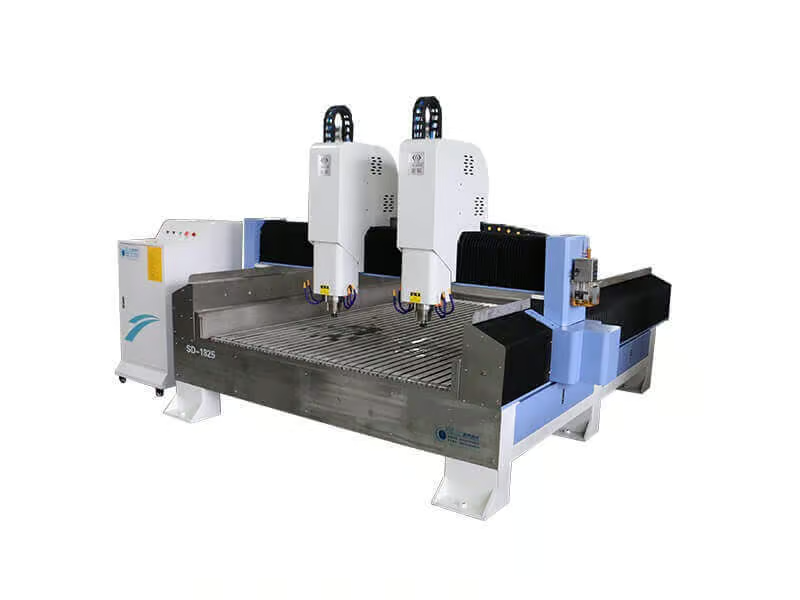 Stone Engraving Machines
 Stone Veneer Saw
 Stone Quarry Machines
 Stone Band Saw Machines
 Stone Edging Beveling Machine
 Other Stone Machines
 Stone Diamond Tools
 Stone Slab Cutting
 Stone Slab Surface Edge Polishing
 Stone Block Slicing
 Stone Quarry Mining
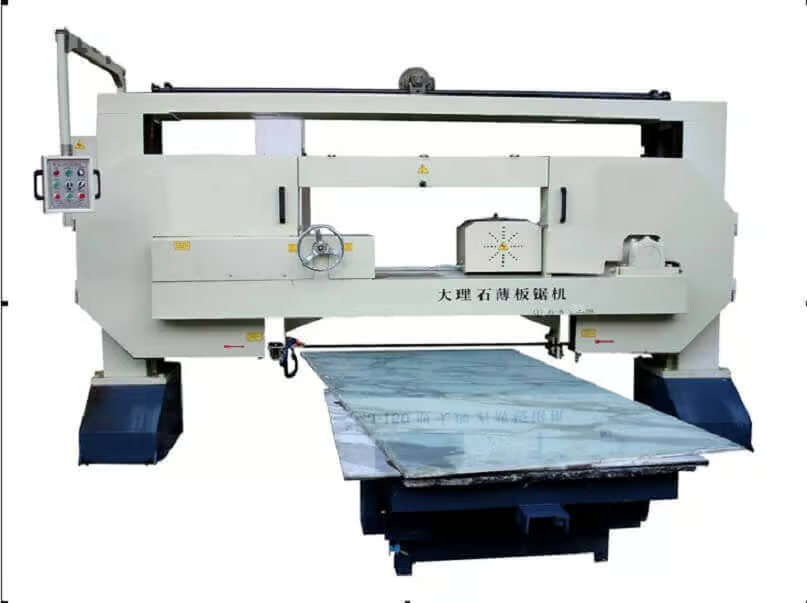 Stone Horizontal Splitting
 Stone Engraving Applications
 CNC Stone Cutting
 Countertop Cutting Polishing
 Other Applications
Why Your Slab Production Needs a Heavy-Duty Circular Stone Saw
The stone fabrication industry is shifting rapidly. With client demands pushing for thicker monumental blocks and massive jumbo slabs, relying on light-duty equipment is a guaranteed way to bottleneck your factory. Forging ahead requires raw mechanical power and uncompromising stability. To scale up your factory’s output, eliminate blade stalling, and guarantee perfectly square edges, upgrading to an industrial stone slab cutting saw is the most profitable and necessary investment you can make for your production line.
1. The Hidden Costs of Light-Duty Saws in Slab Cutting
Many shop owners attempt to save money upfront by purchasing lightweight or entry-level saws. However, when deployed in a high-volume slab production environment, these machines rapidly reveal their hidden costs.
- Machine Vibration: When a light frame attempts to push a circular blade through dense granite, the entire bridge vibrates. This micro-vibration translates directly to the blade, causing severe edge chipping and out-of-square cuts.
- Motor Stalling: Light-duty motors lack the torque to maintain RPM under heavy load. The circular stone saw will repeatedly stall, ruining the diamond segments and burning out expensive electrical contactors.
- Rapid Wear and Tear: Forcing a weak machine to perform heavy-duty tasks drastically shortens its lifespan, leading to constant downtime and delayed project deliveries.

2. Defining “Heavy-Duty”: Anatomy of an Industrial Circular Stone Saw
What exactly separates a true industrial circular stone saw from a standard shop saw? The answer lies in the sheer mass of its construction. True heavy-duty machinery is built to absorb punishment.
A professional heavy-duty stone saw must feature a monoblock chassis weighing upwards of 5.6 tons. This massive cast-iron and thick-walled steel structure is not just for durability; it acts as a giant dampener. By absorbing the immense kinetic energy generated by a 400mm circular diamond blade spinning at high speeds, the monoblock frame ensures the cutting head travels in an absolutely perfect, unyielding straight line.
3. 4-Pillar Hydraulic Lifting vs. Single Plate Mechanisms
One of the most critical failure points on a slab saw is how the cutting head is raised and lowered. This is where the difference between a frustrating machine and a profitable one becomes obvious.
❌ Single Sliding Plate (The Old Way)
Traditional machines use a single iron plate riding on a track to lower the blade. When cutting thick slabs, the mechanical torque twists this single plate, causing the blade to flex, wobble, or jam entirely mid-cut.
✅ 4-Pillar Hydraulics (The Industrial Standard)
Modern heavy-duty saws utilize a synchronous 4-pillar hydraulic lifting system. The massive cutting head is perfectly stabilized and driven by four heavy-duty hydraulic cylinders simultaneously. This provides absolute vertical rigidity.
After hundreds of hours of rigorous factory stress testing, the 4-pillar hydraulic system has been proven to reduce mechanical failure rates by 35% compared to traditional sliding mechanisms, guaranteeing chip-free edges on the thickest jumbo slabs.

4. Relentless Power: Why a 15KW Spindle Motor is Mandatory
A circular stone saw is only as effective as the motor driving it. When a 400mm diamond blade bites into a 100mm thick slab of dense quartzite, the friction is immense.
Standard 7.5KW or 11KW motors will bog down, causing the blade RPM to drop. When the RPM drops, the diamonds stop cutting cleanly and begin to tear at the stone. A true heavy-duty saw is equipped with an industrial-grade 15KW spindle motor. This massive horsepower ensures that the blade powers through the densest natural stones at a relentless, steady pace (up to 15 ㎡/h), slicing through granite block like a hot knife through butter.
5. Scaling Up Your Factory with the Right Stone Slab Cutting Saw
Your fabrication shop’s profitability is directly tied to its cutting capacity. If your operators are constantly stopping to reset tripped breakers, re-measuring because the bridge vibrated, or scrapping expensive material due to blade deflection, your current saw is bleeding your profits.
It is time to dominate large-format slab processing. Explore the technical specifications of our heavy-duty stone slab cutting saw and see the immediate difference true industrial power, 4-pillar hydraulics, and a 5.6-ton monoblock frame can make to your daily production output.
6. Top 10 FAQ on Heavy-Duty Circular Stone Saws
Common questions from fabricators regarding heavy machinery upgrades.
1. What is the maximum blade size for a heavy-duty circular stone saw?
Our standard heavy-duty model comfortably houses a 400mm circular diamond blade, allowing for a deep cutting capacity of up to 100mm in natural stone.
2. Why does my circular blade get stuck in thick granite?
Blade jamming is almost always the result of an underpowered spindle motor (motor stalling) or a weak single-plate lifting mechanism that allows the blade to twist inside the cut.
3. Is a 5.6-ton monoblock frame really necessary for cutting stone?
Absolutely. The sheer weight of the 5.6-ton cast-iron frame absorbs the intense vibrations generated during heavy cutting. Without this mass, the machine vibrates, leading to chipped edges and inaccurate dimensions.
4. How does the 4-pillar hydraulic system improve safety?
By using four synchronized hydraulic cylinders instead of a single sliding plate, the cutting head is locked perfectly in vertical alignment. It prevents the blade from suddenly dropping or twisting, drastically reducing the risk of shattered blades.
5. What kind of power supply does a 15KW motor require?
A heavy-duty circular stone saw with a 15KW motor requires an industrial 3-Phase electrical supply. We custom-configure the machine’s voltage (e.g., 380V, 415V) to match your factory’s local power grid.
6. Can this heavy-duty saw process delicate porcelain slabs?
Yes. While it has immense power, the machine is incredibly stable. When equipped with the proper continuous-rim ultra-thin blade, the vibration-free cutting head slices brittle porcelain perfectly.
7. Do heavy-duty saws consume more diamond blades?
No, they actually extend blade life. Because the 15KW motor maintains a constant RPM and the monoblock frame prevents vibration, the diamond segments wear down evenly and efficiently, rather than being chipped away by unstable movements.
8. How do you load a heavy jumbo slab onto the machine?
Our heavy-duty models feature an 85° hydraulic tilting table. Instead of using overhead cranes to lay the slab flat, the operator simply leans the slab against the tilted table, and the hydraulics smoothly lower it to the cutting position.
9. What maintenance is required for the 4-pillar lifting system?
The 4-pillar system is highly reliable. Maintenance primarily involves ensuring the hydraulic fluid is clean and occasionally lubricating the guide pillars to ensure they remain frictionless.
10. How quickly can a heavy-duty saw cut through standard granite?
With a 15KW motor and a high-quality 400mm blade, a heavy-duty circular stone saw can comfortably achieve cutting speeds of up to 15 square meters per hour (15 ㎡/h) on standard granite slabs.
Stop Struggling with Underpowered Saws
Leave the frustration of stalled motors and vibrating bridges behind. Connect with the MOSCUT engineering team today for a factory-direct quote on an industrial-grade circular stone saw.
Get a Factory-Direct Quote