
 Stone Cutting Machines
 Stone Polishing Machines
 Bridge Saw Machines
 CNC Stone Wire Saw Machine
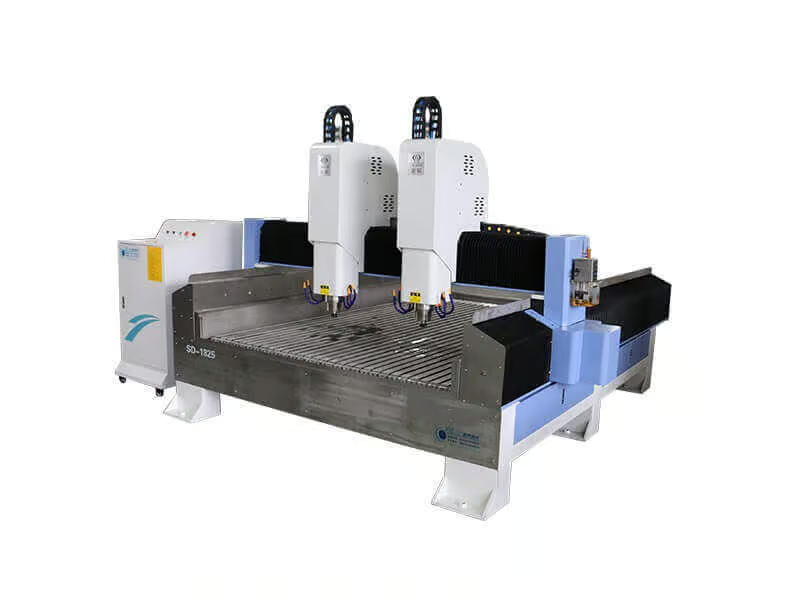 Stone Engraving Machines
 Stone Veneer Saw
 Stone Quarry Machines
 Stone Band Saw Machines
 Stone Edging Beveling Machine
 Other Stone Machines
 Stone Diamond Tools
 Stone Slab Cutting
 Stone Slab Surface Edge Polishing
 Stone Block Slicing
 Stone Quarry Mining
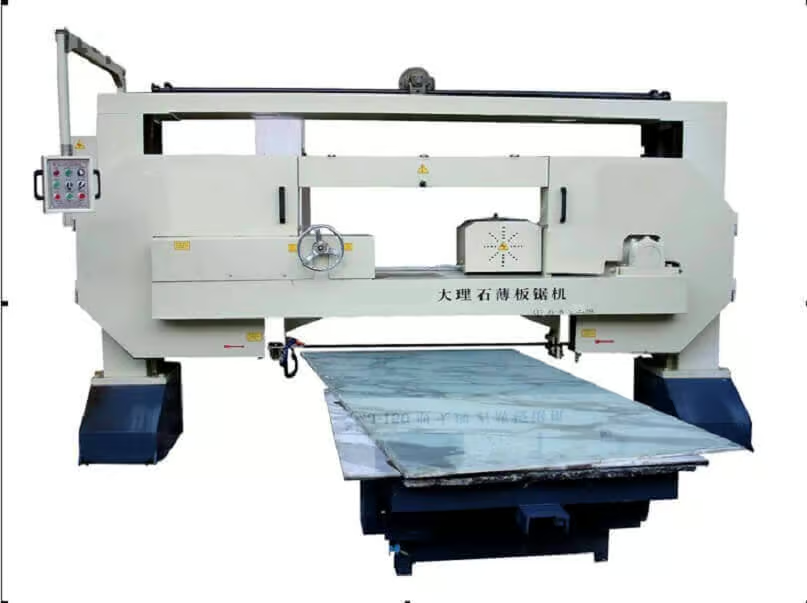 Stone Horizontal Splitting
 Stone Engraving Applications
 CNC Stone Cutting
 Countertop Cutting Polishing
 Other Applications
Modern architectural design is undergoing a massive transformation. Plain, flat stone surfaces are increasingly being replaced by complex, flowing geometric structures. According to design trend reports by authoritative institutions like the American Institute of Architects (AIA), bespoke natural stone facades and complex 3D architectural elements are experiencing a major resurgence in high-end commercial and residential projects.
For stone fabricators, this shift represents the ultimate high-profit opportunity. However, fulfilling these complex orders requires stepping away from traditional 2D cutting and embracing the lucrative world of 3D architectural stone profiling.


The End of Manual Stone Carving for Complex Designs
Historically, fabricating a complex Roman column capital or a bespoke geometric base required an army of master stone carvers. Today, relying on manual labor for complex 3D shapes is a recipe for project failure.
- Extreme Time Consumption: Hand-carving a single intricate capital can take weeks. In modern construction, architects demand rapid lead times that manual labor simply cannot meet.
- Lack of Consistency: When an architect orders 20 identical complex column bases, manual carving guarantees that no two pieces will look exactly the same, often leading to rejected materials.
- Exorbitant Labor Costs: Skilled stone artisans are rare and expensive, completely eroding the profit margins of your architectural projects.

What is 3D Architectural Stone Profiling?
3D architectural stone profiling is the automated process of carving complex, multi-dimensional shapes from solid stone blocks using a heavy-duty CNC stone wire saw.
Unlike standard block cutters that only cut straight lines, a 3D profiling wire saw utilizes Multi-axis CNC Interpolation. The computer system simultaneously coordinates the vertical and horizontal movements of the diamond wire (X/Y axes) with the continuous rotation of a heavy-duty rotary worktable (A-Axis). This allows the machine to effortlessly “slice” complex CAD geometries directly into solid granite or marble.
Top 3 Lucrative 3D Stone Products You Can Fabricate
By upgrading your fabrication shop to handle true 3D profiling, you immediately unlock the highest-paying tiers of the architectural stone market. Here are the top three products you can produce:
- 1. Ornate Column Capitals & Geometric Bases: Move beyond simple cylinders. You can automatically carve polygonal bases, chamfered edges, and sweeping curved profiles required for classical and modern column designs with 100% repeatability.
- 2. 3D Wave Facades & Curved Wall Cladding: Architects love dynamic, flowing exteriors. A CNC wire saw can execute continuous, undulating wave cuts through thick granite blocks, creating breathtaking 3D wall panels that command massive premium prices.
- 3. Bespoke Monumental Art & Signage: Municipal projects and corporate headquarters frequently require massive, solid stone 3D letters or abstract geometric sculptures. The 3D interpolation handles these complex artistic shapes effortlessly.

Why the Discovery 5 is Built for 3D Profiling
Executing a flawless 3D wave cut requires more than just software; it demands extreme mechanical engineering. The Discovery 5 is specifically built to handle the heaviest 3D workloads.
First, it boasts Heavy-Duty Rigidity. When cutting complex shapes, any machine vibration will ruin the profile. The Discovery 5’s massive gantry structure and 20-ton payload rotary table guarantee absolute stability. Second, it offers Simplicity via Smart HMI. You don’t need a degree in computer science to operate it. The real-time 3D visual model interface allows your operators to import standard DXF files and execute complex 3D cuts with simple, one-click automated setups.
Conclusion & Step Into the Future of Fabrication
The era of standard, flat architectural stone is giving way to the era of bespoke 3D profiling. Do not let outdated machinery limit your company’s growth. By investing in multi-axis CNC wire saw technology, you eliminate expensive manual labor and position your factory to win the most lucrative architectural contracts in the industry.
Ready to Master 3D Architectural Stone?
Explore how the heavy-duty Discovery 5 CNC Wire Saw can automate your complex column capitals, bases, and 3D wave facades.
View the CNC Wire Saw for Columns & 3D ProfilingTop 10 FAQ: 3D Architectural Stone Profiling
1. Do I need specialized 3D software to create these profiles?
While complex 3D models can be used, our intelligent CNC system can often generate complex architectural sweeps and profiles directly from standard 2D DXF vector files by interpolating the rotary axis.
2. Is 3D profiling with a wire saw faster than using a 5-axis CNC router?
Yes, significantly. A CNC router uses a small milling bit to slowly grind away material. A wire saw slices completely through the block, separating massive chunks of waste instantly, making it vastly faster for deep 3D profiles.
3. Can I cut sharp internal corners with a wire saw?
The sharpness of an internal corner is limited by the diameter of the diamond wire (typically 8mm to 11mm). While it cannot cut a perfect 90-degree internal point, it creates incredibly tight, clean radiuses suitable for almost all architectural designs.
4. How smooth is a 3D wave facade cut by a wire saw?
Thanks to the micro-tensioning system and vibration-free gantry structure, the wire leaves a remarkably smooth, consistent finish that requires very little secondary hand polishing.
5. What happens if the wire breaks during a complex 3D cut?
Our intelligent CNC system features automatic wire break detection. If a break occurs, the machine pauses instantly, remembers its exact coordinates, and allows you to resume the 3D cut seamlessly once the wire is repaired.
6. Can the machine profile asymmetrical column bases?
Absolutely. Because the A-axis (rotary table) is fully synchronized with the X and Y axes via the CNC controller, the machine can easily cut complex asymmetrical, polygonal, or eccentric geometric shapes.
7. How long does it take to train an operator for 3D profiling?
Due to our highly intuitive Human-Machine Interface (HMI) with a real-time 3D visual model, an operator with basic CNC or CAD experience can learn to execute complex 3D cuts within just a few days of training.
8. Will the heavy weight of the stone damage the rotary table during 3D rotation?
No. The Discovery 5 is engineered specifically for monumental stone, featuring a heavy-duty rotary worktable capable of safely supporting and rotating payloads up to 20 tons.
9. Can I use the offcuts from a 3D profile cut?
Yes! Because the wire saw slices rather than grinds, the negative piece of your 3D cut (the offcut) is perfectly preserved. A 3D wave cut yields two perfectly matching wave panels from a single block.
10. What kind of diamond wire is best for intricate 3D profiling?
For complex architectural 3D profiling, we recommend using a premium, smaller diameter sintered diamond wire (e.g., 8mm to 8.8mm). This provides a smaller kerf, allowing for tighter radiuses and finer geometric detailing.