
 Stone Cutting Machines
 Stone Polishing Machines
 Bridge Saw Machines
 CNC Stone Wire Saw Machine
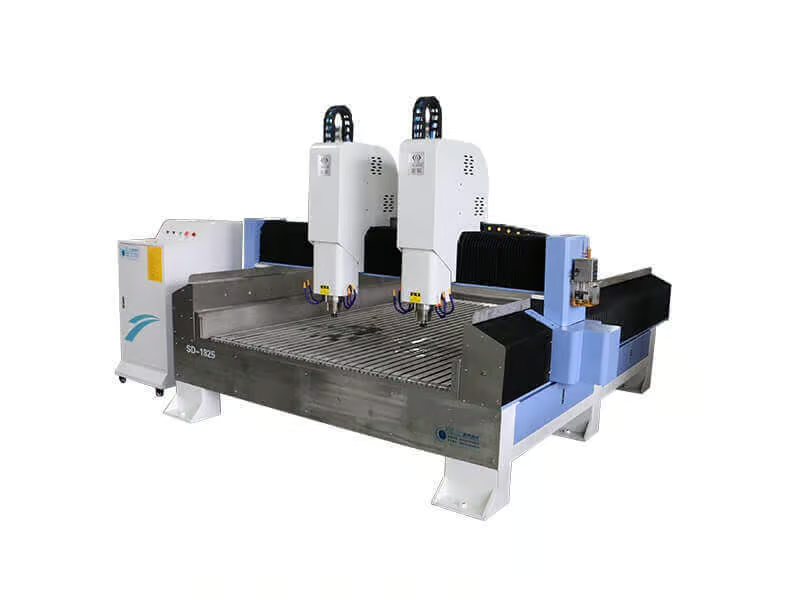 Stone Engraving Machines
 Stone Veneer Saw
 Stone Quarry Machines
 Stone Band Saw Machines
 Stone Edging Beveling Machine
 Other Stone Machines
 Stone Diamond Tools
 Stone Slab Cutting
 Stone Slab Surface Edge Polishing
 Stone Block Slicing
 Stone Quarry Mining
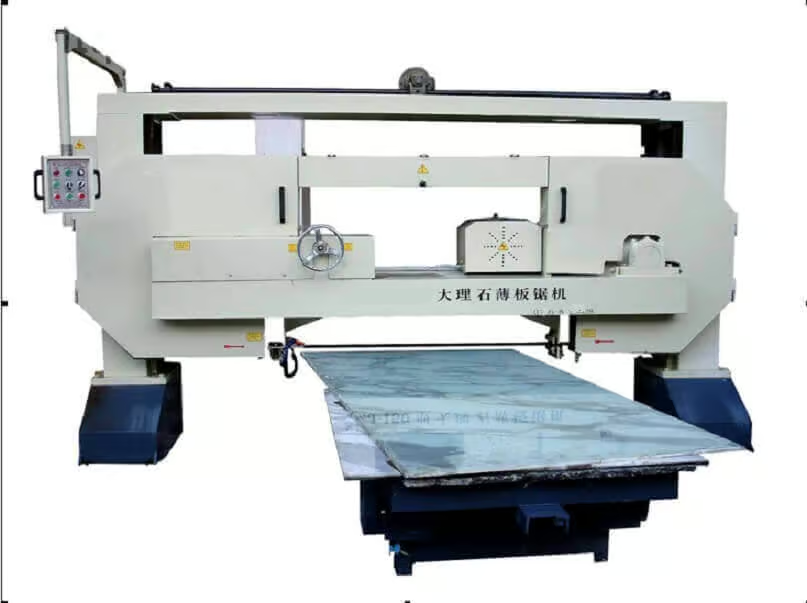 Stone Horizontal Splitting
 Stone Engraving Applications
 CNC Stone Cutting
 Countertop Cutting Polishing
 Other Applications
The global stone fabrication industry is undergoing a massive transformation. Consumer demand has shifted away from simple, flat countertops toward highly complex, architectural luxury designs like seamless waterfall islands, 3D carved stone sinks, and bookmatched sintered stone walls. To meet this demand, factory owners face a critical equipment dilemma: should they invest in a traditional standard bridge saw, or upgrade to a fully automated 5-Axis CNC machining center?
According to the technical equipment guidelines published by the Natural Stone Institute (NSI), upgrading to advanced CNC technology is the most effective way to offset severe labor shortages and reduce expensive material waste. In this comprehensive comparison, we will break down the exact capabilities, limitations, and Return on Investment (ROI) of both machine types to help you make the right choice for your factory.


Understanding the Standard Bridge Saw
The standard bridge saw (typically a 3-axis or a basic 4-axis machine) has been the reliable workhorse of the stone industry for over two decades. They are rugged, generally affordable, and straightforward to operate. However, their physical design limits their application in the modern luxury market.

Primary Capabilities
A standard bridge saw excels at rapid, straight-line cutting. Moving along the X (left/right) and Y (forward/backward) axes, these machines are perfect for efficiently slicing raw granite blocks into standard dimension flooring tiles, rectangular cladding panels, and basic cut-to-size kitchen countertops. They are the ideal solution for high-volume, low-complexity production.

The Limitations
The main drawback is the lack of automated head articulation. On a 3-axis saw, if you want to make a 45-degree miter cut, the operator must manually unlock the cutting head, tilt it by hand using a gauge, and lock it back into place—a slow process highly prone to human error. Furthermore, they generally lack the sophisticated software required to execute complex curved cuts or sink hole routing automatically.
What Makes a True 5-Axis CNC Center Different?
A 5-axis CNC is not just a standard saw with an extra motor bolted on. It represents a quantum leap in machine kinematics and software control. It transforms a simple cutting table into a true 3D spatial fabrication center.

Simultaneous 5-Axis Interpolation
While a standard saw moves in straight lines, a 5-axis machine can move its X, Y, Z, A (0°–90° tilt), and C (0°–360° rotation) axes simultaneously. Governed by advanced Italian CNC software (like ESA), this simultaneous “interpolation” allows the cutting blade to glide smoothly through complex 3D curves, carving intricate statues, sloping sink basins, and undulating architectural wave panels from solid stone blocks.

Advanced Tool Integration
A true 5-axis center features a highly versatile spindle. With a 1/2-inch gas fitting, the machine can drop its large diamond saw blade and instantly equip high-speed milling router bits or core drills. This means the machine can slice the slab, plunge and route out a perfect sink hole, and drill faucet holes all in one single, automated setup without moving the stone.
Head-to-Head: Processing Capabilities & ROI
Let’s put aside the mechanical specifications and look at the real-world financial impact. How do these two types of machines perform when your factory receives a high-margin, complex client order?

Miter Cuts and Waterfall Edges
Standard Saw: Requires manual head tilting. Cuts are often slightly wavy due to blade deflection, requiring a fabricator to spend hours manually grinding the edge with an angle grinder before gluing.
5-Axis CNC: Automatically tilts the blade to a mathematically perfect 45.0 degrees. It calculates blade thickness and automatically adjusts feed rates, delivering a flawless, mirror-smooth joint right off the table. Zero manual grinding required.


Labor and Material Yield
Premium 5-axis machines are usually equipped with overhead cameras and integrated vacuum lifters. An operator can digitally nest the cuts on a screen to avoid natural fissures, increasing material yield by up to 20%. As the machine cuts, the vacuum lifter automatically moves the pieces out of the way. One single operator can manage an output that would require three men on a standard manual saw.
Which Machine is Right for Your Fabrication Shop?
There is no “one-size-fits-all” answer. The best machine is the one that perfectly aligns with your current budget and your future business strategy.

When to Choose a Standard Saw
If you are a startup fabrication shop with a strict budget, or your primary business is fulfilling high-volume wholesale commercial orders (like standard hotel bathroom vanities, basic square tiles, and straight cladding), a high-quality standard 4-axis monoblock saw will provide an excellent return on investment without paying for 3D features you won’t use.

When to Upgrade to a 5-Axis CNC
If you are turning away lucrative jobs because you can’t produce complex curved profiles, solid stone sinks, or seamless mitered islands, you are losing money. A 5-Axis CNC is mandatory if you want to dominate the high-margin luxury custom market, process brittle sintered stone, and drastically reduce your reliance on hard-to-find manual labor.
Quick Reference: Standard Saw vs. 5-Axis CNC
Short on time? Use this side-by-side comparison matrix to instantly understand the operational, technical, and financial differences between a traditional bridge saw and a fully automated 5-axis machining center.
| Feature / Capability | Standard Bridge Saw (3/4-Axis) | 5-Axis CNC Machining Center |
|---|---|---|
Axis Interpolation | X, Y, Z (Straight lines & basic curves) | X, Y, Z, A, C (Simultaneous 3D spatial movement) |
45° Miter Cuts | Manual head tilting; prone to blade deflection, chipping, and wavy edges. | Fully automated A-axis tilt; delivers flawless, mirror-smooth joints instantly. |
Sink Cutouts & Milling | Usually requires moving the slab to a secondary manual routing station. | Integrated 1/2″ gas fitting automatically switches to CNC router bits for instant cutouts. |
Material Nesting | Manual laser line alignment; relies heavily on operator estimation. | Overhead HD Camera & CAD software maximize yield and perfectly match stone veins. |
Slab Handling | Requires operators to manually drag heavy, dangerous cut pieces off the table. | Automated Vacuum Lifter moves cut pieces seamlessly, allowing unattended operation. |
Manual Labor Needed | High. Requires hours of manual edge grinding and polishing prep after cuts. | Minimal. Precision cuts are ready for immediate gluing or edge polishing machines. |
Ideal Application | Basic cut-to-size, wholesale commercial flooring, standard granite slabs. | Luxury waterfall islands, 3D architectural profiling, ultra-hard Sintered Stone (Dekton). |
Step Into the Future
While a standard bridge saw will always have a place in basic cut-to-size operations, the future of highly profitable stone fabrication belongs to 5-axis automation. By investing in true 3D capabilities, camera nesting, and perfect miter execution, you transition your shop from a high-labor sweatshop into a modern, highly efficient manufacturing facility.
Ready to Dominate the Luxury Market?
Explore the ultimate fabrication powerhouse. Discover how the MOSCUT 5-Axis CNC Bridge Saw can automate your production line, eliminate material waste, and carve complex 3D profiles effortlessly.
Explore the Ultimate 5-Axis CNC CenterTop 10 FAQ: 5-Axis vs Standard Bridge Saws
Comparing machine specs can be confusing. Here are the most common questions fabricators ask when deciding whether to upgrade to a 5-axis CNC.
Technical & Functional Differences
1. Does a 5-axis machine cut faster than a standard saw?
In terms of raw straight-line speed (X and Y axis), they are similar. However, a 5-axis machine is drastically faster overall because it automates the transitions. It rotates and tilts automatically without the operator stopping the machine to manually adjust the stone or the cutting head.
2. Is the 5-axis CNC software difficult for my workers to learn?
Modern Italian CNC systems (like ESA) are highly intuitive and feature touchscreen interfaces with visual CAD simulations. While 3D profiling takes training, an operator can learn to program basic 2D cuts and automated miters in just a few days.
3. Can a standard 4-axis saw cut a circle?
Yes. A true 4-axis machine has a rotating C-axis, which allows the blade to turn continuously to cut curved lines, ovals, and perfect circles. However, it cannot tilt to bevel the edge of that circle—only a 5-axis machine can do that.
4. Why do 5-axis machines weigh more?
Simultaneous 5-axis movement generates complex multidirectional torque and vibration. To ensure microscopic accuracy during 3D carving, a 5-axis frame must be built with significantly thicker, heavier steel and cast iron to maintain absolute rigidity.
5. Can I use the same diamond blades on both machines?
While basic straight blades are interchangeable, 5-axis machines require highly specialized tooling for advanced tasks. You will need thicker continuous-rim blades for 45-degree miters, and specialized CNC milling router bits for carving and sink hole routing.
Investment & Operations
6. How much more expensive is a 5-axis CNC?
A standard 4-axis monoblock might cost between $25,000 and $45,000. A true 5-axis CNC center loaded with a camera system, vacuum lifter, and Italian software typically ranges from $60,000 to over $100,000 depending on the spindle power and brand.
7. What is the typical ROI period for a 5-axis machine?
If your shop is consistently busy with custom countertop orders, the savings from reduced manual labor, zero rework on miter joints, and 15% better material yield from camera nesting can often pay for the price difference of a 5-axis machine within 12 to 18 months.
8. Does a 5-axis machine cost more to maintain?
Yes, slightly. It has more absolute servo motors, a more complex electronic cabinet, and sophisticated software. However, because it is usually built with premium linear guides and automatic lubrication systems, mechanical breakdowns are rare if properly maintained.
9. Do I need a full-time CAD designer for a 5-axis saw?
For standard countertops and miters, no—the operator can program it directly on the machine’s touchscreen. However, if you plan to do highly complex 3D architectural reliefs, having a draftsman familiar with AutoCAD or Alphacam is highly recommended.
10. Can a 5-axis machine process Sintered Stone (Dekton, Neolith)?
Absolutely. In fact, it is the preferred machine. Sintered stone is extremely brittle and requires highly controlled plunge speeds, step-cutting algorithms, and perfectly rigid 45-degree mitering—all of which are standard features on a 5-axis CNC.