
 Stone Cutting Machines
 Stone Polishing Machines
 Bridge Saw Machines
 Stone Quarry Cutting Machines
 Stone Block Cutter Machine
 CNC Stone Wire Saw Machine
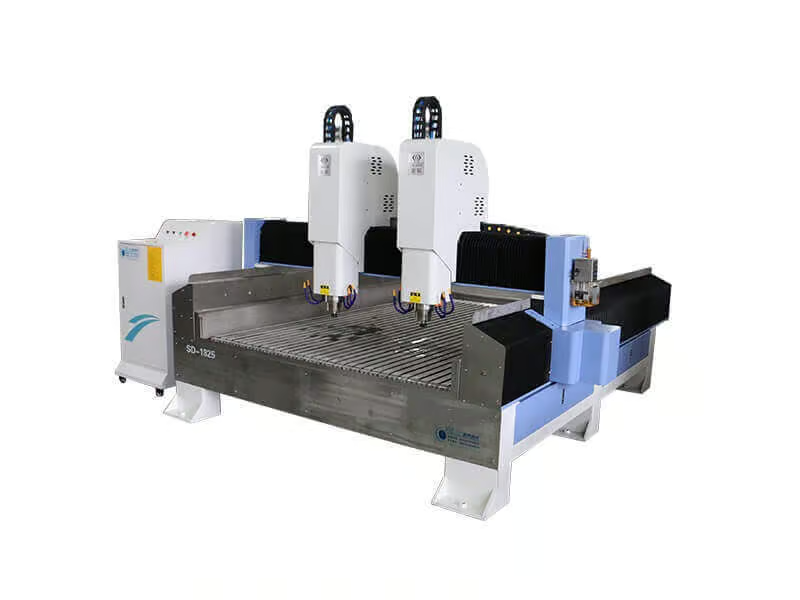 Stone Engraving Machines
 Thin Stone Veneer Saw Machine
 Horizontal Stone Slab Splitting Machine
 Stone Edge Polishing Profiling Machine
 Stone Auxiliary Equipment
When selecting the expansion medium for a stone pushing bag, operators are making a critical decision rooted in fluid thermodynamics. According to safety protocols published by the National Fluid Power Association (NFPA), the defining difference between pneumatic (air) and hydrostatic (water) systems lies in their compressibility. Air behaves like a mechanical spring; it compresses tightly and stores massive amounts of explosive potential energy. Water is rigid and incompressible; it transfers mechanical power instantly without storing an explosive shockwave. Understanding this physical distinction is the absolute prerequisite for safely toppling massive quarry blocks.
A deep-pit granite quarry in Brazil provides a perfect case study for this distinction. Initially, the management team utilized pneumatic air bags to topple massive 300-ton granite benches. However, because they were operating deep within an enclosed, cavernous quarry pit, the risk was extreme: if the razor-sharp granite accidentally punctured a highly compressed air bag, the resulting concussive shockwave and deafening blast within the enclosed space posed severe acoustic and projectile risks to the crew. Upon consulting with MosCut engineers, they immediately switched to filling their dual-purpose MosCut bags with pressurized water (Hydrostatic). Because water is incompressible, the explosive risk was eliminated instantly. Furthermore, by utilizing a specialized 15 Bar water pump, they safely generated nearly double the thrust they previously achieved with their 8 Bar air compressor, solving both their safety and efficiency challenges simultaneously.
The Physics of Fluids: Compressible vs. Incompressible
Air behaves like a loaded spring. Water behaves like solid steel. This dictates their ultimate safety profiles.Air Compressibility (Boyle’s Law): When you pump compressed air into a pushing bag at 8 Bar (116 PSI), you are packing millions of air molecules tightly together. The air acts like a tightly coiled metal spring. It stores immense potential energy. If the Kevlar bag is cut by a sharp rock, that “spring” suddenly uncoils. The air expands violently back to its normal atmospheric volume in a fraction of a second, causing a loud blast and a concussive shockwave.
Water Incompressibility: Liquids fundamentally cannot be compressed. When you pump high-pressure water into a bag, the water simply takes up space and pushes against the rubber walls with immediate, rigid force. It does not store explosive energy. If a hydrostatic bag is accidentally punctured under maximum pressure, the water merely leaks or sprays out like a busted garden hose. The internal pressure drops to zero instantly, with absolutely zero explosion or shockwave.

Pneumatic Pushing Bags (Air): The Speed Champion
Fast, lightweight, and directly compatible with your existing quarry infrastructure.The Pros: For the vast majority of standard marble and limestone quarries, pneumatic (air) bags are the daily workhorse. Their primary advantage is Speed and Convenience. Air rushes into the bag rapidly, toppling blocks in just 2 to 3 minutes. Furthermore, you do not need to buy any new equipment; you simply plug the bag directly into the DTH air compressor you already have on-site. When deflated, air bags are extremely light and easy for one worker to carry across uneven quarry terrain.
The Cons: Because they rely on your standard quarry air compressor, their pushing capacity is strictly limited by the compressor’s maximum output (usually capped around 7 to 8 Bar). Additionally, the inherent stored energy of compressed air means they carry a higher concussive risk if catastrophic failure occurs.
Ideal Application: Open-pit quarries moving regular, standard-sized blocks (50 to 150 tons) where cycle speed and logistical convenience are the highest priorities.

Hydrostatic Pushing Bags (Water): The Safety Titan
Maximum tonnage and absolute safety. The undisputed choice for massive or hazardous extractions.The Pros: The primary advantage is Absolute Safety and Limitless Force. Because water is incompressible and perfectly safe under high pressure, hydrostatic bags can be connected to specialized high-pressure water pumps that safely push 10, 15, or even 20 Bar of pressure into the bag. Because $Thrust = Area times Pressure$, doubling the internal pressure with a water pump literally doubles the pushing capacity of the exact same bag, allowing you to move ultra-massive blocks that air simply cannot budge.
The Cons: They are significantly slower to fill than air bags. You also must have a dedicated water source, a specialized hydrostatic water pump, and dealing with draining hundreds of liters of water after the block falls can make the quarry floor messy.
Ideal Application: Super-massive monolithic blocks (200 to 400+ tons), enclosed underground/deep-pit mining where air blasts are dangerous, and safety-critical zones.
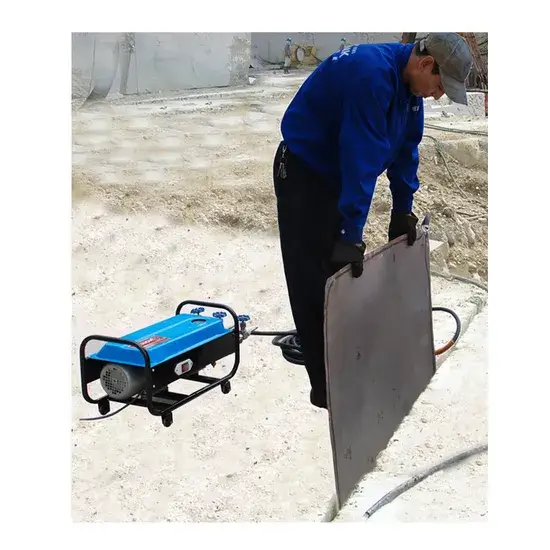
The Ultimate Selection Matrix
Air or Water? Use this side-by-side comparison to equip your quarry correctly.| Operational Parameter | Pneumatic (Air) | Hydrostatic (Water) |
|---|---|---|
| Inflation Speed | Very Fast (2-4 minutes) | Slower (Depends on pump GPM) |
| Standard Pressure Limit | 7 – 8 Bar (Limited by compressor) | 15+ Bar (Safely handles high pressure) |
| Burst Concussion Risk | High (Stored air energy) | Zero (Water is incompressible) |
| Power Source Required | Standard DTH Air Compressor | Dedicated Water Pump & Water Source |
| Ideal Block Weight | Standard (50 to 150 Tons) | Massive (150 to 450+ Tons) |
| Post-Drop Cleanup | None (Air vents cleanly) | Messy (Hundreds of liters of water released) |
❄️ The Winter Warning: Freezing Hydro Dynamics
Water’s greatest strength becomes its greatest weakness below 0°C (32°F). When water freezes into ice, it physically expands by approximately 9%. If you use hydrostatic pushing bags in freezing winter conditions and fail to completely drain them, the residual water inside will freeze overnight. This internal ice expansion will violently tear the vulcanized rubber seams and snap the internal Kevlar fibers from the inside out, permanently destroying the bag. Winter Recommendation: During freezing months, MosCut strongly advises running your dual-purpose bags exclusively on compressed Air (Pneumatic mode). If you absolutely must use water for safety reasons, you must mix the water with an industrial anti-freeze (like Ethylene Glycol) and meticulously blow out the bag with compressed air at the end of the shift.
Master Your Extraction Strategy
Whether you prioritize rapid inflation for daily production or maximum hydrostatic safety for monolithic blocks, MosCut has you covered. All MosCut pushing bags are dual-purpose designed to handle both Air and Water flawlessly.
View Dual-Purpose Pushing Bags