
 Stone Cutting Machines
 Stone Polishing Machines
 Bridge Saw Machines
 CNC Stone Wire Saw Machine
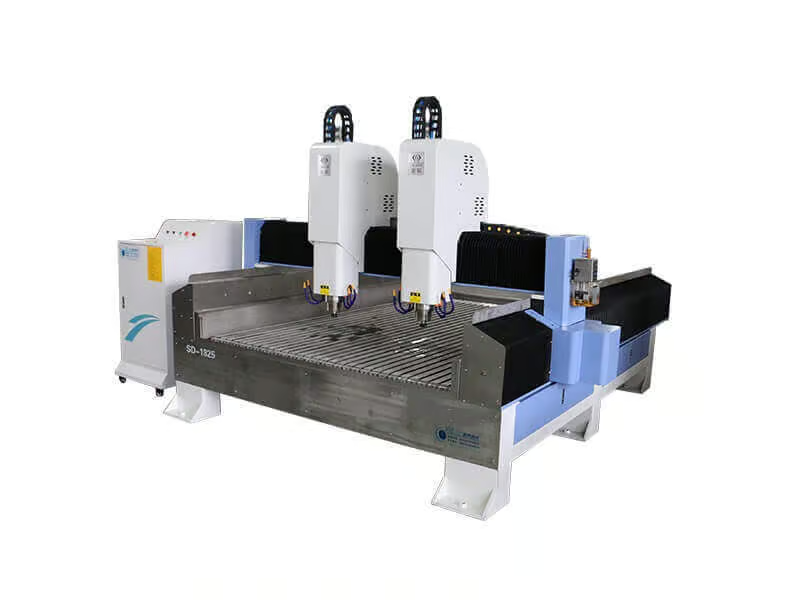 Stone Engraving Machines
 Stone Veneer Saw
 Stone Quarry Machines
 Stone Band Saw Machines
 Stone Edging Beveling Machine
 Other Stone Machines
 Stone Diamond Tools
 Stone Slab Cutting
 Stone Slab Surface Edge Polishing
 Stone Block Slicing
 Stone Quarry Mining
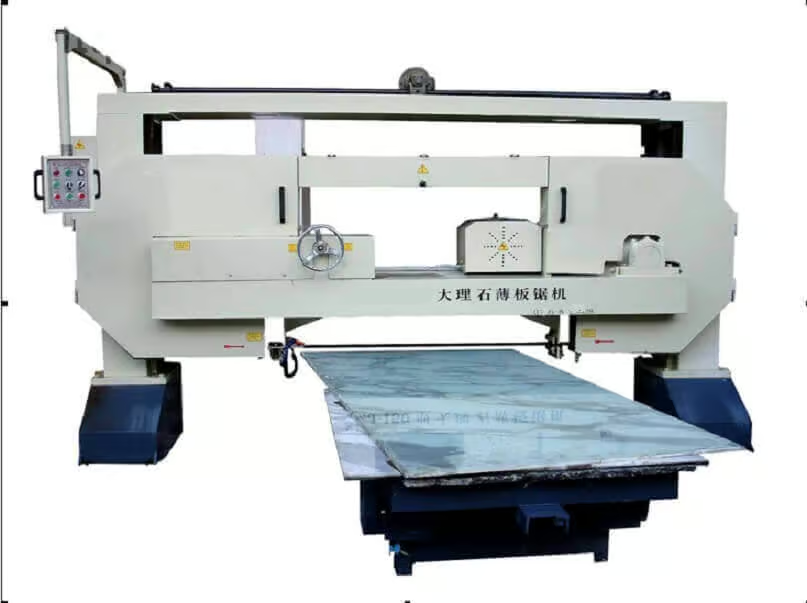 Stone Horizontal Splitting
 Stone Engraving Applications
 CNC Stone Cutting
 Countertop Cutting Polishing
 Other Applications
High-end commercial buildings, luxury hotels, and bespoke estates are driving a massive demand for solid granite architectural columns and intricate Roman pillars. However, fabricating these colossal, multi-ton blocks presents a severe bottleneck for many stone fabrication shops. When faced with a 3-meter-long solid rock, the equipment you choose dictates your profit margins.
For decades, the industry relied on traditional stone lathes. Today, modern fabricators are upgrading to heavy-duty CNC stone wire saw machines. Let's explore why the traditional lathe is holding your business back and why the wire saw is the ultimate upgrade for cutting granite columns.

The Bottleneck of Traditional Stone Lathes
A traditional blade-style stone lathe operates by scraping away layers of the stone block as it spins. While acceptable for softer materials like marble or sandstone, this technology completely fails when applied to hard igneous rocks.
- Scraping is Too Slow: Traditional lathes scrape off material millimeter by millimeter. When processing high-density granite, the cutting speed slows to an agonizing crawl, tying up your machine for days on a single column project.
- Severe Tool Wear: The abrasive nature of granite destroys lathe cutting blades incredibly fast. Frequent machine stops to replace worn-out cutting heads severely drag down production schedules and inflate consumable costs.
- Weight Limitations: Solid granite is incredibly heavy. Many older stone lathes lack the structural rigidity to support a 15-ton block. The immense weight can cause the spindle to deflect or the entire machine to vibrate dangerously.
- Inferior Cutting Precision: Manual and semi-automatic lathes simply cannot match the micro-millimeter precision of a modern CNC system. The scraping action often leaves a rough, stepped surface that requires massive amounts of secondary manual grinding to smooth out.
The Nightmare of Manual Profiling for Roman Pillars
Beyond simple cylinders, architectural projects often demand complex detailing, such as fluted grooves and ornate capitals.
- Inconsistency in Mass Production: If an architect orders 50 identical fluted Roman pillars, relying on hand-carving or manual lathe operation guarantees geometric inconsistencies. Human error makes it impossible to replicate the exact depth and spacing on every single piece.
- High Labor Costs: Hiring master stone carvers to manually profile column bases and capitals takes weeks of expensive labor, completely destroying your project's profit margins.
Why a Heavy-Duty CNC Wire Saw is the Ultimate Solution
To eliminate these bottlenecks, industry leaders use a CNC stone wire saw for columns. Instead of scraping, a diamond wire physically slices through the stone at high speeds, completely changing the fabrication game.
- Unmatched Cutting Speed: A high-tension diamond wire slices directly through the thickest granite blocks. It can profile a massive cylinder in a fraction of the time it takes a traditional lathe to scrape it down, tripling your factory's output.
- Absolute CNC Consistency: Once you import your CAD file into the system, the machine interpolates the X, Y, and rotary axes automatically. Whether you are cutting 1 or 100 fluted Roman pillars, every single one will be geometrically identical and architecturally perfect.
- Massive 20-Ton Payload: Our heavy-duty machines feature a monumental gantry structure, a motorized tailstock, and a CNC rotary worktable that can effortlessly support and rotate payloads up to 20 tons without a single millimeter of deflection or vibration.
- Easy Operation & Maintenance: Despite its massive power, the machine is incredibly easy to use. The clear HMI touch screen features a real-time 3D visual model and simple one-click buttons. Furthermore, changing a diamond wire is vastly faster and easier than constantly replacing broken lathe blades, ensuring maximum machine uptime.
Head-to-Head Comparison for Column Fabrication
| Feature | Traditional Stone Lathe | Heavy-Duty CNC Wire Saw |
|---|---|---|
| Speed on Granite | Extremely Slow (Scraping) | Fast & Highly Efficient (Slicing) |
| Precision & Consistency | Low to Medium (Prone to human error) | 100% Perfect (Fully CNC automated) |
| Complex 3D Profiling | Impossible (Requires manual labor) | Fully Automated via CAD |
| Operation & Setup | Labor Intensive & High Skill | Simple Touchscreen & 3D Visual HMI |
| Max Payload Stability | Limited (Prone to deflection) | Massive (Up to 20 Tons) |
Conclusion & Upgrade Your Fabrication Shop
If your shop is still struggling to fulfill large architectural column orders using slow, outdated lathes, you are losing money to your competitors. A heavy-duty wire saw allows you to process the hardest granites, the heaviest blocks, and the most complex 3D profiles efficiently and profitably.
Ready to Dominate the Architectural Stone Market?
Stop fighting with slow cutting speeds and worn-out lathe blades. Discover how our Discovery 5 machine can revolutionize your massive column and pillar production.
Explore the CNC Wire Saw for Columns & 3D ProfilingTop 10 FAQ: Cutting Granite Columns with a Wire Saw
1. Is a wire saw really faster than a lathe for cutting granite columns?
Yes. A lathe scrapes the stone slowly, which is highly inefficient on hard granite. A diamond wire saw physically slices through the block at high speed, significantly reducing total processing time.
2. Can the wire saw cut fluted grooves into the column?
Absolutely. By synchronizing the cutting wire with the CNC rotary worktable, the machine can automatically cut perfectly spaced and dimensioned fluted grooves around the entire pillar.
3. How much weight can the rotary worktable support?
Our heavy-duty CNC rotary worktable is engineered for monumental architectural stone and can support an astonishing payload of up to 20 tons without vibration.
4. Is the CNC operating system difficult to learn for my workers?
No. The interface is specifically designed for ease of use. It features a clear, real-time 3D visual model and large touch-screen buttons, allowing operators to master basic column profiling on their first day.
5. Can this machine cut complex 3D column capitals and bases?
Yes. Thanks to the advanced multi-axis CNC interpolation, you can import standard CAD files to automatically carve ornate column bases, intricate capitals, and bespoke 3D profiles.
6. Does the diamond wire leave a smooth finish on the column?
Yes. The continuous, high-speed slicing action of the micro-tensioned diamond wire leaves a remarkably smooth finish, which drastically reduces the amount of secondary manual polishing required.
7. How do I change the diamond wire, and is it difficult?
Changing the diamond wire is a straightforward process managed via the control panel's tensioning system. It is much faster and more convenient than constantly swapping out dull cutting heads on a traditional lathe.
8. Does the machine require a massive concrete foundation?
While the machine is heavy-duty, the balanced gantry design provides immense inherent stability. Depending on your factory floor, it often requires much less invasive foundation work compared to massive cantilevered block cutters.
9. What is the maximum diameter column I can cut?
Our heavy-duty Discovery 5 model can handle an impressive maximum processing size of 2600mm x 2600mm x 1500mm, allowing you to fabricate massive structural columns easily.
10. Can the machine save the core material when cutting a cylinder?
Yes! Unlike a lathe that turns excess stone into worthless dust, a wire saw can often "core" the block. This allows you to preserve the outer arc-shaped offcuts to use as curved wall cladding, maximizing your material profits.