
 Stone Cutting Machines
 Stone Polishing Machines
 Bridge Saw Machines
 Stone Quarry Cutting Machines
 Stone Block Cutter Machine
 CNC Stone Wire Saw Machine
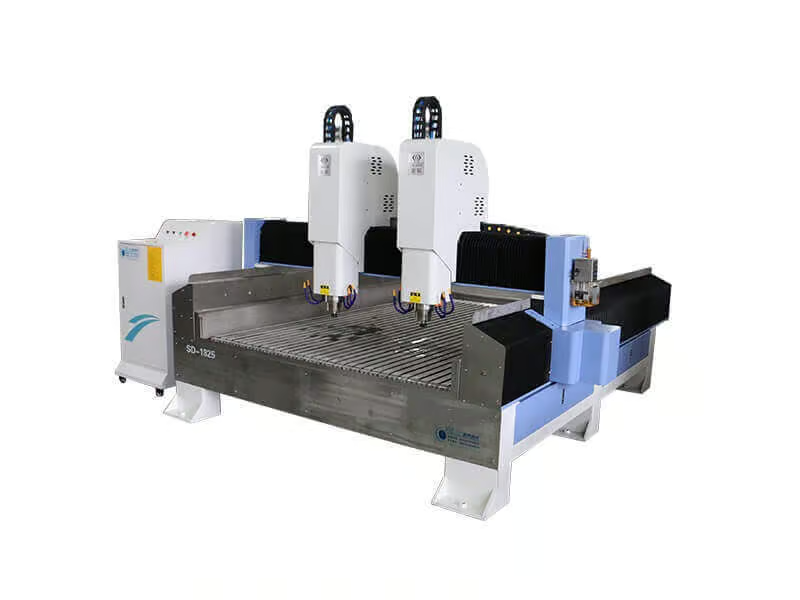 Stone Engraving Machines
 Thin Stone Veneer Saw Machine
 Horizontal Stone Slab Splitting Machine
 Stone Edge Polishing Profiling Machine
 Stone Auxiliary Equipment
In the realm of automated continuous edge polishing, understanding the physics of “Floating Pressure” is the dividing line between amateur results and architectural perfection. When stone slabs travel down a continuous conveyor, they are never perfectly uniform in thickness or flatness. If a polishing spindle is bolted rigidly in place, even a 0.5mm variance in the stone will cause the diamond pad to either smash into the slab and shatter, or miss the edge entirely. To solve this, MosCut continuous lines utilize pneumatic air cylinders to act as “Air Shock Absorbers.” These cylinders allow the spinning resin pads to float against the stone edge with dynamic, yielding pressure, mimicking the sensitivity of a human hand. However, dialing in the correct pneumatic pressure (measured in Bar or PSI) for each individual head is a highly specialized skill.
A quartz countertop fabrication facility in Melbourne, Australia, learned this lesson the hard way. Upon installing their new continuous line, inexperienced operators assumed that “more pressure equals faster polishing.” They dialed all 8 polishing heads to a maximum pressure of 4.0 Bar. The results were disastrous: their expensive resin pads were destroyed in just two days, and the edges of the engineered quartz emerged from the machine heavily scorched with a milky-white “resin burn.” After a remote video consultation with MosCut engineers, the shop was introduced to the “Stepped Depressurization” technique. By aggressively lowering the air pressure on the final, fine-grit buffing heads, the burning instantly ceased, the abrasive lifespan doubled, and the final gloss reading consistently peaked above 90 degrees.
🚨 The Air Shock Absorber: Why Rigid Mechanical Polishing Fails
Commercial stone slabs—especially natural marble and heavily veined granites—exhibit microscopic surface undulations. If you force a rigid, unyielding polishing head against a moving slab, the tool will instantly crush the high spots and skip over the low spots, leaving deep gouges and dull patches. Pneumatic cylinders solve this by delivering elastic pressure. By supplying regulated compressed air to the cylinder, the polishing spindle becomes a fluid suspension system. It extends instantly to fill microscopic valleys and compresses slightly when hitting a peak, ensuring 100% continuous contact with the stone margin without violent impact.
The Step-Down Sequence: Calibrating the Relay
Not all grits are created equal. Pressure must decrease as the grit becomes finer.⚙️ 1. Metal Calibration (High Pressure)
Recommended: 2.5 – 3.5 Bar. The initial metal-bonded diamond wheels act as planers. Their job is brutal stock removal—milling away saw marks and forcing the slab to a uniform width. High pneumatic pressure is required to force the metal matrix to aggressively bite into the stone.
🌫️ 2. Transition Honing (Medium Pressure)
Recommended: 1.5 – 2.0 Bar. For intermediate resin grits (200# to 800#), the goal shifts from shaping to scratch removal. Medium pressure ensures the diamonds erase the deep gouges left by the metal tools without generating excessive thermal friction.
✨ 3. Mirror Buffing (Low/Floating Pressure)
Recommended: 1.0 – 1.2 Bar. Grits from 1500# to 3000# and chemical buffs rely on high-speed surface friction, not cutting, to pop the final polish. High pressure here will instantly glaze the pads or burn the stone. You want the pad to “kiss” the stone lightly.
Material Strategies: Engineered Quartz vs. Natural Granite
Heat is the mortal enemy of engineered stone, while dense granite demands heavy friction.Engineered Quartz: Quartz countertops contain up to 10% polymer resin to bind the aggregate. If pneumatic pressure is too high on the fine grits, the intense friction boils the water coolant and melts the polymer resin, turning the edge a cloudy white (Resin Burn). When running quartz, you must universally lower the air pressure across all resin heads by 20% and ensure hydro-cooling jets are running at maximum capacity.
Natural Granite: Dense natural stones like Black Galaxy or Absolute Black granite have exceptionally hard, tight pores. If the pneumatic pressure is set too low (e.g., under 1.0 Bar), the polishing pads will simply “ice skate” across the surface. The diamonds will fail to penetrate the hard minerals, leaving the edge with a hazy, matte finish rather than a deep mirror reflection. Granite demands firm, authoritative pressure.

Troubleshooting: Pad Glazing and Edge Burning
Listen to the machine and read the stone to diagnose pressure faults instantly.Pad Glazing (The Pad Becomes Hard as Glass): This occurs when pneumatic pressure is too low while water volume is too high. The diamond abrasive fails to bite into the stone, causing fine stone dust to pack into the resin matrix. The pad stops cutting entirely. Solution: Dress the pad with a silicon carbide block to expose fresh diamonds, and slightly increase the Bar pressure.
Edge Burning (Scorching & Smoke): A catastrophic fault where the pad generates so much heat it scorches the stone or the pad itself starts to smoke. This means the pneumatic pressure is violently high, or the water line is clogged. Solution: Immediately back the regulator off to 1.0 Bar and verify the water jet is aimed directly into the contact zone.

Take the Guesswork Out of Polishing
Stop wasting money on ruined slabs and prematurely destroyed diamond pads. Master the art of automated stone finishing with the precise, independent pneumatic control systems built into every MosCut Vertical Edge Polisher.
View Machine Control Features