
 Stone Cutting Machines
 Stone Polishing Machines
 Bridge Saw Machines
 Stone Quarry Cutting Machines
 Stone Block Cutter Machine
 CNC Stone Wire Saw Machine
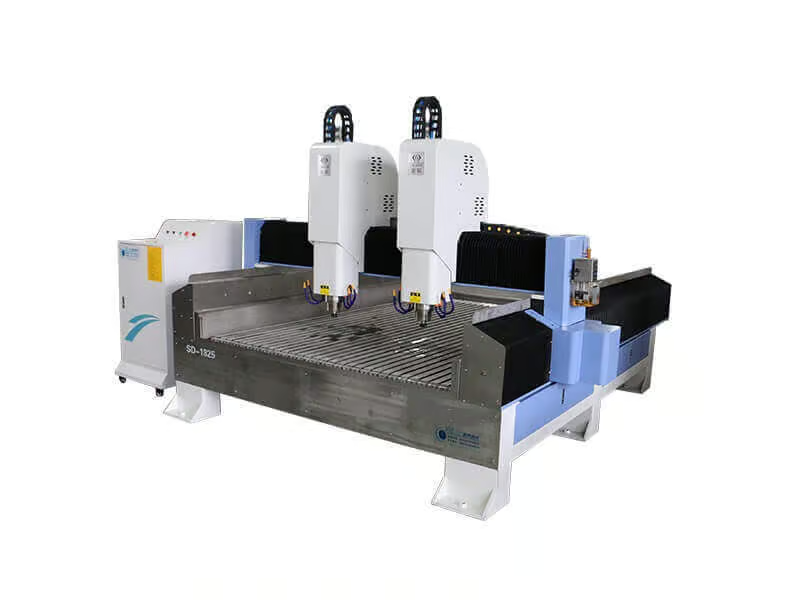 Stone Engraving Machines
 Thin Stone Veneer Saw Machine
 Horizontal Stone Slab Splitting Machine
 Stone Edge Polishing Profiling Machine
 Stone Auxiliary Equipment
In hard rock drilling operations, fluid mechanics dictates success just as much as mechanical force. According to technical papers published by the International Society for Rock Mechanics and Rock Engineering (ISRM) regarding Annular Return Velocity, ‘borehole flushing failure’ is the leading cause of drill string entrapment. When the upward velocity of the compressed air is insufficient to overcome the terminal settling velocity of the rock cuttings, gravity wins. Statistics indicate that over 80% of stuck drill incidents in open-pit quarries are not caused by the rock being too hard, but rather by inadequate air volume allowing crushed rock to re-compact above the DTH hammer.
A high-yield ‘Black Ice’ granite quarry in South Africa faced this exact nightmare. Extracting from a bench with heavy natural fracturing, their operators were frequently burying 15-meter drill strings. They were losing 3 to 4 expensive DTH hammers every single month, crippling their wire saw threading schedule. Upon integrating MosCut DTH Drilling Machines, our field engineers retrained their crew on pneumatic fundamentals. By implementing strict ‘Blow-out’ (pull-back flush) techniques and optimizing their rotational speed (RPM) to match the feed pressure, the quarry achieved an astounding ‘zero-jam’ record over 6 months of continuous, high-intensity granite extraction.
The Physics of a Jam: Why Do Rods Get Stuck?
Understanding the enemy is the first step. Rock doesn’t shrink; drill cuttings accumulate.A DTH (Down-The-Hole) hammer operates in a highly constrained environment. As the carbide buttons crush solid rock into small chips and dust, that debris must be instantly evacuated to the surface through the narrow annular space (the gap between the drill pipe and the hole wall).
Jams primarily occur due to three geological and operational failures:
1. Cuttings Settling: If the upward airflow is weak, heavy rock chips lose momentum halfway up the hole and fall back down, forming a concrete-like plug on top of the hammer.
2. Fractured Rock (Faults): When drilling through natural faults, the vibration of the hammer can cause loose rocks from the borehole wall to cave in, physically wedging the drill pipe.
3. Clay Bands / Mud Rings: Encountering a wet clay seam mixes moisture with rock dust. This forms sticky ‘mud rings’ that adhere to the drill pipe, completely sealing off the upward airflow and choking the hammer.

Airflow Dynamics: CFM vs. PSI
Air pressure (PSI) breaks the rock, but air volume (CFM) cleans the hole. Starving the hole of volume is a guaranteed jam.Quarry owners often make a fatal mistake when pairing air compressors with DTH drills: they look only at the Pressure (PSI or Bar) and ignore the Flow Volume (CFM or m³/min).
High PSI is necessary to drive the internal piston of the hammer and crush the rock. However, once the rock is crushed, the air must travel back up the hole carrying the debris. To lift dense granite cuttings from a 20-meter deep hole, you need massive Air Volume (CFM) to maintain a high Annular Return Velocity (typically recommended to be over 15 meters per second). If your compressor is undersized in volume, the air will lazily drift out of the hole, leaving the heavy rock chips behind to bury your expensive drill string.

Balancing RPM and Feed Pressure
DTH drilling is a percussive action, not a grinding one. Pushing harder does not mean drilling faster.Novice operators often believe that applying more downward force will make the drill cut faster. This is incorrect. A DTH hammer needs to ‘bounce’ slightly to allow the internal piston to strike with maximum kinetic energy.
Feed Pressure: If you push too hard, you choke the hammer. It stops percussing and simply grinds, causing the bit to overheat and get stuck. You must maintain a balanced ‘floating’ feed pressure.
Rotational Speed (RPM): DTH drilling requires surprisingly slow rotation (typically 20 to 40 RPM). If you rotate too fast, the carbide buttons will rapidly wear flat, and the bit will bind against the rock walls. If you rotate too slowly, the buttons will strike the exact same craters repeatedly, resulting in zero penetration and a jammed bit.

The Golden SOP: The Pull-Back & Flush Technique
Preventative maintenance during the drill cycle is your ultimate insurance policy against stuck rods.The most critical habit a DTH operator can develop is the ‘Pull-Back Flush’. You must never attempt to drill a 20-meter hole in one continuous, uninterrupted push.
The Procedure: For every 2 to 3 meters of downward progress, the operator must stop feeding the drill. They must then pull the entire drill string back up about 0.5 to 1 meter while keeping the rotation and the air compressor fully engaged. This acts as a ‘Full-Volume Flush’. It allows a massive surge of uninterrupted air to blow out all accumulated cuttings and loose rocks from the borehole wall. Only when the air blowing out of the collar runs clean (pure dust, no heavy chips) should the operator resume downward drilling.
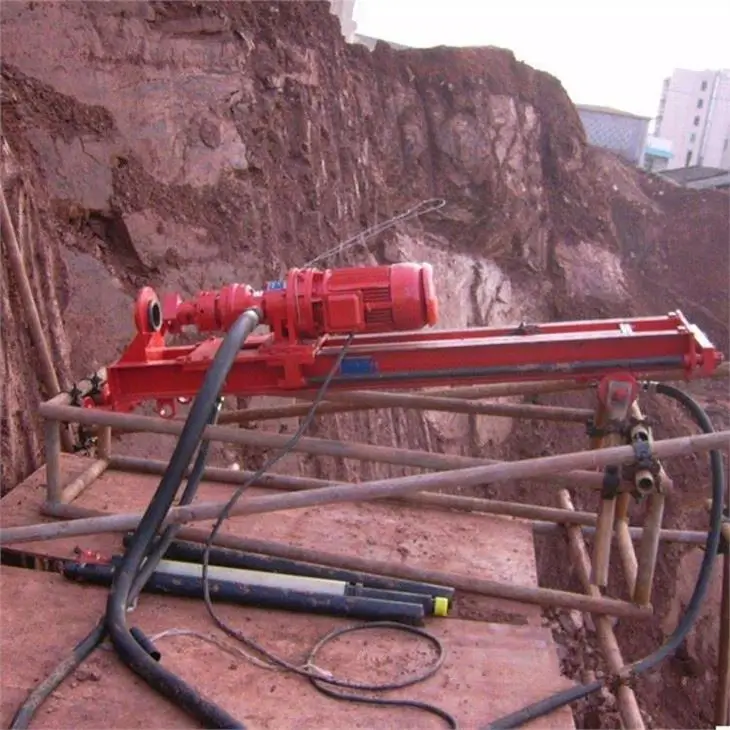
Emergency Protocol: How to Rescue a Stuck Rod
When the inevitable happens, brute force is your worst enemy. Do not attach an excavator to your drill string.Despite all precautions, geological anomalies can still trap a rod. Panic is the leading cause of permanent loss. The absolute worst thing you can do is tie a chain to an excavator and try to yank the drill string out. This will instantly snap the threaded joints, leaving the hammer buried forever.
The Correct Rescue Sequence:
1. Stop rotation immediately, but leave the air compressor running at maximum CFM to try and dry out or blow past the blockage.
2. If dry blowing fails, pour a mixture of water and environmentally safe rock drill oil down the hole (Mud/Oil flush) to lubricate the jammed cuttings.
3. Engage the hammer’s percussion (hammering action) without rotating the string, while applying a very slow, steady upward lifting force. The vibration of the hammer combined with upward tension is often enough to shatter the wedged rocks and free the string.
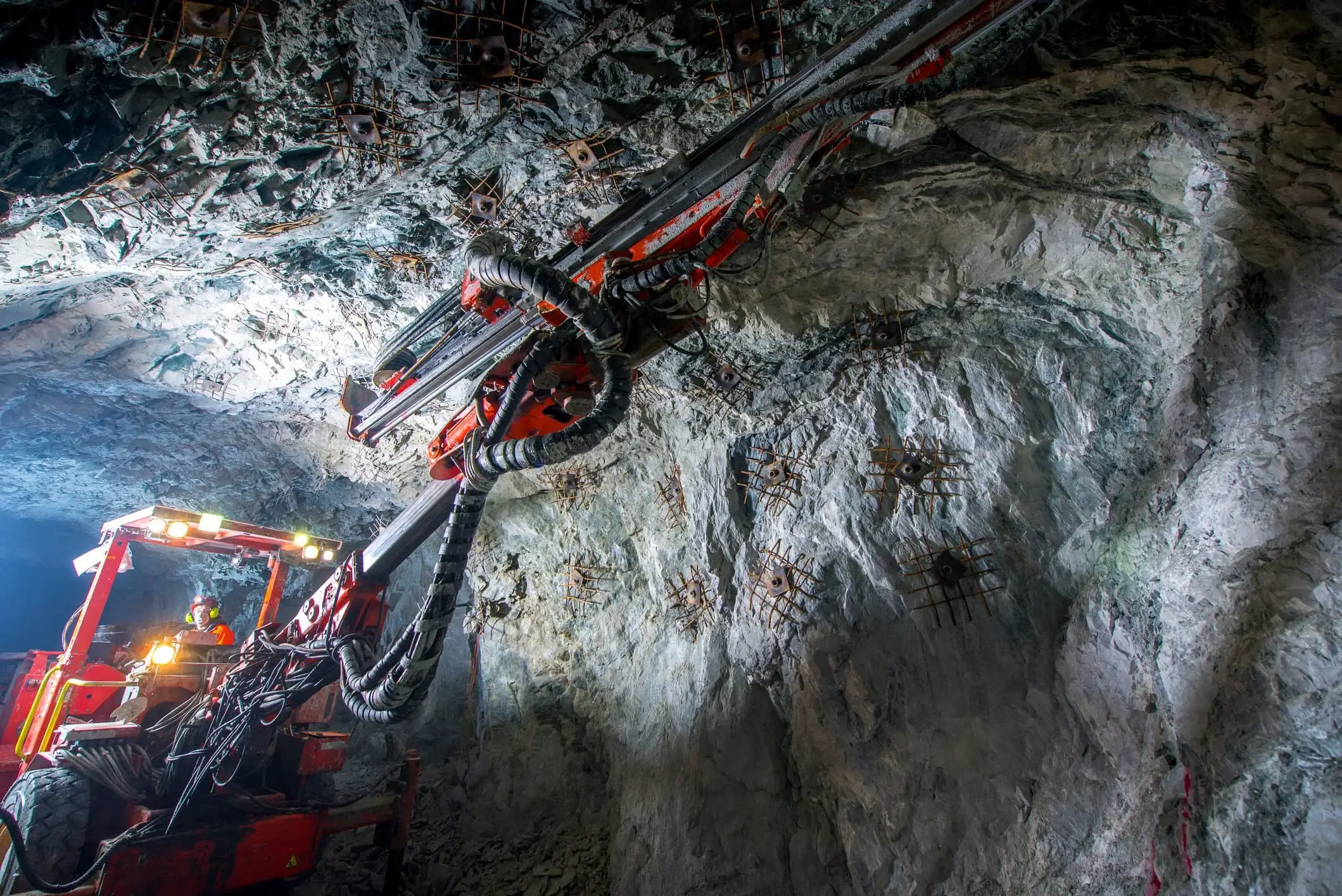
Stop Burying Your Profits
Equip your team with MosCut high-rigidity DTH drilling machines, engineered for superior hole-flushing, extreme torque, and maximum operational safety.
Explore MosCut DTH Drillers