
 Stone Cutting Machines
 Stone Polishing Machines
 Bridge Saw Machines
 Stone Quarry Cutting Machines
 Stone Block Cutter Machine
 CNC Stone Wire Saw Machine
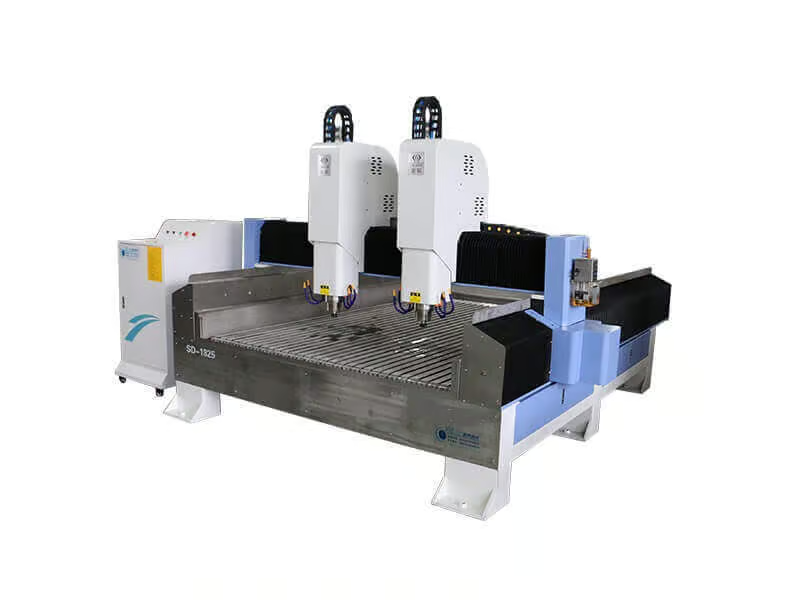 Stone Engraving Machines
 Thin Stone Veneer Saw Machine
 Horizontal Stone Slab Splitting Machine
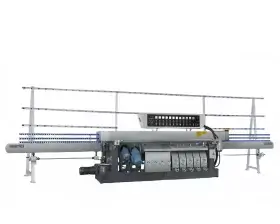 Stone Edge Polishing Profiling Machine
 Stone Auxiliary Equipment
In the hierarchy of stone fabrication, processing heavy masonry separates the standard kitchen shops from the high-margin architectural studios. Profiling 60mm thick stone edges—whether for public commercial stair treads or luxury laminated kitchen islands—introduces severe mechanical challenges. While compact vertical polishers are excellent for fast, 2cm/3cm standard runs, feeding a 60mm heavy slab into a vertical track creates a dangerous top-heavy center of gravity, risking fatal tipping or violent vibrations. To machine these massive pieces safely and accurately, the stone must “Lay Flat.” The MosCut Single-Head Automatic Router utilizes a horizontal flatbed architecture, transforming gravity from a tipping hazard into a clamping ally. This structural design allows even the smallest boutique shops to confidently bid on massive commercial infrastructure projects.
A masonry firm based in Munich, Germany, specializes exclusively in commercial exterior cladding and public staircases. Their daily operation involves machining 60mm thick natural granite, requiring a perfect Half-Bullnose edge for pedestrian safety. Relying on manual angle grinders for this depth was a physical nightmare—operators suffered severe muscle fatigue and HAVS (Hand-Arm Vibration Syndrome), while the resulting edge often suffered from asymmetrical curves. Upon integrating the MosCut Single-Head Machine into their workflow, the transformation was instant. Operators simply used a jib crane to lay the massive 200kg slabs flat onto the rigid worktable, locked the pneumatic clamps, and let the 4.75kw spindle do the heavy lifting. Their daily throughput of 60mm stair treads tripled, the symmetry was mechanically flawless, and workplace injury complaints vanished overnight.
⚖️ The Gravity Advantage: Why Flatbed Clamping Wins
You cannot fight physics when machining a 200-kilogram slab of dense granite. The problem with thick stone isn’t just the weight; it’s the massive lateral resistance (torque) generated when a high-speed diamond router bit bites into a 60mm vertical face. If the stone is standing vertically, this lateral force acts as a lever, causing the top of the slab to shudder. These micro-vibrations shatter diamond tools and create chattered, ugly edges. By laying the slab completely flat on the single-head router’s worktable, you neutralize the lever effect. Gravity naturally pulls the mass down, anchoring the stone. When the heavy spindle presses against the edge, the slab remains as immovable as the floor itself.
Commercial Application 1: Stair Treads & Monument Bases
Unlock the highly profitable public infrastructure and masonry markets.Public infrastructure contracts demand strict adherence to architectural codes. A commercial stair tread or a heavy monument base usually requires a Half-Bullnose or Full-Bullnose edge that is perfectly symmetrical.
When hand-grinding a 6cm thick bullnose, human operators naturally apply more pressure to the top half than the bottom half, resulting in an asymmetrical, “flattened” curve. The MosCut single-head router eliminates this human error. By equipping a massive 60mm metal-bonded diamond profile wheel, the machine mills the entire 6cm face in a single, unwavering pass. The top and bottom radii are cut simultaneously, ensuring the final curve is mathematically perfect and strictly compliant with commercial building codes.

Commercial Application 2: The Laminated Drop Edge
Creating the illusion of monolithic luxury in residential kitchens.In high-end residential design, a “Laminated Edge” is created by gluing two standard 3cm slabs together, face-to-face, to create the illusion of a single, massive 6cm thick luxury countertop. The critical challenge in this process is hiding the seam line where the two slabs meet.
If you hand-polish a laminated edge, the abrasive pad will often “dig into” the slightly softer epoxy glue line, creating a micro-groove that feels wavy to the touch and gathers dirt. The single-head router’s flat, unyielding travel path grinds both layers of the 6cm stone—and the epoxy between them—at the exact same rate. Once polished up to 3000 grit, the rigid calibration leaves a perfectly flush surface, rendering the glued seam virtually invisible to the naked eye.

The Power Core: Spindle Torque & Deep Cooling
Machining 60mm material requires exponential power, not just linear scaling.⚙️ Unyielding Rotational Force
Milling a 60mm edge is not simply “twice as hard” as a 30mm edge; the increased surface friction demands exponential torque. A standard handheld grinder or weak router will instantly stall when plunged into a 6cm thick block of quartzite. The MosCut single-head machine is equipped with a heavy-duty industrial 4.75kW main spindle motor. This massive power plant ensures that even during maximum-depth stock removal, the RPM remains constant, preventing the diamond matrix from binding or tearing the stone.
🌊 Deep Hydro-Cooling Penetration
A massive 60mm contact patch generates extreme thermal friction. If heat builds up, metal-bonded tools warp, and the resin in quartz slabs will burn white. The MosCut spindle head is equipped with highly directed, multi-nozzle coolant jets. These jets pump water at high pressure directly into the deep cutting zone, flushing out heavy stone slurry and instantly dissipating heat, ensuring your expensive 60mm diamond tooling runs cool and lasts longer.
Equip Your Shop for Heavy-Duty Masonry
Stop rejecting lucrative commercial stair tread orders or risking your employees’ safety with manual grinders. Equip your shop with the MosCut Single-Head Router and start profiling 60mm thick laminated edges with absolute precision and safety.
View Single-Head 60mm Capacity