
 Stone Cutting Machines
 Stone Polishing Machines
 Bridge Saw Machines
 Stone Quarry Cutting Machines
 Stone Block Cutter Machine
 CNC Stone Wire Saw Machine
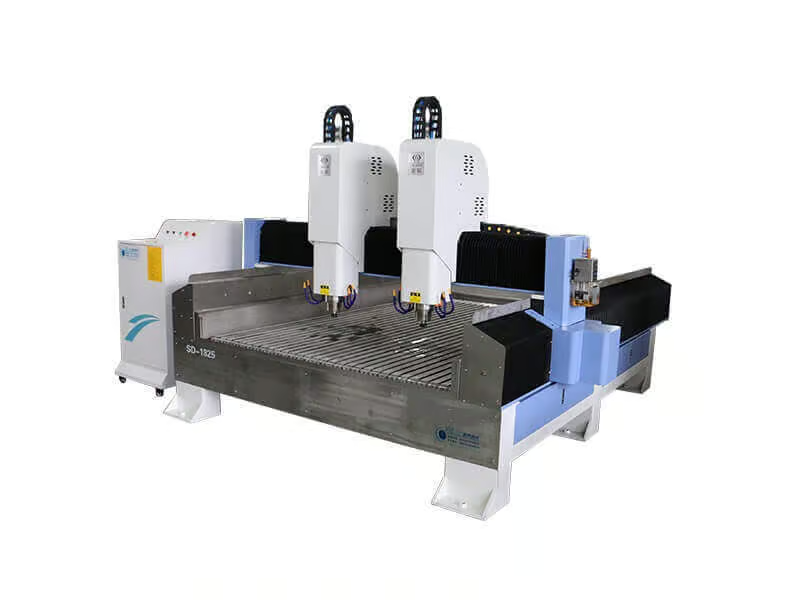 Stone Engraving Machines
 Thin Stone Veneer Saw Machine
 Horizontal Stone Slab Splitting Machine
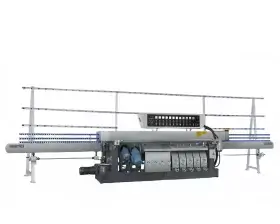 Stone Edge Polishing Profiling Machine
 Stone Auxiliary Equipment
In the modern commercial fabrication industry, kitchen backsplashes and bathroom baseboards represent massive volume. A standard commercial housing contract often requires thousands of linear meters of these narrow (typically 6cm to 10cm wide) stone strips. However, processing them introduces a severe mechanical nightmare: The Physics of Tipping. When a narrow stone strip is fed flat into a traditional horizontal edge polisher, the immense downward torque of the spinning polishing head easily overpowers the stone’s center of gravity. The strip flips over, jamming the conveyor, shattering expensive diamond abrasives, and destroying the stone itself.
A major countertop supplier in Toronto, Canada, faced this exact crisis. Contracted to deliver 400 apartment kitchens per week, their facility needed to polish nearly 2,000 meters of 10cm wide quartz backsplashes weekly. They attempted to run these through their massive horizontal flatbed line, resulting in a disastrous 15% breakage rate and constant machine downtime. Desperate, they resorted to hiring five manual laborers just to grind backsplashes by hand, entirely consuming their profit margin. Their operational rescue came when they integrated a MosCut Vertical Continuous Edge Polisher. By utilizing its unique lateral V-groove clamping system, the machine held the narrow strips securely on their sides. The breakage rate plummeted to absolute 0%. Today, they run their vertical line for just two hours a day to complete what previously took five men a full shift, transforming a logistical headache into their most reliable cash cow.
🚨 The Horizontal Flaw: Why Narrow Strips Fail
There is a dangerous misconception that a massive horizontal flatbed machine can process any stone format. Gravity and downward pressure are working against you on a flatbed conveyor. A horizontal belt relies on the broad, flat bottom surface area of a large countertop to generate enough friction to resist the aggressive lateral and downward force of the polishing spindles. Once you reduce that width to 10cm or 6cm, the leverage is lost. As soon as the first metal calibration wheel makes contact, the narrow strip acts like a domino. It tips sideways, gets dragged under the pressure plates, and causes a violent machine jam.
The V-Groove Solution: Side-Clamping Physics
Sandwich the stone, isolate the vibration, and unleash maximum spindle pressure.The MosCut Vertical Continuous Line completely bypasses the tipping problem by changing the angle of attack. Instead of laying the stone flat, the machine requires the operator to stand the stone up (at an 85-degree angle).
The stone is fed into a V-groove channel created by two heavy-duty, synchronized vulcanized rubber belts. These belts apply massive pneumatic clamping force directly to the broad front and back faces of the stone, rather than relying on the narrow bottom edge. Whether your backsplash is 6cm wide or 60cm wide, it is locked into a rigid “rubber wall.” When the polishing heads press against the top edge, the lateral resistance is entirely absorbed by the conveyor belts, rendering tipping physically impossible.

Continuous Feed Speed: Meters Per Minute
Comparing throughput methods for narrow stone strips.✋ Manual Grinding
Yield: 5 – 8 meters / hour. Highly labor-intensive and prone to human error. Workers struggle to maintain an even chamfer, resulting in wavy edges and inconsistent gloss levels that fail quality control.
🤖 CNC / Single-Head
Yield: Intermittent / Slow Setup. While highly precise, securing hundreds of small strips with vacuum pods takes longer than the actual polishing. Using a CNC for standard flat backsplashes is a severe misallocation of expensive resources.
🏭 Vertical Continuous Line
Yield: Up to 300 meters / hour. The ultimate volume solution. As soon as one 2.4m strip enters the tunnel, the operator feeds the next. Operating at speeds of 3-5m/min, it acts as a literal printing press for finished edge profiles.
Eliminating Breakage: The “Zero Tension” Approach
Fragile materials demand rigid, unwavering support through the entire cutting zone.Narrow stone strips—especially those cut from natural marble or heavily veined granite—are exceptionally fragile. When carried horizontally or pushed across uneven rollers, they can easily snap in half under their own weight.
The vertical architecture solves this by providing continuous, full-surface backing. From the moment the strip enters the machine until it exits fully polished, its entire face is supported by the thick rubber conveyor. Because the stone is standing vertically, it does not bow or flex in the middle. The pneumatic polishing heads apply even, floating pressure, keeping the stone in a state of Zero Tension. This eliminates the micro-fractures and snapping associated with high-speed horizontal processing.

Dominate the High-Volume Backsplash Market
Stop destroying your profit margins on high-volume backsplash and baseboard orders. Eliminate manual labor, eradicate breakage, and scale your daily output with the unmatched gripping power of the MosCut Vertical Edge Polisher.
Explore Vertical Polisher Specs