
 Stone Cutting Machines
 Stone Polishing Machines
 Bridge Saw Machines
 Stone Quarry Cutting Machines
 Stone Block Cutter Machine
 CNC Stone Wire Saw Machine
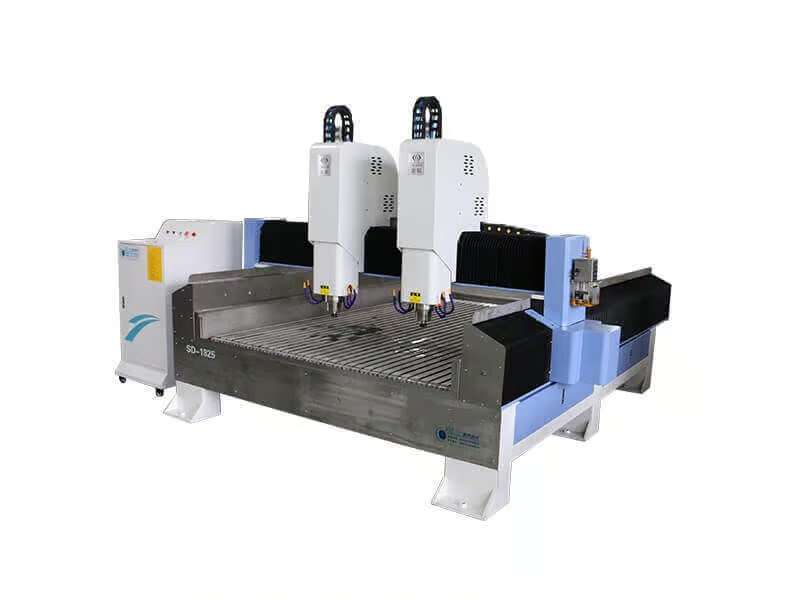 Stone Engraving Machines
 Thin Stone Veneer Saw Machine
 Horizontal Stone Slab Splitting Machine
 Stone Edge Polishing Profiling Machine
 Stone Auxiliary Equipment
In heavy dimensional stone extraction, separating a perfectly cut block from the mountain face is the most hazardous phase of the operation. According to stringent guidelines published by the Mine Safety and Health Administration (MSHA) regarding pneumatic lifting bags and compressed gas hazards, operators must respect the lethal potential of stored pneumatic energy. An over-pressurized or structurally compromised air pushing bag acts as an unexploded pressure vessel. When a sudden ‘blowout’ occurs inside a narrow rock kerf, the ensuing concussive shockwave and flying debris present a severe, life-threatening risk to quarry personnel.
A premier white marble quarry in Turkey learned this the hard way. For years, they utilized heavy excavators to physically pry cut blocks loose. This brutal mechanical force caused micro-cracking in the bottom layer of 15% of their premium blocks, resulting in massive financial losses. Attempting to solve this, they purchased cheap, single-layer rubber pushing bags. During the tipping of a 600-ton block, a sharp rock inclusion caused a catastrophic bag blowout, narrowly missing their ground crew. MosCut engineers intervened, outfitting their operation with our Kevlar-reinforced, multi-layer vulcanized pushing bags. We implemented a strict ‘Pressure-to-Area’ calculation SOP and mandated the use of steel protective shims. Today, the quarry boasts a 0% bottom-crack rate and has maintained a flawless, multi-year zero-injury safety record during block separation.
The Physics of Tipping: Leverage is Everything
You are not lifting the entire mountain. You are creating a wedge to shift the center of gravity.A common misconception among novice quarry workers is that the air pushing bag must generate enough force to physically ‘lift’ a 1,000-ton block. This is physically impossible and highly dangerous to attempt. The true function of an air pushing bag is to act as a pneumatic lever.
Your goal is simply to tilt the block far enough that its Center of Gravity (CG) crosses over its bottom pivoting edge. Once the CG crosses that critical tipping point, gravity takes over and pulls the massive block down onto the cushion bed. Therefore, placement is everything. Inserting the bags higher up in the vertical kerf drastically increases the ‘tipping moment’ (leverage). A bag placed near the top requires exponentially less internal air pressure to tip the block than a bag placed at the bottom, making the entire operation vastly safer.

The Golden Formula: Force = Pressure x Area
A large bag at low pressure is infinitely safer and more powerful than a small bag at high pressure.The single greatest cause of bag blowouts is operators ignoring fundamental pneumatic physics. When a block refuses to tip, the instinct is to crank up the air compressor pressure (PSI/Bar). This forces the bag beyond its rated burst limit.
The golden formula governing pneumatic displacement is absolute:
Where $F$ is the total Tipping Force, $P$ is the internal Pressure, and $A$ is the Contact Area between the bag and the stone. For example, a standard $1text{m} times 1text{m}$ MosCut bag has a surface area of $1text{ m}^2$. If you inflate it to just 2 Bar (approximately $20,000text{ kg/m}^2$), it generates an astonishing 20 tons of pushing force! If the block won’t move, do not increase the pressure. Increase the Area. Slide a second or third bag into the kerf side-by-side. Doubling the surface area doubles your tipping force safely at the exact same low pressure.

Kerf Preparation: Eliminating the Guillotine
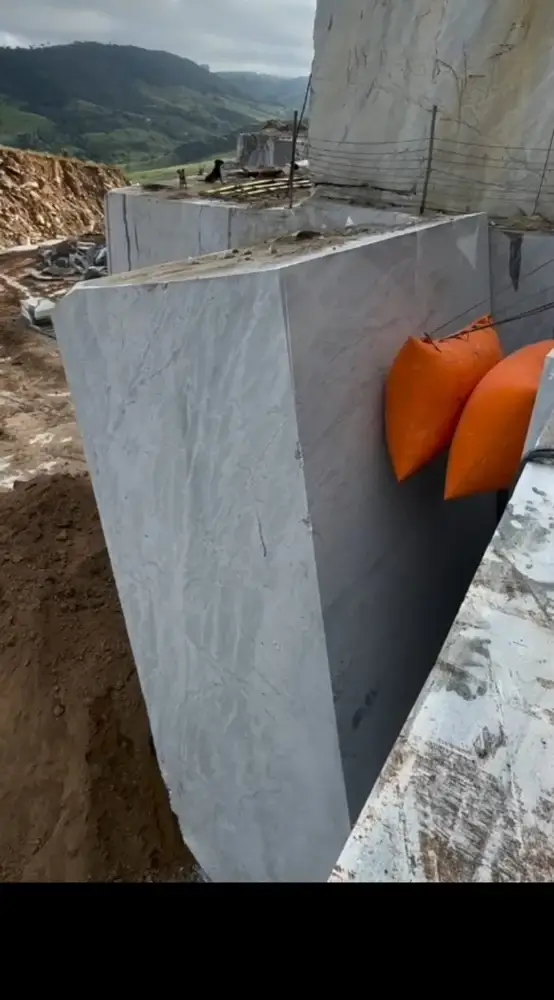
Inserting a Kevlar bag into a jagged kerf filled with razor-sharp quartz is a recipe for a blowout.Even the strongest vulcanized, Kevlar-reinforced multi-layer bag can be destroyed by piercing point-loads. After a diamond wire or chain saw completes a cut, the resulting gap (the kerf) is often littered with sharp, fractured rock chips or ‘blind wedges’ that were not fully cleanly severed.
Before any bag is inserted, the kerf must be vigorously flushed with a high-pressure water hose to remove all loose abrasive debris. Furthermore, if the quarry rock is inherently jagged or heavily fractured (such as certain granites or tuffs), operators must use Steel Shims. By placing thin, smooth steel plates on either side of the uninflated pushing bag, you create an impenetrable armor jacket. As the bag expands with tremendous force, it presses against the smooth steel, completely neutralizing the risk of a sharp rock puncturing the pressurized bladder.
The Safe Inflation SOP: Step-by-Step
Never stand behind the block. Controlled, incremental inflation is the only way to manage stored pneumatic energy.The act of inflation must be treated with the same discipline as setting explosives. The operator must position themselves laterally, well away from the ‘crush zone’ directly in front of or behind the tipping block, utilizing a long airline with a remote pressure regulator.
The Incremental Inflation Method:
1. Inject a burst of air up to 0.5 Bar just to inflate the bag until it firmly contacts both walls of the kerf.
2. Stop and inspect (visually from a safe angle) to ensure the bag is not folded, pinched, or twisted.
3. Slowly increase pressure to 1.5 Bar and listen closely. You should hear the bottom of the block ‘release’ or crack slightly from the bedrock.
4. Continue inflating in slow, 0.5 Bar increments, pausing to observe the block’s movement. Do not rush. Once the block visibly starts to tilt, hold the pressure steady and let gravity take over.
Deflation and Recovery: Saving Your Investment
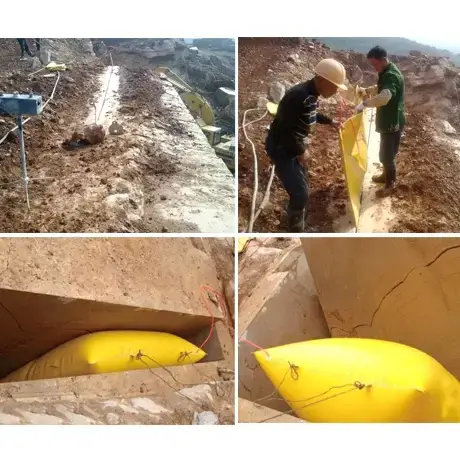
A successful tip can quickly turn into a destroyed bag if it gets dragged under the falling block.The danger to the pushing bag does not end once the block begins to fall. In fact, the moment of separation is when bags are most frequently destroyed due to operator hesitation.
As the massive block crosses its center of gravity and begins its irreversible, accelerating descent toward the cushion bed, the bottom of the block will often kick backward or slide violently. If the air pushing bag is still fully pressurized inside the kerf, this sliding bedrock will instantly crush the bag, bursting the seams or tearing the brass valves right off the hose. Operators must keep their hands on the quick-exhaust dump valve. The exact second the block is clearly falling on its own, the operator must dump the air pressure completely. A deflated bag will harmlessly fall flat, safely avoiding the crushing forces of the shifting bedrock.

Safety Starts with Superior Equipment
Protect your workers and eliminate bottom-cracking on your premium blocks. Upgrade to MosCut Kevlar-reinforced Air Pushing Bags for massive, controlled separation power.
View MosCut Pushing Bags