
 Stone Cutting Machines
 Stone Polishing Machines
 Bridge Saw Machines
 CNC Stone Wire Saw Machine
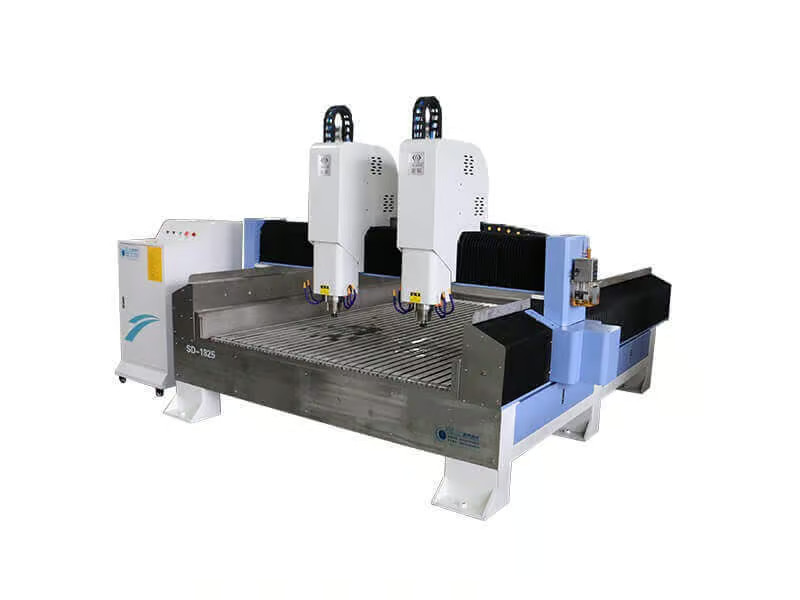 Stone Engraving Machines
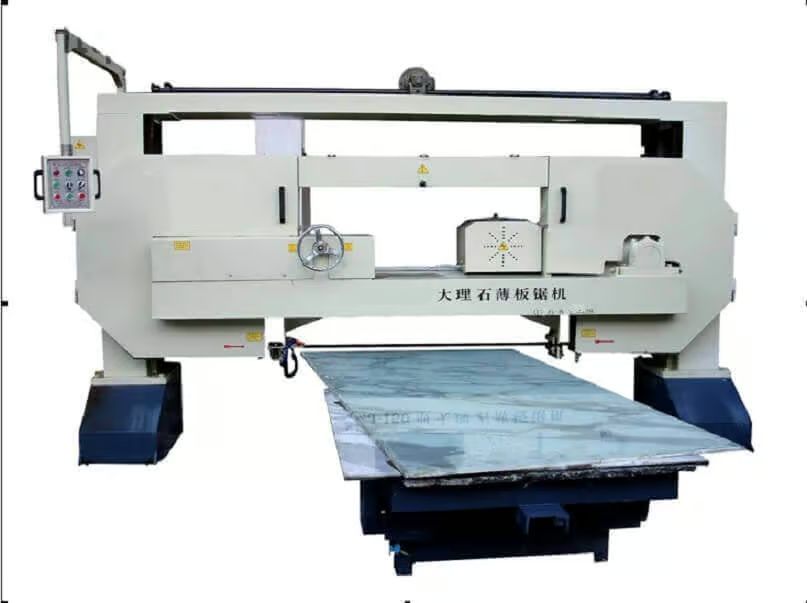
 Stone Veneer Saw
 Stone Quarry Machines
 Stone Band Saw Machines
 Stone Edging Beveling Machine
 Other Stone Machines
 Stone Diamond Tools
 Stone Slab Cutting
 Stone Slab Surface Edge Polishing
 Stone Block Slicing
 Stone Quarry Mining
 Stone Horizontal Splitting
 Stone Engraving Applications
 CNC Stone Cutting
 Countertop Cutting Polishing
 Other Applications
In the modern luxury kitchen market, the standard flat-polished edge is no longer enough. High-end clients and interior designers demand stunning “waterfall islands” where the veining of the stone cascades seamlessly down the sides, and ultra-thick drop aprons made from 2cm slabs. To achieve these breathtaking illusions, your fabrication shop must master one essential technique: the flawless 45-degree miter cut.
However, cutting a perfect 45-degree angle on extremely dense materials like quartz, granite, or sintered stone is notoriously difficult. If the joint is wavy, chipped, or leaves a visible “black line” gap, the illusion is ruined, and the material is wasted. In this technical guide, we will reveal the secrets to achieving completely seamless miter joints right off the bridge saw, eliminating hours of costly manual grinding.

Why Miter Cuts Are the Ultimate Test of a Bridge Saw
Executing a 90-degree straight cut is relatively easy because the cutting force goes directly downward into the table. But when you tilt the spindle head 45 degrees, the physics change dramatically. Gravity and heavy cutting resistance now exert massive lateral (sideways) forces on the machine’s frame and the saw blade.

The Problem of Blade Deflection
If your bridge saw is built with a lightweight steel frame or has worn-out linear guides, the lateral pressure of a 45-degree cut will push the cutting head slightly off course. More importantly, it causes “blade deflection”—the steel core of the diamond blade actually bends while spinning. This results in a wavy, uneven cut edge that will never sit flush against its mating piece.

The Cost of Manual Grinding
When a cheap machine produces an inaccurate miter, the burden falls on your workers. A skilled fabricator must spend hours with an angle grinder trying to manually flatten the wavy edge or fix the chips before gluing. This destroys your production efficiency and creates an inconsistent, low-quality finish that luxury clients will reject.
Secret #1: Absolute Machine Rigidity and Axis Calibration
A perfect miter cut cannot be achieved with “good enough” equipment. It requires a machine with a skeleton of steel and an incredibly precise electronic brain to ensure the cutting angle is exactly 45.0 degrees, not 44.5 or 45.5.

Heavy-Duty Monoblock or Gantry Frame
The foundation of a good miter cut is sheer weight. Massive cast-iron crossbeams and heavy-duty steel monoblock structures are essential because they absorb vibrations and completely resist the lateral forces generated by the tilted blade. A rigid frame ensures the cutting head travels in a microscopically straight line, from the first inch to the last.

CNC Angle Calibration
On manual machines, operators tilt the head using a hand crank and a visual gauge, which is prone to human error. Advanced CNC bridge saws utilize absolute servo motors on the A-axis (the tilt axis). The computer digitally locks the spindle at a mathematically perfect 45-degree angle. Furthermore, CNC calibration accounts for the exact thickness of your diamond blade to ensure the sharp point of the miter is flawless.
Secret #2: Selecting the Right Diamond Blade
The biggest mistake novice fabricators make is attempting to cut a 45-degree miter using their standard 90-degree straight-cutting blade. Miter cuts require highly specialized tooling designed specifically for smooth, lateral slicing.

Continuous Rim vs. Segmented Blades
Standard segmented blades have large gaps between the diamond teeth, which strike the edge of the stone aggressively, causing severe chipping on the fragile, thin point of a mitered edge. To achieve a perfectly smooth, chip-free finish, you must use a continuous rim blade or a tightly-spaced “turbo” segment blade formulated specifically for mitering.

Core Thickness and Flanges
To combat blade deflection (bending), a professional miter blade features a thicker, reinforced steel core. Additionally, it is critical to use a larger stabilizing flange (the metal disc that clamps the blade to the spindle). A larger flange provides more surface area support to the back of the blade, forcing it to remain perfectly rigid while cutting at a 45-degree angle.
Secret #3: Mastering Feed Rates and Plunge Techniques
Even with a rigid machine and a premium blade, the operator’s cutting parameters will dictate the final quality of the joint. You must program the CNC software to respect the material.

Slowing Down the Feed Rate
When cutting at 45 degrees, the blade must travel through significantly more material than when cutting straight down (due to the diagonal path). If you maintain your normal feed rate, the blade will overheat and chip the stone. You must program the CNC to reduce the forward feed rate by 30% to 50%, allowing the diamonds to grind the stone smoothly without excessive pressure.

Step Cutting for Ultra-Hard Materials
When mitering ultra-dense, tension-heavy materials like Sintered Stone (Dekton, Neolith) or Quartzite, a single aggressive pass will often shatter the slab. Advanced CNC software utilizes a “Step Cutting” algorithm. The blade makes a shallow 45-degree pass to score the surface, followed by progressively deeper passes, safely releasing internal stress and delivering a mirror-smooth finish.
Secret #4: The Advantage of 5-Axis CNC Automation
Manual tilting heads are obsolete for high-volume custom fabrication. To achieve consistent, profitable results, the modern factory relies on the fully automated capabilities of a 5-axis machining center.

Automated Tilting and Interpolation
On a 5-axis machine, the A-axis (tilt) and C-axis (rotation) are fully motorized and synchronized. The machine can cut a straight edge, automatically lift, rotate 90 degrees, tilt 45 degrees, and immediately begin cutting a mitered drop apron—all without the operator ever touching the machine or manually turning the heavy stone slab.

Perfect Inside Corners
Fabricating an “L-shaped” countertop with a seamless waterfall edge requires cutting complex 45-degree inside corners. A manual saw blade is circular and will overcut the intersection, ruining the joint. A 5-axis CNC system calculates the exact blade radius compensation, stopping the cut perfectly at the corner, allowing a router bit to finish the inner apex flawlessly.
Elevate Your Fabrication Quality
Achieving perfect, seamless 45-degree miter joints right off the saw is a combination of heavy-duty machine rigidity, intelligent CNC calibration, premium tooling, and proper cutting parameters. When you eliminate the need for manual edge grinding, you instantly boost your factory’s production speed and drastically elevate the premium quality of your finished countertops.
Stop Wasting Time on Manual Grinding
Ready to produce flawless waterfall islands automatically? Upgrade your shop with MOSCUT’s high-precision 4-Axis and 5-Axis CNC Bridge Saws, engineered for absolute miter accuracy.
Explore Precision CNC Bridge SawsTop 10 FAQ: 45-Degree Miter Cuts
Still struggling with your miter joints? Review these common troubleshooting questions to perfect your cutting technique.
Machine & Tooling Setup
1. Can a 4-Axis bridge saw make 45-degree miter cuts?
It depends on the specific model. A true 4-axis machine usually has X, Y, Z, and C (360-degree rotation). To do miters automatically, it must also have an A-axis (tilting head). If it only has a manual tilt lock, you can do miters, but it will be a slower, semi-automatic process.
2. Do I need to increase water cooling for a miter cut?
Absolutely. Because the blade is slicing through the stone diagonally, there is significantly more surface area contact and friction. Open your water valves to maximum flow to prevent the blade and the stone’s resin from burning.
3. Why do I need a larger flange for miter cuts?
A standard small flange allows the steel core of the blade to flex slightly under the lateral pressure of a 45-degree cut. Installing a larger, heavy-duty flange provides a wider backing, stiffening the blade to ensure a perfectly straight cut line.
4. What is the ideal blade diameter for miter cuts?
While 400mm (16″) is common for straight cuts, using a slightly smaller, thicker blade (like 350mm / 14″) with a large flange is often better for mitering, as a smaller diameter blade is inherently stiffer and less prone to deflection.
5. How close to the edge should a miter cut be made?
To ensure a clean edge without the material breaking off prematurely during the cut, CNC operators generally leave at least 2mm to 3mm of “meat” (uncut material) at the bottom point of the miter, which is then lightly sanded or filled with epoxy during assembly.
Troubleshooting Bad Joints
6. Why is my miter joint tight on the outside but leaves a gap on the inside?
This is the classic sign of “blade deflection” or an inaccurate machine angle. The blade is bending away from the stone as it cuts deeper. Ensure you are using a thick-core blade with a large flange, slow down the feed rate, and recalibrate your machine to exactly 45.0 degrees.
7. Why does my mitered edge look jagged and chipped?
Severe chipping means you are either using a segmented granite blade instead of a continuous-rim miter blade, your feed rate is far too fast, or your blade has become dull and lost its diamonds.
8. Why do the edges of my quartz turn yellow or brown during a miter cut?
Yellowing or browning is caused by extreme friction heat melting and burning the industrial resin inside the quartz. You must significantly slow down the RPM and feed rate, and immediately check that the water cooling jets are directly hitting the cut path.
9. The cut starts perfect but gets wavy towards the end of the slab. Why?
If the cut diverges near the end, your slab might be shifting on the table, or your machine’s linear guides are worn and losing stability over long distances. Ensure the slab is clamped securely and the Y-axis rails are heavily lubricated.
10. How do I fix a miter cut that is slightly wavy?
If the cut is already wavy, it cannot be glued directly without leaving a gap. Your fabricator must use a specialized set of diamond polishing pads on an angle grinder, along with a straight edge guide, to manually grind the wave flat before applying the epoxy adhesive.