
 Stone Cutting Machines
 Stone Polishing Machines
 Bridge Saw Machines
 Stone Quarry Cutting Machines
 Stone Block Cutter Machine
 CNC Stone Wire Saw Machine
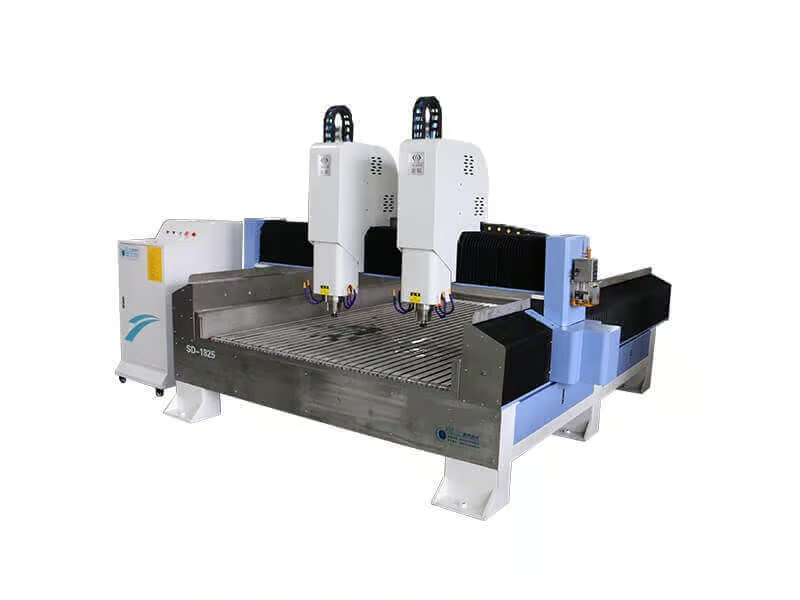 Stone Engraving Machines
 Thin Stone Veneer Saw Machine
 Horizontal Stone Slab Splitting Machine
 Stone Edge Polishing Profiling Machine
 Stone Auxiliary Equipment
In the heavy industrial world of dimension stone quarrying, the lowest initial price is often the most expensive mistake. According to the strategic financial guidelines within ISO 55000 (Asset Management), the true value of an industrial asset is determined by its Life Cycle Cost (LCC) rather than its initial acquisition price (CapEx). In granite extraction, reducing daily operating expenses (OpEx) through superior machine torque and efficiency is the most direct route to sustainable profitability.
A high-volume granite quarry in Rustenburg, South Africa, specialized in ultra-hard ‘Nero’ granite, provides a clear financial lesson. They initially purchased three 45kW wire saws to save on CapEx. However, the machines struggled with the rock’s density, leading to slow cutting speeds and frequent wire snaps. After switching to a MosCut 75kW heavy-duty machine, they reduced cutting time by 30% and extended wire life by 20%. The 75kW unit paid for its own price difference within just 8 months through consumable savings alone, while simultaneously doubling the site’s monthly net revenue.
CapEx vs. OpEx: The Real Cost of Quarrying
Buying a machine is a one-time financial event, but running it is a daily reality. Understanding the balance between CapEx and OpEx is crucial for quarry profitability.It is a common pitfall to focus solely on the machine’s purchase price. However, in a 24/7 quarry operation, the Operational Expenditure (OpEx)—comprised of electricity, diesel, labor, and diamond wire consumables—will surpass the machine’s initial cost within the first year.
A 75kW machine requires a higher initial investment than a 55kW model, but it is built with heavier chassis steel, larger bearings, and a high-torque motor. This structural superiority allows it to maintain a steady speed under load, preventing the overheating and mechanical fatigue that kill cheaper, lower-powered machines. Over a 5-year lifespan, the 75kW machine consistently delivers a lower Total Cost of Ownership (TCO).

Decoding the Cost Per Square Meter
In the dimensional stone extraction industry, your ultimate metric of financial success is the cost required to extract one square meter of granite.The most expensive part of your operation is the Diamond Wire. To calculate your ROI, you must look at the ‘Cost Per Square Meter’ ($/m²). Cheap or underpowered machines cause the wire to vibrate and jump when it hits hard quartz pockets. This vibration shatters the diamond beads and causes ‘Oval Wear’.
The MosCut 75kW heavy-duty model provides massive pulling force that keeps the wire in a state of ‘Stable Tension’. By eliminating vibration, the 75kW system allows a single meter of wire to cut 15-20% more stone than a 55kW machine. In a large quarry, this efficiency saves tens of thousands of dollars in annual consumable costs.

The Yield Premium: Export-Grade Squaring
Extraction speed means nothing if the blocks are rejected at the processing factory. Precision power guarantees premium export pricing.There is a massive price difference between an irregular block sold domestically and a perfectly squared ‘Class-1’ block sold for export. Underpowered machines often suffer from Wire Deflection—where the wire curves inside a deep cut due to lack of traction. This produces ‘Belly’ blocks that are difficult and wasteful to process.
The 75kW heavy-duty machine has the power to pull the wire straight through the hardest rock without bowing. Producing a perfectly flat face ensures maximum recovery at the gang saw. The price premium you receive for perfectly squared export blocks can often cover the machine’s monthly lease payment in just a few weeks of production.

Labor, Energy, and Downtime Economics
An idle machine burns cash. A heavy-duty 75kW saw maximizes the daily output of your labor force and expensive diesel generators.Labor Productivity: A 75kW machine typically cuts 30% faster than a 55kW unit in hard granite. Since you pay the same operator wages regardless of speed, the 75kW machine lowers your ‘Labor Cost Per Block’.
Energy Efficiency: While the 75kW motor has a higher peak draw, its faster cutting speed means the large site diesel generator runs for fewer hours to complete the same cut. This reduces the total liters of fuel consumed per block. Furthermore, the 75kW model operates well within its ‘Comfort Zone’, whereas a 55kW machine is often pushed to its limit, leading to overheating, VFD faults, and expensive unplanned downtime.

Stop Bleeding Profit to Inefficiency
Invest in the heavy-duty power of the MosCut 75kW Quarry Wire Saw Machine. Lower your consumable costs and maximize your export block yield today.
View the 75kW Heavy-Duty Model