
 Stone Cutting Machines
 Stone Polishing Machines
 Bridge Saw Machines
 Stone Quarry Cutting Machines
 Stone Block Cutter Machine
 CNC Stone Wire Saw Machine
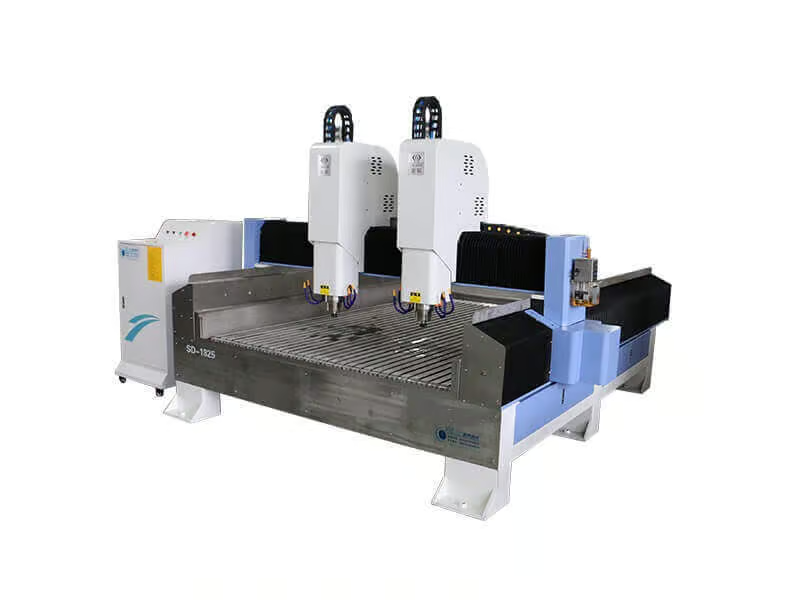 Stone Engraving Machines
 Thin Stone Veneer Saw Machine
 Horizontal Stone Slab Splitting Machine
 Stone Edge Polishing Profiling Machine
 Stone Auxiliary Equipment
In the modern mining landscape, the transition from industrial explosives to mechanical extraction is no longer a matter of preference—it is a matter of long-term survival. According to the strict directives established by the European Agency for Safety and Health at Work (EU-OSHA), eliminating explosive hazards, controlling seismic vibrations, and reducing silica dust emissions are critical protocols for modern industrial compliance. For the dimensional stone industry, zero-blasting technology is the only viable path to securing mining permits in the 21st century.
A leading granite quarry operator in Galicia, Spain, provides a compelling case study. Faced with expanding residential developments near their site, they were threatened with a permanent shutdown due to noise and ground vibration complaints. By transitioning to a fully mechanical zero-blasting model using MosCut 75kW Wire Saw Machines, they not only achieved full environmental compliance but also eliminated the ‘Micro-fractures’ caused by blasting. This resulted in a 35% increase in export-grade block yield and a significantly higher net profit margin per cubic meter extracted.
Comparison Table: Blasting vs. Zero-Blasting Wire Sawing
A side-by-side technical evaluation is essential for understanding the long-term economic and legal infrastructure of your quarrying business.| Feature | Explosive Blasting | Zero-Blasting Wire Saw |
|---|---|---|
| Block Yield (Net) | 40% – 50% (High Waste) | 85% – 95% (Maximum Recovery) |
| Internal Fractures | Severe Micro-Fracturing | Zero Structural Impact |
| Vibration & Noise | Extreme / Destructive | Minimal / Silent Operation |
| Safety Buffer Zone | 3 – 5 km Evacuation | 50m Safe Remote Range |
| Permit Difficulty | Extremely High (Explosives Lic.) | Standard Machinery Permits |
The Hidden Costs of Industrial Explosives
While explosives may seem fast and inexpensive upfront, the massive volume of generated rubble and waste rock tells a different financial story.The perceived ‘low cost’ of dynamite is a dangerous illusion. When a blast is triggered, it doesn’t just separate a block; it pulverizes everything in the immediate vicinity. In a granite or marble quarry, this results in tons of high-value stone being turned into low-value gravel and rubble instantly.
Cleaning this debris requires thousands of extra excavator hours and massive fuel consumption. Furthermore, you are losing nearly 40% of your mountain’s resource to the waste pile. Zero-blasting wire saws, however, produce thin, 11mm cuts, ensuring that almost every cubic meter of stone on your mountain is converted into a high-value, salable block.

Preserving Integrity: The Micro-Fracture Problem
Shockwaves from blasting compromise the stone’s structural integrity long before the blocks reach the processing gang saw.Perhaps the most lethal hidden cost of explosives is the Micro-fracture. These are invisible internal cracks caused by the seismic shockwaves of the blast. A block may look perfectly intact on the quarry floor, but once it reaches the factory and is sliced by a gang saw, it shatters into useless pieces.
This ‘delayed loss’ ruins factory efficiency and kills profitability. Diamond wire saws use pure physical abrasion with Zero Shockwaves. Because there is no impact energy, the stone’s natural crystal structure remains perfectly preserved, ensuring a 100% processing success rate at the factory.

Environmental Compliance & Community Relations
As urban areas expand near quarry sites, the ability to operate silently and cleanly is no longer a luxury—it is a legal necessity.Modern quarries are increasingly under the microscope of local governments and environmental agencies. Blasting creates three major liabilities: massive seismic vibrations that can damage nearby structures, deafening noise pollution, and toxic silica dust clouds that travel for miles.
Mechanical wire sawing produces only the sound of an electric motor and flowing water. There is no seismic signature and virtually zero airborne dust (thanks to constant water cooling). This allows quarries to operate within close proximity to residential areas without the risk of community backlash or government-ordered shutdowns.

Continuous vs. Disrupted Production Cycles
Mechanical extraction allows for a smooth, continuous workflow, eliminating the dangerous and disruptive ‘evacuate-and-clear’ cycles.The ‘Blast-and-Clear’ cycle is inherently inefficient. Every time a blast is scheduled, the entire quarry must stop. Personnel must evacuate, heavy machinery must be moved several kilometers away, and hours must be spent waiting for dust and toxic gases to dissipate.
Zero-blasting allows for Continuous Production. While the MosCut wire saw is cutting one block, excavators and staff can safely work just 50 meters away. There is no downtime, no evacuation, and no lost man-hours. This steady workflow drastically increases the total square meters of stone extracted per month.

Ready for the Zero-Blasting Transition?
Stop wasting your mountain’s resources on explosives. Upgrade to the MosCut 75kW Quarry Wire Saw and maximize your yield, safety, and legal compliance today.
View Our Zero-Blasting Machinery