
 Stone Cutting Machines
 Stone Polishing Machines
 Bridge Saw Machines
 Stone Quarry Cutting Machines
 Stone Block Cutter Machine
 CNC Stone Wire Saw Machine
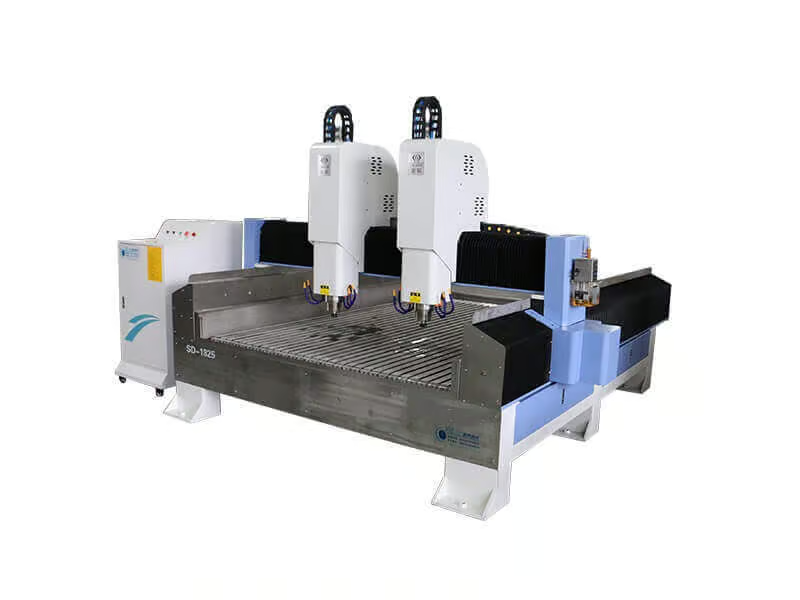 Stone Engraving Machines
 Thin Stone Veneer Saw Machine
 Horizontal Stone Slab Splitting Machine
 Stone Edge Polishing Profiling Machine
 Stone Auxiliary Equipment
Purchasing a massive, multi-head automatic stone polishing line is a significant Capital Expenditure (CAPEX). It is natural for factory owners to hesitate. However, according to the MOSCUT Q1 2026 Global Stone Equipment Investment Report, facilities with a monthly output exceeding 3,000 square meters that upgraded to an automatic line saw an average payback period of just 2 years.
Consider a mid-sized fabrication plant in Valencia, Spain, that was facing a severe labor shortage last year. They were employing six workers to operate multiple single-head bridge polishers. Not only was the production agonizingly slow, but the skyrocketing manual labor costs were eating 40% of their gross margins. After consulting with financial advisors, they utilized equipment financing to install a MOSCUT 16-head Automatic Polishing Line. The transformation was absolute: the labor requirement dropped from six men to just one operator. Daily output exploded from 80 square meters to 600 square meters. Most importantly, the flawless, mirror-like gloss allowed them to sell their slabs at an $8 premium per square meter. Within exactly 12 months, the machine had paid for itself entirely. Sticking to inefficient manual equipment is, in reality, the most expensive business decision you can make.
The Hidden Trap of Operational Expenses (OPEX)
Semi-automatic or manual polishing machines act like a slow leak in your factory’s bank account.

The Labor Black Hole
Single-head or manual polishers are heavily reliant on human stamina and experience. You are paying high hourly wages, overtime, and bearing the cost of employee turnover and potential workplace injuries. When your profit relies on a worker pushing a heavy machine over wet stone for eight hours a day, scaling your business becomes mathematically impossible.

The “B-Grade” Slab Penalty
Manual polishing results in inconsistent pressure, leaving water ripples and dull patches on the slab’s surface. In the competitive wholesale market, these imperfect slabs must be downgraded to “B-Grade” status and sold at a 20% to 30% discount. This is pure profit literally washed down the drain simply because your machine lacks automated pressure control.
Breaking Down the ROI Equation
Let’s look at exactly where the money comes from when you make the upgrade to automation.

Variable 1: Exponential Output vs. Fixed Overhead
A heavy-duty automatic line easily processes 500 to 800 square meters per day. When you multiply your daily output by 10, your fixed overhead costs—like warehouse rent, management salaries, and insurance—are suddenly amortized over a massive volume of slabs. Your cost-per-square-meter drops off a cliff.

Variable 2: Premium Pricing for A-Grade Gloss
Equipped with intelligent PLC pneumatic pressure systems, an automatic line consistently outputs a 95+ GU (Gloss Unit) mirror finish. Architects and luxury commercial buyers gladly pay a premium for this flawless, high-end reflection. Even a modest $3 to $5 premium per square meter adds hundreds of thousands of dollars to your bottom line annually.

Variable 3: Maximized Abrasive Lifespan
Human error and uneven manual pushing cause diamond abrasives to chip and wear prematurely. The robotic precision, constant water flow, and shock-absorbing cast-iron bridge of an automated line ensure that every abrasive block is utilized to its absolute maximum lifespan, saving your purchasing department a fortune every month.
The Financial Tipping Point: When Must You Upgrade?
How do you know it is time? Look at your factory floor. If your front-end machinery (gang saws or multi-wire saws) is easily cutting blocks, but your back-end polishing department has slabs stacked up waiting to be finished, you have reached the tipping point. If you are processing anywhere near 2,000 to 3,000 square meters a month, the wages you are currently paying your manual polishing crew are more than enough to cover the monthly financing payment on a brand new automatic line. Delaying the upgrade simply means handing your profits over to better-equipped competitors.
Start Minting Your Margins Today
Do not let manual inefficiencies drain your working capital. An automatic polishing line is not an expense; it is the most reliable profit engine in the stone industry.
Ready to calculate your factory’s exact payback period?
Connect with our engineering team to map out your production volume and explore how quickly an automated solution will pay for itself.
Explore Automatic Stone Polishing LinesTop 10 FAQ: Investing in an Automatic Polishing Line
1. Is equipment financing or leasing available for automatic polishing lines?
Yes. Because heavy-duty stone polishing lines retain their resale value exceptionally well, commercial lenders and banks are highly willing to finance them, allowing you to pay for the machine using the increased cash flow it generates.
2. Will my electricity bill skyrocket with a 20-head machine?
While the total KW rating is high, the machine processes slabs infinitely faster than manual tools. When you calculate the electricity cost *per square meter of finished stone*, an automatic line is actually far more energy-efficient.
3. How much factory floor space do I need for a full line?
A standard 16-to-20-head line, including the loading tables and calibrator, typically requires a straight footprint of 15 to 25 meters in length. Our engineers will provide a precise CAD layout based on your facility.
4. How many operators are required to run an automatic line?
Typically, only one skilled operator is needed to monitor the PLC control panel and abrasive wear, along with one forklift driver or a robotic vacuum lifter to load and unload the slabs.
5. Do I need to pour a special concrete foundation?
Yes. Due to the immense weight and high-speed vibration of a multi-head machine, a reinforced, level concrete foundation is required to ensure long-term stability and perfect polishing accuracy.
6. How long does it take to install and commission the machine?
Once the foundation is prepared and the machine arrives, our technicians typically require 7 to 14 days to fully assemble the line, connect the water/air systems, and calibrate the PLC for your specific stone.
7. What happens if the machine breaks down? Will it halt my entire factory?
MOSCUT machines use standardized, globally available components (like Siemens and Schneider). Routine parts can be sourced locally in most countries, and our remote support team ensures your downtime is minimized to hours, not weeks.
8. Can an automatic line polish slabs of varying thicknesses at the same time?
No. To prevent damage to the polishing heads, batches of slabs must be calibrated to the exact same thickness before entering the line. This is why a calibrating machine is essential.
9. What is the typical lifespan of a heavy-duty MOSCUT polishing line?
With proper daily greasing, routine maintenance, and scheduled abrasive replacements, our cast-iron automatic lines are built to operate reliably for 15 to 20+ years.
10. Can I upgrade a 12-head machine to a 20-head machine later?
The main bridge and chassis are cast as a single structural unit. Therefore, you cannot simply “add” more heads to an existing machine later. It is highly recommended to buy the capacity you will need 3 years from now, rather than what you need today.