
 Stone Cutting Machines
 Stone Polishing Machines
 Bridge Saw Machines
 Stone Quarry Cutting Machines
 Stone Block Cutter Machine
 CNC Stone Wire Saw Machine
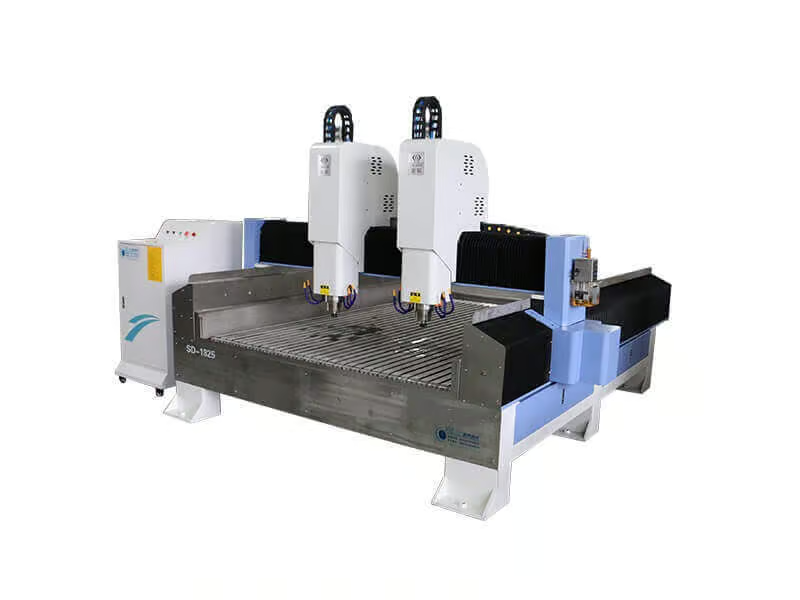 Stone Engraving Machines
 Thin Stone Veneer Saw Machine
 Horizontal Stone Slab Splitting Machine
 Stone Edge Polishing Profiling Machine
 Stone Auxiliary Equipment
In the stone industry, a “one-size-fits-all” approach to polishing is a guaranteed recipe for financial waste. According to the MOSCUT Q2 2026 Global Process Report, polishing granite consumes 35% more electricity and requires 50% more frequent abrasive changes compared to marble on the same automatic line. Understanding the mechanical and chemical differences between these stones is the first step toward optimizing your factory’s ROI.
Last year, we analyzed two contrasting facilities: a high-end studio in Carrara, Italy, specializing in soft, high-luster marbles, and an exporter in Recife, Brazil, processing extremely dense exotic granites. The Brazilian client initially tried using marble polishing parameters on their new granite line; the result was frequent motor overloads and severe “burning” marks on the slab surfaces. This case study reaffirms that stone polishing has no “master key.” Mastering the synergy between Fickert and Frankfurt abrasives, pressure calibration, and RPM management is essential to avoiding costly overheads.
The Abrasive Shape: Frankfurt vs. Fickert
The physical hardness of the stone dictates the mechanical engineering of the tool that grinds it.

Frankfurt Abrasives (The Gentle Touch)
Named after the German city where they were standardized, Frankfurt abrasives feature a horseshoe-shaped design. They are specifically engineered for marble, travertine, and limestone. Their oscillating movement allows for more uniform surface coverage on these softer, more porous materials, preventing localized high-pressure points that could lead to deep, irreparable scratches.

Fickert Abrasives (The Industrial Powerhouse)
For the unyielding crystal structure of granite, we utilize Fickert abrasives. These elongated, heavy-duty blocks are mounted on 6-claw or 8-claw rotary heads. This design is built to withstand massive pneumatic polishing head pressure, allowing the diamond grits to physically cut through the quartz and feldspar minerals in granite to reveal a deep, reflective luster.
Pressure Calibration: “Soft Touch” vs. “Heavy Bite”
Calibrating pressure is where the art of stone processing meets PLC technology. Marble requires a gentle “soft touch” (typically 0.1 – 0.2 MPa); excessive pressure will cause the stone to crack or create “stress ripples.” Conversely, granite requires a “heavy bite” (typically 0.3 – 0.5 MPa) to be effective. MOSCUT automatic lines utilize proportional valves to ensure pressure fluctuations stay within 2%, providing consistent gloss from the first millimeter to the last.
Cooling and RPM: Managing Friction Heat
Granite has high thermal resistance and can handle higher spindle RPMs for increased productivity. However, marble and resin-based Quartz are extremely heat-sensitive. If cooling water is insufficient or RPM is too high, the friction can cause “yellowing” or surface discoloration on white marbles. Our Inverter Control systems allow operators to precisely sync conveyor speed with spindle RPM, balancing output with uncompromising quality.
Head-to-Head: Granite vs. Marble Polishing Parameters
Use this technical baseline as a starting point for configuring your MOSCUT polishing line.
| Technical Metric | Marble (Soft Stone) | Granite (Hard Stone) |
|---|---|---|
| Abrasive Type | Frankfurt (Horseshoe) | Fickert (Elongated) |
| Primary Bond | Magnesite / Resin | Metal / Diamond / Magnesite |
| Suggested Pressure | 0.15 – 0.25 MPa | 0.35 – 0.55 MPa |
| Head RPM | 350 – 450 RPM | 450 – 550 RPM |
| Gloss Target | 90 – 100+ GU | 85 – 95 GU |
Stop Guessing Your Polishing Parameters
Precision engineering is useless if it’s applied incorrectly. Don’t let trial-and-error drain your factory’s profit and damage your machines.
Ready to optimize your polishing line?
Contact MOSCUT experts today to configure the perfect sequence of abrasives and pressure settings for your specific stone types.
Configure Your Polishing SolutionTop 10 FAQ: Stone Abrasives and Machine Tuning
1. Can I use Fickert heads to polish marble?
It is not recommended. Fickert heads are generally too aggressive and heavy for marble, which can lead to over-grinding, surface chipping, and deep scratches that the resin pads cannot remove.
2. Why does my granite have a “hazy” or “cloudy” look after polishing?
Cloudiness usually indicates that the “grit sequence” was skipped too quickly. If a deep scratch from a coarse Fickert head isn’t removed by the intermediate grit, the final resin buff will only highlight the error.
3. What is the biggest mistake when polishing Quartz?
Overheating. Quartz contains about 7-10% resin. If you use granite-level pressure or high RPM without massive water flow, the resin will scorch, leaving a permanent yellow or brown stain.
4. How do I know when an abrasive block is reached its end of life?
You will notice a drop in the GU (Gloss Unit) meter or an increase in the motor’s amperage as the machine struggles to cut. Most modern MOSCUT lines have a sensor that alerts the operator when abrasive height is too low.
5. Is wet polishing always better than dry polishing for slabs?
For industrial slab production, yes. Water is essential for cooling the diamond tools and, more importantly, for flushing away the stone slurry to prevent “clogging” the abrasives.
6. Does the color of the stone affect the polishing settings?
Darker stones (like Absolute Black Granite) show scratches and imperfections much more easily than lighter stones. They typically require a slower conveyor speed and a more gradual grit progression.
7. What is the role of the final buffing head?
The last 2-3 heads often use specialized felt or ultra-fine resin pads with polishing powder (like cerium oxide) to “close” the stone’s pores and achieve that mirror-like reflection.
8. How does water quality affect abrasive lifespan?
Recycled water with too much stone sediment acts like sandblasting on your machine. Clean, filtered water is critical for extending the life of your fine-grit resin disks.
9. Can a single machine be easily switched between marble and granite?
Yes, but it requires changing the entire set of polishing heads and updating the PLC pressure presets. Most high-volume factories prefer to have dedicated lines for each material type.
10. How much does a full set of abrasives cost for a 20-head line?
Costs vary by stone type and abrasive brand. However, the ROI of premium abrasives is seen in the significantly lower “cost per square meter” due to longer life and faster cutting speeds.