
 Stone Cutting Machines
 Stone Polishing Machines
 Bridge Saw Machines
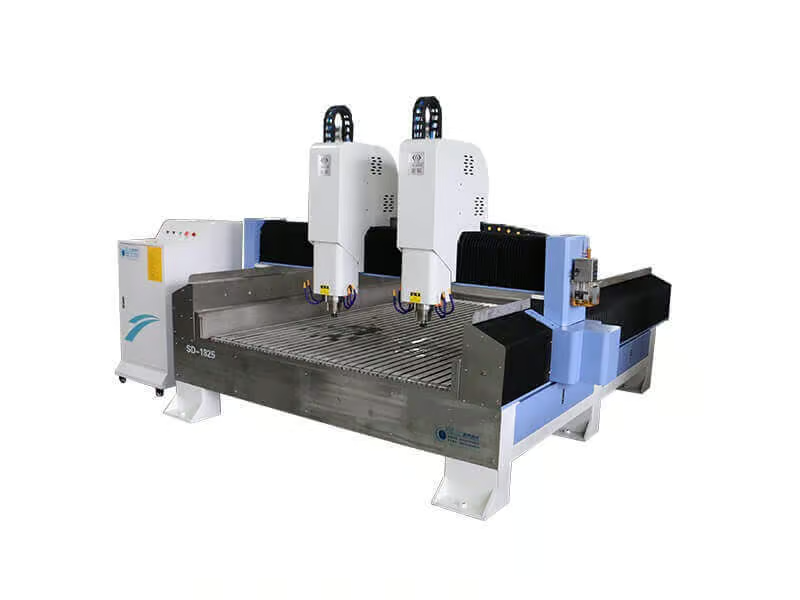 Stone Engraving Machines
 Stone Veneer Saw
 Stone Quarry Machines
 Stone Band Saw Machines
 Stone Edging Beveling Machine
 Other Stone Machines
 Stone Diamond Tools
 Stone Slab Cutting
 Stone Slab Surface Edge Polishing
 Stone Block Slicing
 Stone Quarry Mining
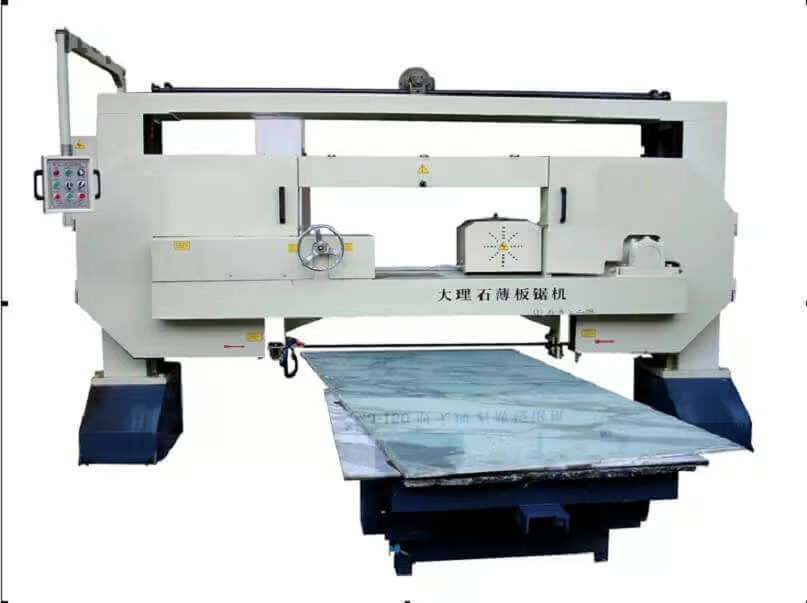 Stone Horizontal Splitting
 Stone Engraving Applications
 CNC Stone Cutting
 Countertop Cutting Polishing
 Other Applications
The stone fabrication industry is undergoing a massive digital transformation. As modern architectural designs demand complex geometries, zero-margin miter joins, and flawless vein matching, relying on traditional manual saws is no longer viable. Today, upgrading your workshop with an advanced CNC stone cutting machine is not just a luxury—it is the definitive baseline for remaining competitive, maximizing material yield, and achieving unparalleled processing efficiency.
1. The Evolution of Stone Fabrication: Manual Saws vs. CNC
Historically, stone fabrication relied heavily on the physical strength and experience of master craftsmen. While manual bridge saws were standard, they presented massive bottlenecks. Producing an L-shaped kitchen countertop or a complex sink cutout required hours of measuring, manual grinding, and repositioning heavy slabs.


The stark contrast in precision and cleanliness between traditional and CNC stone fabrication.
Enter the automatic stone cutter. By replacing manual hand-wheels with high-torque servo motors and utilizing a programmable logic controller (PLC), a CNC system completely removes human fatigue from the equation. The result is a monumental leap in safety, speed, and dimensional accuracy, completely eradicating the costly errors associated with manual processing.
2. Anatomy of a High-Performance Stone CNC Machine
What makes a machine truly “industrial-grade”? It is the perfect synergy of rigid mechanical engineering and intelligent software.
The Monoblock Foundation
High-end machines utilize a heavy-duty, stress-relieved cast-iron or steel mono-block frame. This structure absorbs the intense centrifugal vibrations generated when a diamond blade slices through hard granite, ensuring that the industrial stone cutter maintains a surgical precision of ±0.05mm without the need for expensive concrete foundations.

5-Axis Interpolation
Unlike basic 3-axis machines that only move linearly (X, Y, Z), a 5-axis bridge saw CNC adds continuous 360-degree head rotation (C-axis) and 0°-90° blade tilting (A-axis). This allows the machine to effortlessly execute curved cuts, circular medallions, and automatic 45-degree miter joints without ever moving the slab.
Vacuum Manipulators
To further reduce manual labor, advanced machines feature integrated vacuum lifters on the spindle head. This system automatically picks up and relocates cut pieces, enabling unattended batch processing and protecting delicate slabs from handling damage.

3. The Digital Shift: CAD/CAM Software and Vein Matching
The true power of modern fabrication lies in the software. Today’s stone CNC machines feature seamless DXF/DWG file support, allowing fabricators to import complex architectural drawings directly into the machine’s interface.
[Image Placeholder: A digital camera system capturing a Calacatta marble slab, with software showing virtual cutting paths overlaid on the veins]
Digital vein-matching allows fabricators to perfectly align natural stone patterns before cutting.


Perhaps the most revolutionary digital tool is the Overhead Camera System. When working with luxury, highly-veined materials, operators can capture a high-resolution photo of the slab. Using the touchscreen, they can virtually “drag and drop” cutting templates over the image to avoid natural fissures and ensure perfect pattern continuity (vein matching) across waterfall islands and wall claddings.
4. Material Versatility: What Can CNC Technology Process?
A workshop’s profitability is tied to its versatility. By integrating a Variable Frequency Drive (VFD), the spindle speed of the CNC machine can be precisely adjusted. This makes it the ideal marble cutting machine—running at higher speeds for delicate, brittle marble or ultra-compact sintered stone (porcelain), while seamlessly dropping into high-torque, lower-RPM modes to chew through ultra-dense granite and engineered quartz.

5. Maximizing ROI: The Business Case for CNC Upgrades
For shop owners, the decision to upgrade always comes down to Return on Investment (ROI). The math overwhelmingly favors automation. By utilizing intelligent auto-nesting software to minimize the gaps between cut pieces, workshops typically see a 15% reduction in material waste.
Furthermore, because the machine operates autonomously, one operator can easily manage production that previously required three skilled workers. To explore the exact technical specifications and see how these features can transform your bottom line, explore our flagship industrial CNC stone saw solutions.
6. FAQ: Understanding CNC Stone Fabrication
Expert answers to the most common questions surrounding digital stone processing technology.
1. What is the main advantage of a CNC stone cutting machine over a manual saw?
The primary advantage is automated precision. A CNC stone cutting machine completely eliminates human error, significantly increases daily output, and can execute complex curved and mitered cuts that are practically impossible with manual saws.
2. Is a stone CNC machine difficult to operate for beginners?
Not at all. Modern stone CNC machines feature highly intuitive touch-screen interfaces. With basic training, standard operators can quickly learn to import DXF files and run automated cutting cycles.
3. Can a bridge saw CNC perform 45-degree miter cuts automatically?
Yes. A 5-axis bridge saw CNC can automatically tilt its cutting head from 0 to 90 degrees, executing perfect, chip-free 45-degree miter joints for high-end kitchen countertops and waterfall edges.
4. How does an automatic stone cutter reduce material waste?
An automatic stone cutter uses smart CAD/CAM “nesting” software. It calculates the most efficient way to arrange cut pieces on a single slab, minimizing gaps and saving up to 15% on expensive stone materials.
5. Why is a mono-block structure important for an industrial stone cutter?
A mono-block frame provides exceptional rigidity. It dampens the severe vibrations caused by cutting thick stone, ensuring the industrial stone cutter maintains ±0.05mm accuracy and prevents edge chipping.
6. What materials can the ideal marble cutting machine process?
Despite the name, the ideal marble cutting machine with variable spindle speed can easily process hard granite, engineered quartz, delicate quartzite, sintered stone, and ultra-thin porcelain slabs.
7. Does the machine to cut marble require a specialized concrete foundation?
No. Thanks to the heavy-duty mono-block design, our machine to cut marble is highly stable and does not require the expensive and permanent concrete foundations needed by older, separated-rail models.
8. How does the camera system work on a stone saw machine?
The overhead camera takes a digital photo of the raw slab. Operators use the stone saw machine software to overlay their cutting templates on the photo, allowing them to perfectly match natural veins and avoid stone defects.
9. What maintenance is required for a CNC stone fabrication center?
Routine maintenance includes a daily wash-down of abrasive stone slurry, weekly greasing of the X/Y/Z linear guide rails, and ensuring the electrical cabinet’s cooling fans remain free of stone dust.
10. How quickly can a workshop see an ROI on a stone CNC machine?
Due to massive savings in labor, a 15% reduction in material waste, and the elimination of manual secondary polishing, most professional fabrication shops see a full Return on Investment within 12 to 18 months.
Ready to Upgrade Your Fabrication Capabilities?
Don’t let outdated technology limit your business growth. Contact our experts to find the perfect CNC solution tailored to your workshop’s production volume.
Explore Our CNC Stone Machines