
 Stone Cutting Machines
 Stone Polishing Machines
 Bridge Saw Machines
 Stone Quarry Cutting Machines
 Stone Block Cutter Machine
 CNC Stone Wire Saw Machine
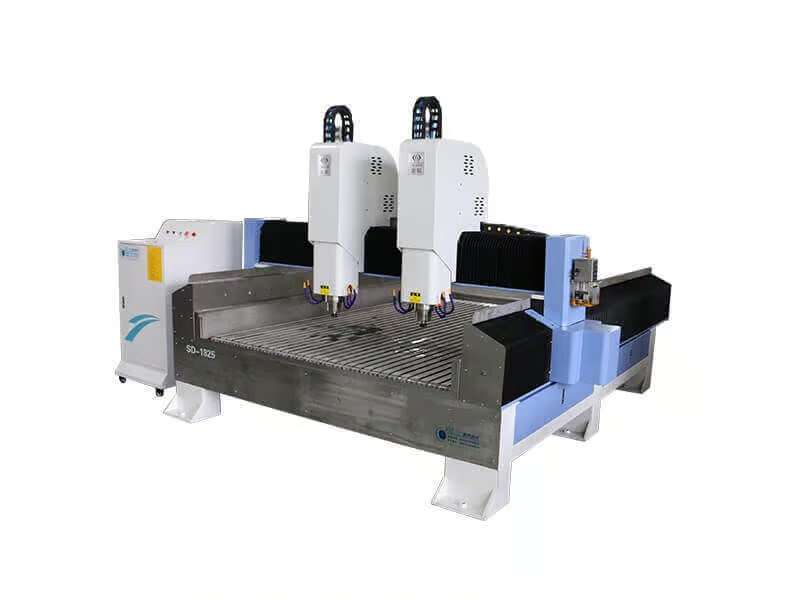 Stone Engraving Machines
 Thin Stone Veneer Saw Machine
 Horizontal Stone Slab Splitting Machine
 Stone Edge Polishing Profiling Machine
 Stone Auxiliary Equipment
In the high-stakes manufacturing of thin stone composite panels, geometric accuracy is not a luxury; it is the absolute baseline of survival. According to machining dynamics studies published by the Society of Manufacturing Engineers (SME) regarding the tribological behavior of flexible band tools in hard, non-uniform mediums, long-span slicing introduces severe lateral reaction forces. When slicing horizontally through natural stone, the tool encounters alternating crystalline structures (like calcite and hard quartz nodes). Maintaining a thickness tolerance strictly within $pm0.5text{mm}$ is not achieved by simply “feeding the stone slower.” It requires a highly synchronized physical system involving extreme hydraulic blade tensioning, rigid gantry self-balancing, and the elimination of micro-vibrations across the conveyor bed.
A major marble honeycomb panel exporter in Turkey recently found themselves on the brink of catastrophic financial loss due to equipment inaccuracy. Relying on an under-engineered horizontal splitting machine with poor gantry rigidity, their cuts on 1200mm wide slabs were suffering from mid-span harmonic resonance. This caused the blade to wander, resulting in “bellied” slabs that were 1.5mm thicker in the center. During the vacuum epoxy lamination process, this irregularity created severe dry-bonding voids (empty pockets lacking adhesive). The finished panels experienced massive delamination and failure during overseas shipping due to thermal expansion. Upon upgrading to the heavy-duty MosCut MS-1250 Horizontal Slicer, equipped with hydraulic self-balancing tensioners and digital inverter feed tuning, the cutting deviation was instantly locked down to $pm0.3text{mm}$. The panels passed all US architectural weathering tests, permanently eliminating their delamination claims.
The 0.5mm Borderline: Why Tolerance Determines Composite Survival
A deviation smaller than a single fingernail can create a cascade of structural failures on the bonding line.If your horizontal splitting machine produces wavy cuts, the financial bleeding occurs far down the production line in two distinct areas:
1. The Vacuum Bonding Leak: The ideal spread thickness for specialized structural epoxy resin is generally between $0.5text{mm} – 0.8text{mm}$. If the sliced veneer has undulations exceeding 0.5mm, the low valleys will form thick pools of un-cured resin, while the high peaks will be squeezed completely dry against the aluminum honeycomb backing. This guarantees localized delamination (hollow pockets) that will fail under building wind loads.
2. The Calibrating Cost Burn: If the cut is terrible, the only way to save the stone is to run it through a heavy-duty multi-head calibrating machine. You are forced to literally grind away valuable natural stone into worthless dust just to make it flat, simultaneously increasing your diamond calibrating roller consumption costs by over 300%.

Culprit 1: Dynamic Blade Wandering & Inadequate Hydraulic Tension
When a flexible steel ribbon acts like a loose rubber band inside the rock.📉 Yield Deflection Physics
Both diamond band saws and wire loops are “flexible line materials” suspended under tension. When the heavy stone slab is pushed into the cutting edge, the tool experiences a massive backward and lateral reactive force from the stone matrix.
〰️ The Static Sag Event
If the machine relies on manual screw-tensioning or a weak hydraulic system, the tool will develop “Static Sag” in the middle of a wide cut. The blade will literally take the path of least resistance through softer mineral veins, causing aggressive blade wandering and wavy cuts.
🔒 The MosCut Solution
The MosCut system utilizes a heavy-duty, closed-loop hydraulic system paired with an accumulator. This locks the steel blade’s internal stress at absolute limits, making the flexible band act identically to a solid steel beam.
By maximizing the denominator (Hydraulic Tension), MosCut mathematicaly forces Deflection ($Delta x$) down to sub-millimeter levels.
Culprit 2: Inverter Mismatch and Feed-Velocity Desynchronization
Forcing the stone forward when the diamond matrix is localized-blind causes catastrophic blade deflection.Natural stone is not uniform; it is riddled with sudden, ultra-hard quartz inclusions or dense mineral knots. If the conveyor belt’s feed rate is rigidly fixed, a disaster occurs when the blade strikes one of these hard nodes.
Because the diamond segments need a fraction of a second longer to grind through the hard node, a fixed-speed conveyor will continue to aggressively push the heavy slab forward. This overwhelming forward pressure violently forces the sharp blade sideways, deviating it from its perfectly horizontal axis. The result is a sudden spike in thickness. High-precision slicing requires the machine to “feel” the rock and dynamically adjust the feed rate in real-time.

🚨 Culprit 3: Conveyor Micro-Slippage & Bed Vibration Harmonic
Many factories obsess over the cutting tool but completely ignore the foundation: the conveyor bed. If the rubber conveyor belt is worn out, or constantly coated in a slick layer of limestone slurry without proper cleaning, the massive stone slab will experience “Micro-slippage.”
This slippage means the stone is advancing in a stuttering, stop-and-go microscopic rhythm. This fluctuating resistance induces a violent sub-harmonic resonance within the metal blade. This high-frequency shuddering physically hammers the stone face, leaving deep, stepped chatter marks across the veneer that utterly destroy the 0.5mm tolerance threshold.
The MosCut Precision Calibration Protocol: 3 Steps to Sub-Millimeter Success
Master these mechanical protocols before engaging the main drive motor.⏱️ Step 1: Digital Coplanar Alignment
Whenever a new band saw or wire loop is installed, operators must use a magnetic base dial indicator to verify the absolute coplanar alignment of the primary and secondary flywheels. A coplanar deviation greater than $0.03text{mm}$ will introduce an inherent twist to the blade before it even touches the stone.
🗜️ Step 2: Dual Pressure-Roller Stabilization
Before the slab enters the cutting zone, the front and rear pneumatic overhead pressure rollers must be engaged. These rollers apply immense downward force, completely flattening out any natural bowing in the raw 2cm slab and preventing it from chattering upwards as the blade bites in.
🧠 Step 3: Smart Amperage-Adaptive Tuning
Activate the MosCut CNC Auto-Cruise. When the system detects the main spindle motor amperage spike by 15% (indicating a hard inclusion), the inverter automatically decelerates the conveyor belt within 0.1 seconds. Once the hard node is pulverized, normal feed speed resumes, conquering the stone with intelligence rather than brute force.
Command Absolute Geometric Precision
Stop compounding your raw material losses with wavy, inaccurate cuts. Upgrade your fabrication floor to MosCut’s dynamic micro-compensated horizontal splitting lines and master the art of sub-millimeter precision.
Explore MosCut Horizontal Splitting