
 Stone Cutting Machines
 Stone Polishing Machines
 Bridge Saw Machines
 Stone Quarry Cutting Machines
 Stone Block Cutter Machine
 CNC Stone Wire Saw Machine
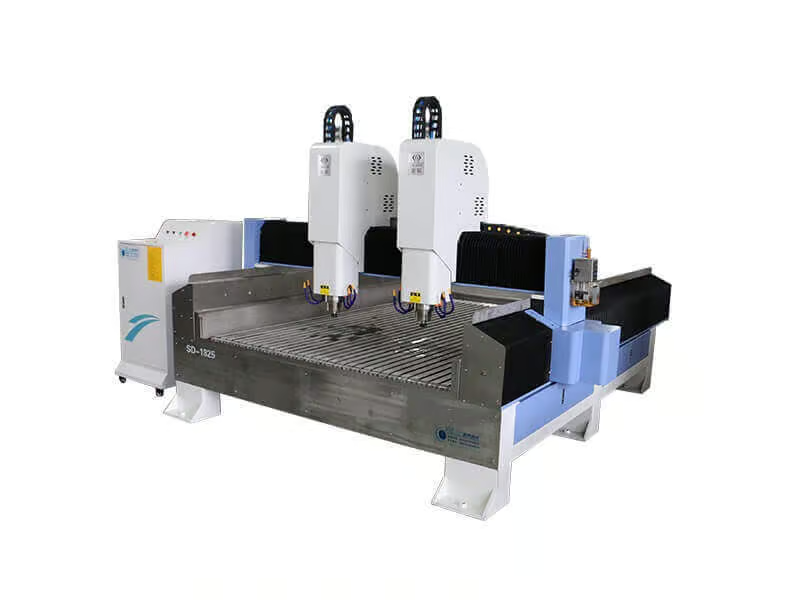 Stone Engraving Machines
 Thin Stone Veneer Saw Machine
 Horizontal Stone Slab Splitting Machine
 Stone Edge Polishing Profiling Machine
 Stone Auxiliary Equipment
In the highly profitable sector of horizontal thin slab splitting, the machine’s chassis provides the power, but the tooling matrix dictates the survival of your operation. When slicing a 2cm slab into 1cm veneers, the difference between success and catastrophic failure lies in “Contact Fracture Mechanics”. According to tribological tool wear standards published by ASTM International, the geometric structure of superabrasives against brittle non-metallic materials heavily influences localized stress distribution and heat dissipation. A mismatch between your chosen tool (flat band vs. rounded wire loop) and your geological target will not only obliterate your consumable lifespan but will instantly destroy sub-millimeter thickness tolerances, ruining highly valuable slabs.
A premier exotic stone fabricator based in Vitória, Brazil, recently learned an expensive lesson regarding tooling geometry. Aiming for the narrowest possible kerf (sawdust waste) to preserve premium Quartzite blocks, they equipped their horizontal splitting machine with a rigid diamond band saw system. Within 30 minutes of slicing into the highly abrasive, silica-dense quartzite, the immense lateral resistance of the quartz nodules caused the flat steel band to bow, overheat, and violently snap—destroying thousands of dollars in tooling. MosCut’s engineering team audited the site and guided their transition to an Endless Diamond Wire Loop system. The rubber-encapsulated wire beads provided the necessary rotational “give” to absorb the extreme shock of the hard rock nodes. Consumable lifespan surged by 12x, permanently solving their hard-rock extraction dilemma.
The Kinematic Divergence: Line vs. Dot Contact
Understanding how a tool enters the atomic matrix of stone dictates its mechanical lifespan.To choose the correct system for your horizontal splitting machine, you must understand the fundamental physical movements of these two cutting profiles:
Continuous Line Contact (Band Saw): A diamond band saw is a flat, flexible ribbon of steel with diamond segments continuously welded along one straight edge. When it enters the stone, the entire line engages simultaneously. It acts like a rigid knife, providing exceptional planar guidance, but it absorbs all lateral impact directly into the steel core.
Rotational Point Contact (Wire Loop): An endless wire saw is composed of individual cylindrical diamond beads strung on a steel cable. As it cuts, it operates through a series of rapid “point contacts.” More importantly, the wire naturally rotates on its own axis as it travels around the flywheels. This spinning motion allows it to grind away hard localized nodes from multiple angles, dissipating shock waves that would otherwise shatter a solid steel band.

Diamond Band Saw: The Mirror Slicer for Calcite Stones
When sub-millimeter precision and flawless surface finish are your ultimate goals.🔬 Metallurgy & Structure
Constructed from a premium high-tensile alloy spring steel backer. The cutting edge is armed with high-density synthetic diamond segments seamlessly laser-welded along the rim, designed strictly to maintain absolute vertical rigidity under high hydraulic tension.
✨ The Superpower
Unmatched kerf efficiency. Operating with a kerf of just 1.2mm to 2.0mm, it generates practically zero stone powder waste. It leaves the sliced marble, travertine, or limestone with a near-polished, mirror-like finish, bypassing heavy secondary calibration steps for composite panels.
⚠️ The Vulnerability
Highly intolerant to silica. If the band encounters hard granite or dense quartz nodes, the flat steel cannot deflect the lateral pressure. The blade will warp, cause wavy cuts, or suffer severe structural fracturing at the weld seams.
Endless Diamond Wire Loop: The Armor for Hard Granite
When the stone matrix is an aggressive maze of quartz, you need an armor-plated cutter.The Tooling Anatomy: An endless wire loop features an un-spliced, continuous aviation-grade steel cable core. Threaded along this core are heavy-duty sintered diamond beads. The entire length is then vulcanized with heat-resistant rubber or specialized plastics, locking the beads in place while protecting the core from abrasive slurry.
The Core Advantage: Extreme impact resistance. Designed explicitly for Granite, Quartzite, and Basalt. The rubber-coated wire matrix is inherently flexible. When it strikes an ultra-hard quartz inclusion, it dynamically flexes and grinds through it rather than snapping.
The Kerf Penalty: The trade-off for this rugged survivability is a slightly thicker kerf (typically 2.0mm to 2.5mm). Additionally, the rotational slicing action leaves minor, shallow arc-shaped “wire marks” on the split veneer, requiring a brief pass under a calibration head before final composite lamination.

💰 The Kerf Economics: A CFO’s Perspective
A single millimeter of difference in tool thickness might seem trivial on the engineering floor, but it represents a massive leak on your monthly balance sheet. If your quarry specializes in premium, high-value luxury marble (like Calacatta or Statuario), material conservation is paramount.
Using a 2.5mm wire saw on material that could have been cut by a 1.2mm band saw means you are literally turning expensive luxury stone into worthless mud. For every 10 slabs sliced with the thinner band saw, you recover the equivalent of one entirely “free” thin slab just from the saved kerf waste. Multiply that single saved slab by your premium market price per square meter, and the ROI of utilizing band saws for soft stone becomes undeniably clear.
The Technical Selection Matrix
Align your geological material configuration with the correct kinematic cutting edge.| Tooling Type | Core Substrate | Average Kerf Loss | Surface Finish Grade | Max Hardness (Mohs) | Best Applications |
|---|---|---|---|---|---|
| Diamond Band Saw | Alloy Spring Steel Band | 1.2mm – 2.0mm | Excellent (Near-Polished) | 3 to 4.5 | Marble, Travertine, Limestone composite panels. |
| Endless Wire Loop | Rubberized Steel Cable | 2.0mm – 2.5mm | Moderate (Slight wire marks) | 7+ (High Silica) | Granite, Quartzite, Hard Exotic Stones. |
Optimize Your Factory Slicing Matrix
Stop wearing out premium consumables on mismatched machinery. Align your tooling and gantry systems with MosCut’s precision engineered horizontal splitting architecture to maximize your yield.
View the Horizontal Splitting Machine