
 Stone Cutting Machines
 Stone Polishing Machines
 Bridge Saw Machines
 Stone Quarry Cutting Machines
 Stone Block Cutter Machine
 CNC Stone Wire Saw Machine
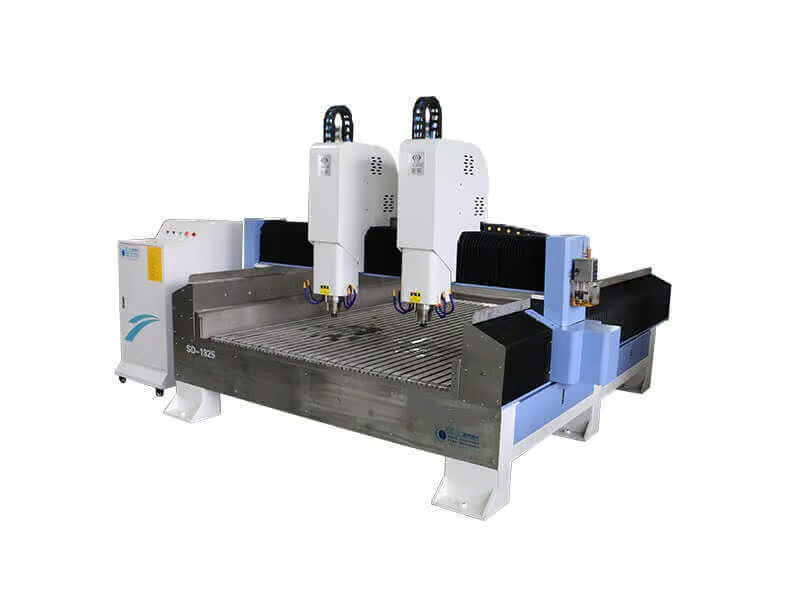 Stone Engraving Machines
 Thin Stone Veneer Saw Machine
 Horizontal Stone Slab Splitting Machine
 Stone Edge Polishing Profiling Machine
 Stone Auxiliary Equipment
In the lucrative manufacturing of lightweight stone composite panels, structural integrity is entirely reliant on polymer cross-linking dynamics. According to thermodynamic shear-strength analyses published in the International Journal of Adhesion and Adhesives, the lifespan of a dry-hung exterior facade does not depend on the natural stone, but on the 0.5mm layer of modified Epoxy Resin sandwiched beneath it. Successful chemical bonding requires precise environmental controls, exact stoichiometric mixing ratios, and, most critically, absolute mechanical flatness of the sliced stone. A wavy stone surface introduces uneven epoxy volumes, which inevitably trigger thermodynamic failure mechanisms such as micro-shrinkage and stress-induced delamination.
A prestigious stone fabrication plant in Greece, specializing in luxury superyacht interiors, recently faced a massive delamination crisis. Utilizing outdated multi-blade saws, their thin marble veneers exhibited heavy “wavy cuts.” To compensate and fill the uneven gaps, workers were forced to trowel on a thick 2.5mm layer of epoxy. During the violent vibrations and temperature swings of maritime navigation, this excessively thick resin layer became highly brittle, fractured, and caused the heavy marble panels to detach. After consulting with MosCut engineers, the factory overhauled their cutting floor with a MosCut MS-1250 Horizontal Splitting Machine. Achieving a staggering ±0.3mm flatness tolerance allowed them to reduce the epoxy glue-line to a standardized 0.6mm. Epoxy consumption plummeted by 60%, while the composite’s seismic shear strength quadrupled, flawlessly passing strict EU maritime safety certifications.
The 0.5mm Prerequisite: Why Chemistry Requires Mechanical Perfection
The most expensive epoxy in the world cannot save a poorly sliced, undulating piece of stone.⚠️ The Danger of Epoxy Pools
If your horizontal splitting machine yields a wavy cut, deep valleys form on the back of the stone. During lamination, these valleys fill up with thick accumulations of resin known as “Epoxy Pools.” Epoxy curing is an exothermic (heat-generating) reaction accompanied by micro-shrinkage. A thick pool of epoxy generates intense localized heat and contracts forcefully as it cures. This shrinkage physically pulls the stone away from the substrate, internally tearing the bond and creating a permanent hollow void.

🔬 The Capillary Action Standard
Conversely, a perfectly flat stone veneer sliced by a MosCut machine maintains a uniform gap against the backing substrate—ideally 0.5mm. This micro-gap triggers perfect Capillary Action. Under pressure, the epoxy is uniformly forced into the microscopic pores of the natural stone and the honeycomb cells, creating a flawless “Mechanical Interlocking” grid. The heat dissipates evenly, shrinkage is nullified, and the bond becomes permanent.
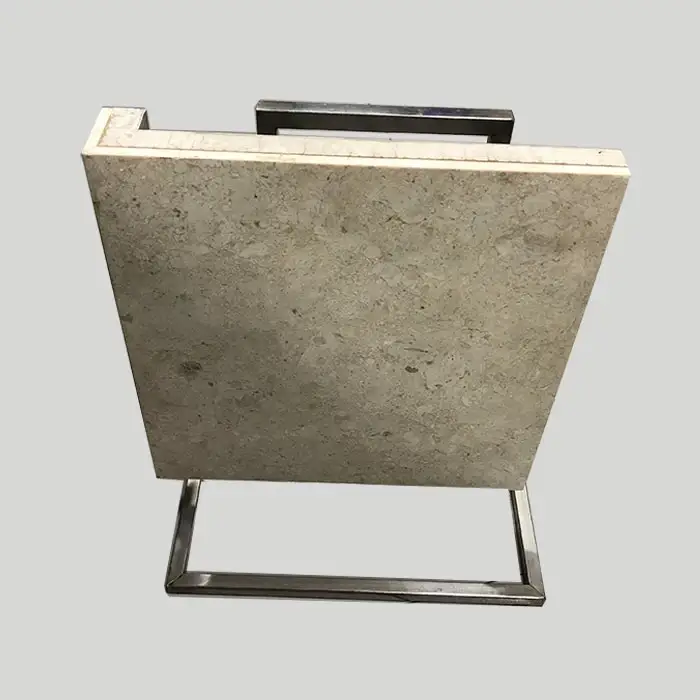
Decoding the Polymer Matrix: Resin vs. Hardener
Understanding the exothermic reaction that turns liquid into structural armor.🧪 Part A: The Resin
The base polymer matrix. Formulated for extreme adhesion, chemical resistance, and mechanical strength. By itself, it is an inert, viscous liquid that will never dry or cure without a catalyst.
⚡ Part B: The Hardener
The amine-based catalyst. Mixing it with Part A initiates the cross-linking chemical reaction. Ratios must be measured in strict grams. Adding extra hardener “to make it dry faster” will permanently ruin the polymer chains, making the glue dangerously brittle.
⏱️ Open Time vs. Cure Time
“Pot Life” is the time you have to spread the glue before it thickens. “Full Cure” is the time until maximum shear strength is reached. Both are heavily dictated by your workshop’s ambient temperature.
Substrate Matching: Choosing the Right Epoxy Formula
Aluminum flexes differently than glass. Your epoxy elasticity must match the substrate’s thermal expansion coefficient.🏗️ Aluminum Honeycomb Composites
Aluminum is highly thermally conductive and expands/contracts significantly under direct sunlight. Bonding stone to aluminum requires a specialized Toughened Epoxy (Flex-modified). Once cured, this epoxy retains a microscopic degree of elastomeric flexibility, allowing it to act as a shock absorber between the rigid stone and the shifting aluminum, preventing the facade from cracking under wind loads.

🏢 Porcelain & Ceramic Backing
Porcelain tiles have a Coefficient of Thermal Expansion (CTE) remarkably similar to natural marble and granite. Because they expand at the same rate, flexibility is less critical. Here, fabricators utilize High-Rigidity Structural Epoxy, optimizing purely for maximum compressive and shear strength. This is ideal for high-traffic commercial flooring where load-bearing capacity is paramount.

✨ Translucent Glass & Onyx
When laminating exotic Onyx or Agate to tempered glass for backlit feature walls, optical clarity is the only metric that matters. Standard epoxies will undergo severe “Yellowing” over time due to UV light and ambient heat. You must specify a premium UV-Stable Clear Epoxy (Aliphatic Resin). It is significantly more expensive but guarantees the translucent background remains crystal clear for decades.

The Lamination Protocol: 3 Steps to Void-Free Bonding
Execute this standard operating procedure to eliminate air entrapment and ensure lifetime adhesion.🔥 Step 1: Thermo-Dehydration
Freshly sliced stone from a water-cooled horizontal machine is saturated. Moisture is the ultimate enemy of epoxy adhesion, causing foaming and bond failure. The 1cm thin veneers must be passed through a continuous drying kiln to reduce internal moisture content to below 1% prior to glue application.
🪒 Step 2: Notched Spreading
Never pour and flatten epoxy directly. Technicians must use a 3mm to 4mm square-notched trowel to comb the resin into uniform ridges. These linear ridges serve a vital mechanical purpose: they provide escape channels for trapped air to bleed out when the top panel is pressed down.
🌬️ Step 3: Vacuum Bagging / Cold Press
The assembled sandwich must be placed in a vacuum bagging table or a hydraulic cold press. Uniform surface pressure is crucial to crush the glue ridges and spread the epoxy into a uniform 0.5mm film, expelling all micro-bubbles before the exothermic cure begins.
💸 The Economics of Flatness: The ROI of Less Glue
MosCut precision doesn’t just save valuable stone; it drastically slashes your chemical overhead. Premium imported structural epoxy resins are incredibly expensive, often priced per kilogram.
If your current splitting machine yields a wavy tolerance of 1.5mm, your workers are forced to over-apply resin to bridge the gaps, consuming approximately 2.5 kg of epoxy per square meter. If you upgrade to a MosCut Horizontal Splitting Machine and dial the tolerance down to an absolute 0.5mm flat plane, your epoxy consumption plummets to just 0.8 kg per square meter. For a factory producing 10,000 square meters of composite panels a month, the money saved purely on wasted glue is enough to purchase two brand-new MosCut machines within a single year.
Stop Compensating for Bad Machinery with Expensive Glue
A perfect chemical bond requires a flawless mechanical cut. Stop wasting expensive epoxy resin to compensate for wavy stone veneers. Equip your lamination line with MosCut’s ultra-precise horizontal splitting machines and guarantee absolute structural integrity.
Discover Precision Horizontal Splitting