
 Stone Cutting Machines
 Stone Polishing Machines
 Bridge Saw Machines
 Stone Quarry Cutting Machines
 Stone Block Cutter Machine
 CNC Stone Wire Saw Machine
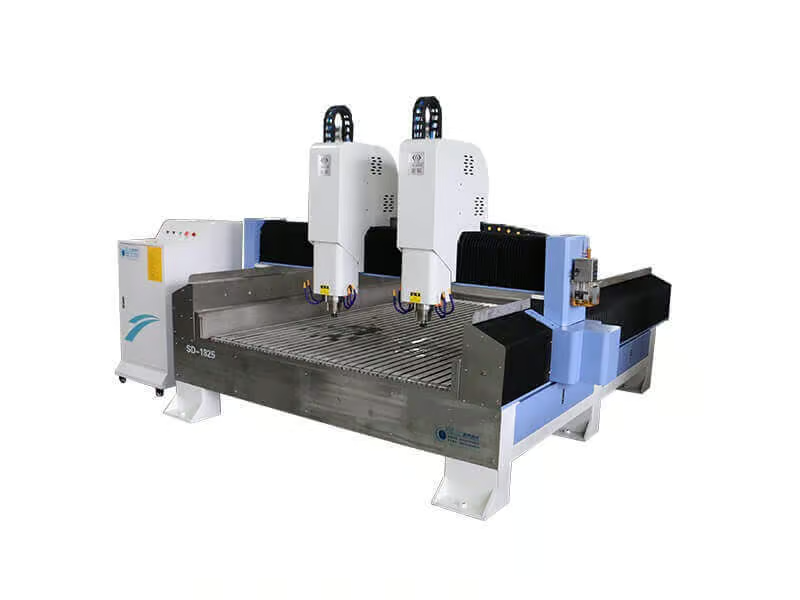 Stone Engraving Machines
 Thin Stone Veneer Saw Machine
 Horizontal Stone Slab Splitting Machine
 Stone Edge Polishing Profiling Machine
 Stone Auxiliary Equipment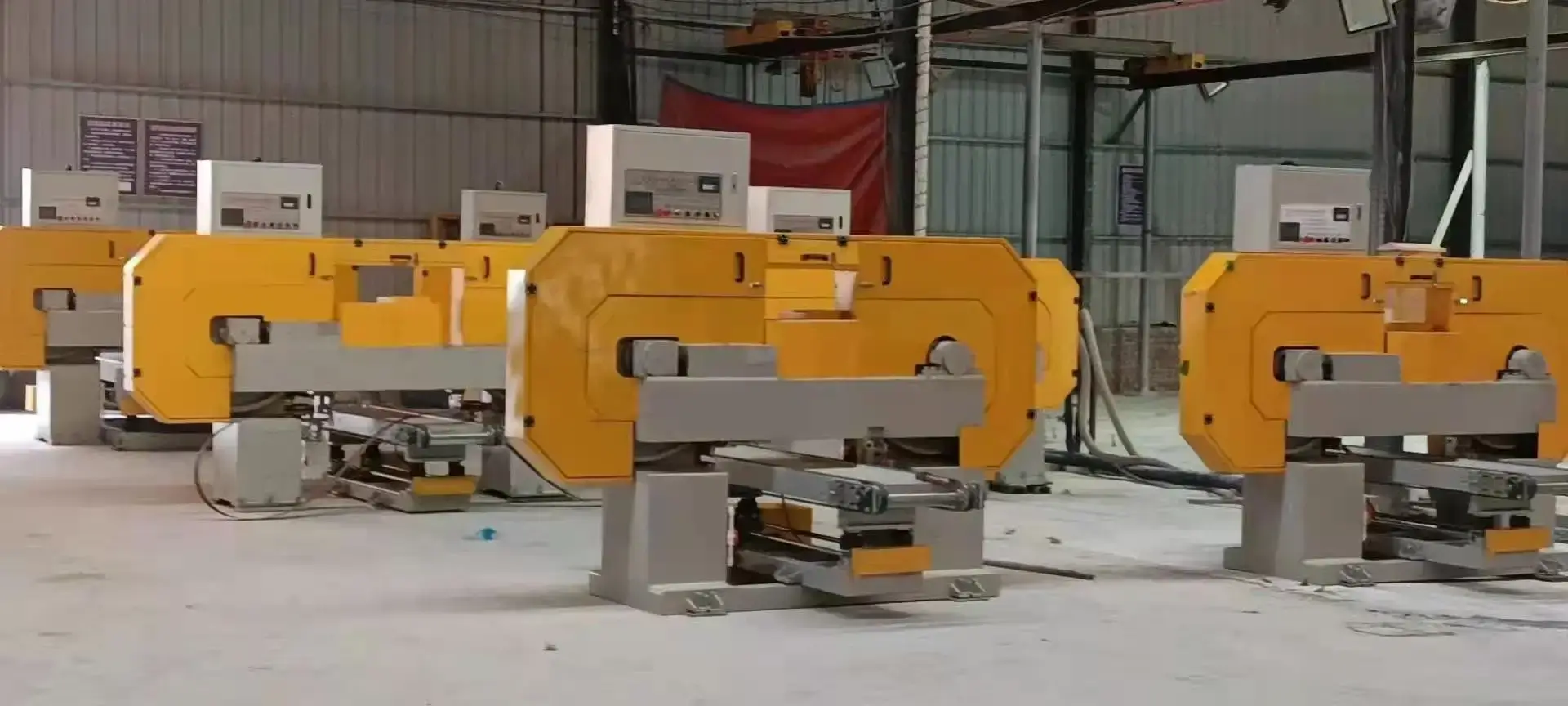
Horizontal Stone Slab Splitting Machine
In modern architectural design, the demand for lightweight, dry-hung exterior cladding has pushed natural stone to its physical limits. According to structural guidelines published by the Natural Stone Institute (NSI) regarding thin stone composite panels, traditional vertical disc cutting results in unacceptably high breakage rates and massive “Kerf Waste” (sawdust loss) when attempting to slice slabs below 15mm. MosCut disrupts this limitation with advanced Horizontal Stone Slicing technology. By laying the slab flat on a rigid, high-friction conveyor and feeding it into a horizontal diamond band saw (or wire saw), gravity-induced deflection is completely eliminated, allowing 2cm slabs to be flawlessly split into two 1cm veneers.
A leading aerospace-grade stone composite manufacturer in Shuitou, China, recently transformed their profitability using this system. Previously relying on multi-blade vertical saws, their attempt to cut 2cm premium Calacatta marble yielded high micro-fracture rates and over 30% material waste. After installing MosCut’s Heavy-Duty Horizontal Splitting Machine equipped with a 1.2mm diamond band saw, they successfully sliced their 2cm inventory into perfect 1cm thin slabs. This 100% immediate expansion in raw material yield, combined with aluminum honeycomb backing, allowed them to fulfill a massive luxury hotel contract in Dubai at a premium markup, recovering their entire machinery investment in under three months.
The Financial Catalyst: Why Splitting Doubles Profits
In an industry where premium raw stone is non-renewable, survival belongs to the master of material yield.100% Yield Expansion
Horizontally slice a standard 2cm thick slab directly down the middle to produce two identical 1cm thin slabs. Your sellable surface area and inventory are instantly doubled using the exact same raw material block.
Micro-Kerf Waste Reduction
Reject the massive powder waste of 8mm circular blades. Our diamond band saws and wire loops feature a kerf as thin as 1.2mm to 2.5mm. By eliminating sawdust waste, every 10 slabs sliced effectively yields a “free” slab in saved material.
Zero Micro-Fracture Splitting
Vertical cutting forces unsupported thin stone to flex and snap. Our horizontal system supports 100% of the stone’s weight on a shock-absorbing rubber belt, dropping the stress-fracture rate of delicate slicing to under 0.5%.
Reduced Freight & Labor
A 1cm thin slab weighs exactly 50% less than a standard 2cm slab. This drastically reduces international shipping container costs, lightens architectural building loads, and simplifies high-altitude dry-hanging installation.
Engineering Physics: Why Horizontal Beats Vertical
Gravity is the enemy of thin stone slicing. Horizontal table integration is the only way to guarantee sub-millimeter thickness tolerance.When attempting to cut a large slab down to 10mm or 5mm using a traditional vertical saw, the sheer weight of the stone works against the blade. Gravity and water pressure cause the unsupported thin slice to warp, inevitably leading to blade pinching (jamming) and shattered edges.
The MosCut Horizontal Solution: We altered the axis of engagement. The slab lies perfectly flat on a high-friction, heavy-duty horizontal conveyor belt. Gravity now acts as a stabilizing force, pressing the stone firmly into the bed. The cutting tool (band or wire) engages laterally. This ensures that dynamic deflection is minimized, governing thickness precision through the following mechanical relationship:
$$Thickness Deflection (Delta T) propto frac{Feed Rate (v) cdot Lateral Force (F)}{Hydraulic Band Tension (tau)}$$
By maximizing hydraulic band tension ($tau$), our machine maintains an absolute thickness tolerance of ±0.5mm across a 2-meter span.

Defeating Gravity: Horizontal axis slicing removes internal bending strain, allowing highly fractured or exotic stones to be cut paper-thin without breaking.
Micro-Engineering Showcase: Machine Structural Anatomy
Every weld, bolt, and sensor is precision-machined to withstand brutal, continuous lateral forces.🏗️ Heavy-Duty Monolithic Appearance
Constructed with a massive gantry-style rigid cast-iron chassis. The ultra-heavy counterweight base and low center of gravity act as a dampener, perfectly locking down multidimensional harmonic vibrations generated during high-speed horizontal splitting. The result is a tool trajectory that remains solid as a rock.

🧠 Smart CNC Electrical Control Box Interior
The operational core of our automated safety system. Heavily integrated with world-class Schneider electrical components and industrial-grade smart frequency inverter systems. Encased in a fully sealed, dust-proof IP54 heavy enclosure, it perfectly isolates delicate circuit architectures from highly abrasive quarry rock dust and moisture, ensuring non-stop 24/7 system uptime.

🖥️ Digital HMI Touchscreen Interface
An intuitive, high-definition Human-Machine Interface (HMI) designed for rugged stone processing floors. It empowers operators with real-time digital micro-millimeter thickness compensation, instantaneous tensile overload auto-protection alerts, and intelligent diagnostic power consumption logging. Custom slicing profiles can be cataloged and automated to maximize consistent batch quality.

⚙️ Oversized Primary & Secondary Drive Pulleys
Engineered for optimal kinetic energy transfer in marble and limestone applications. The massive diameter of the drive wheels drastically reduces the bending fatigue exerted on the steel band, preventing micro-cracks in the blade core. This oversized rotational geometry ensures a perfectly smooth, high-torque linear velocity essential for continuous heavy-duty slicing.

🗜️ High-Pressure Band Saw Tensioning System
Sub-millimeter cutting precision relies on absolute blade rigidity. Our heavy-duty hydraulic tensioning stabilizer continuously applies high-pressure outward force to the band saw blade. This dynamic, self-balancing system absorbs varying rock densities during the feed, completely eliminating blade flutter, mid-span bowing, and the risk of wavy cuts.

⛓️ Endless Diamond Wire Loop System
The ultimate armor against granite. Built with high-rigidity tensioning guide wheels and a specialized dynamic-balanced flywheel. This ensures that the closed-loop diamond wire operates at extreme RPMs without ever experiencing lateral flutter or bouncing inside the hard rock.

🛤️ High-Friction Reinforced Conveyor
The foundation of precision feed. A thickened, anti-slip, multi-layer vulcanized rubber conveyor belt sits atop a heavy-duty rigid steel bed. Whether slicing highly polished slabs or rough sawn blocks, the belt provides 100% grip to prevent the stone from slipping during lateral cutting.

📏 Modular Width Adaptability
Highly flexible modular chassis design to match your specific production capacity and raw block sizes. Equipment can be custom-built to support maximum processing widths of 850mm, 1250mm, 1650mm, or a massive 2250mm, covering everything from narrow strips to jumbo exotic slabs.

High-Value Product Applications
Turn raw stone assets into hyper-profitable, lightweight architectural masterpieces.🏗️ Stone Composite Panels (Laminates)
By splitting a 2cm slab into 1cm or 0.5cm veneers, fabricators can use specialized epoxy resins to laminate the stone onto Aluminum Honeycomb, high-strength tempered glass, or porcelain backing. The final composite product is 70% lighter and boasts 5 times the impact resistance of solid stone. This is the absolute mandatory standard for luxury yacht interiors, elevator cabins, and high-rise exterior cladding.

✨ Ultra-Thin Stone Veneer Panels
Without sacrificing the prestigious natural veins of exotic stones and onyx, extreme thin-slicing (down to 3mm-5mm) allows fabricators to create stunning, translucent backlit feature walls (when backed with glass or acrylic). These ultra-thin veneers are also revolutionizing premium interior design, frequently applied to custom kitchen cabinetry doors and curved architectural surfaces that traditional thick slabs could never accommodate.

⚡ Dynamic Slicing Efficiency & Speed Dynamics
Production throughput on a horizontal splitting machine is a complex calculation of rock resistance, tooling geometry, and kinetic energy. The actual cutting speed (Square Meters per Hour) is not a fixed number, but a dynamic curve dictated by three critical on-site variables:
- Rock Hardness & Mineralogy: The cutting resistance of soft marble versus highly abrasive, silica-rich granite drastically alters feed speeds.
- Physical Slab Width (850mm to 2250mm): A wider slab means a longer continuous friction contact patch for the blade, requiring a slower, more deliberate feed rate to prevent blade bow.
- Tool Tensioning Pressure: Higher hydraulic tension minimizes internal tool deflection, allowing the operator to safely increase feed speed without risking wavy cuts.
Under MosCut’s dynamic CNC calibration, the comprehensive cutting efficiency of the machine stabilizes between 3 to 5 Square Meters per Hour (3-5 m²/h), perfectly balancing extreme sub-millimeter thickness tolerances with peak industrial output.
Industrial Tooling: Machine Consumables
The elite consumables that translate the machine’s brute power into sub-millimeter slits.🪚 Diamond Band Saw Blades (For Soft Stone)
Specifically optimized for slicing marble, travertine, and limestone. Featuring a high-strength alloy spring-steel flat band, the upper edge is lined with densely packed, laser-welded diamond segments. With a kerf as thin as 2.0mm to 2.50mm, it delivers an incredibly smooth, near-polished cut surface, eliminating the need for heavy secondary calibration.

➰ Endless Diamond Wire Loops (For Hard Stone)
The dedicated armor for tackling granite, quartzite, and exotic hard rocks. Constructed from a high-tenacity aerospace steel wire core, threaded with high-density diamond beads, and fully encapsulated in heat-resistant vulcanized rubber. It boasts astonishing tensile strength and prevents bead stripping during the violent friction of granite splitting.

Technical Specifications & Model Configurations
Precision-matched engineering parameters across four heavy-duty broad-width processing platforms.| Machine Parameter Name | Unit | Model MS-850 | Model MS-1250 | Model MS-1650 | Model MS-2250 |
|---|---|---|---|---|---|
| Max. Cutting Width | mm | 850 | 1250 | 1650 | 2250 |
| Travel Height | mm | 80 | 80 | 80 | 80 |
| Power of Main Motor | KW | 7.5 | 7.5 | 9.0 | 11.0 |
| Cutting Speed Efficiency | m²/h | 3 – 5 | 3 – 5 | 5 | 3 – 5 |
| Total Power Consumption | kw | 8.0 | 8.5 | 11.0 | 12.0 |
| Max. Cutting Thickness Capacity | mm | 60 | 160 | 160 | 160 |
| Blade / Wire Core Thickness | mm | 2.50 | 2.50 | 2.00 | 2.50 |
| Water Consumption Rate | m³/h | 2.0 | 2.0 | 3.0 | 3.0 |
| Overall Machine Dimensions (L×W×H) | mm | 3200 * 2500 * 2100 | 4200 * 3100 * 2200 | 4500 * 3600 * 2500 | 5800 * 4400 * 2200 |
| Total Machine Net Weight | kg | 1500 | 2200 | 2500 | 3200 |
Standard Operating Procedure: Precision Slicing Execution
Strict adherence to hydraulic and inverter calibration limits prevents dynamic blade bowing.🎚️ 1. Plate Leveling & Calibration
Before initiating the horizontal push, the raw 2cm slab must be checked for surface warping. Heavy-duty overhead pressure rollers engage to compress and lock the stone completely flat against the conveyor grid, ensuring a uniform horizontal tracking line from entry to exit.
🗜️ 2. Hydraulic Tensioning
Whether configuring the continuous band saw steel band or the endless diamond wire loop, the operator must actuate the high-pressure hydraulic cylinders to factory limits. This rigid tension eliminates midline sag, absorbing structural stone resistance without undulating.
🔄 3. Synchronized Inverter Feed
The CNC dashboard actively calculates cutting amperage. As the conveyor feeds the slab forward, the smart inverter dynamically throttles belt velocity. If the blade collides with an ultra-hard quartz node, the machine automatically slows feed speed to eliminate tool deviation.
Machine in Action: High-Definition Industrial Demonstration
Observe the silent, vibration-free horizontal splitting of raw slabs into premium thin tiles.Global Success Showcase: Industrial Field Records
Dominating throughput metrics across the world’s most demanding stone composite fabrication lines.
China (Shuitou): Composite Mass Line
Deployed the MS-1650 to slice 2cm marble slabs into 1cm backings for continuous ceramic tile lamination. Achieved a massive monthly yield of 20,000 square meters while reducing raw block waste by 48%.

Italy (Carrara): Translucent Luxury Atelier
Successfully achieved extreme thin-slicing down to 0.5cm on premium 2000mm wide Statuario blocks. Slabs were structurally bonded to ultra-clear glass for high-altitude interior backlit facades with absolute zero fracture breakage.

Turkey (Denizli): Travertine Cladding Hub
Configured an automated multi-machine layout running continuous diamond band saw modules. Sliced large travertine slabs into lightweight veneers for aluminum honeycomb fabrication, securing an elite high-rise curtain wall project.

Brazil (Vitória): Quartzite Slicing Node
Conquered highly fractured, dense exotic quartzites by utilizing our premium endless diamond wire loop system. Slashed structural block breakage from an industry average of 25% down to an unyielding 0.8% floor metrics.
Related Technical Insights & Slicing Guides
Master the thermodynamics and fluid mechanics of broad-width horizontal stone processing.
Band Saw vs. Wire Saw Tool Selection
A deep metallurgical breakdown on choosing the correct horizontal slicing mechanism based on quartz percentage and stone compressive thresholds.
Read Insight
The Chemistry of Epoxy Resin Bonding
Master the application, curing cycles, and structural shearing thresholds required to permanently bond thin stone slices to aluminum and ceramic substrates.
Read Insight
Controlling Thickness Tolerance Within 0.5mm
Discover how adjusting hydraulic cylinder back-pressure and belt guide synchronization guarantees parallel slicing across broad 2000mm spans.
Read Insight
The Explosive Growth of Lightweight Stone
An executive market analysis on why the global architecture industry is abandoning thick solid slabs for flexible, ultra-thin veneer applications.
Read InsightMaximize the Yield of Every Non-Renewable Asset
Stop wasting non-renewable quarry assets on thick, outdated slicing methods. From high-yield horizontal splitting to heavy-duty master block cutting, unlock the complete industrial efficiency of your processing layout with MosCut’s full engineering ecosystem.
Explore MosCut’s Full Range of Stone Cutting MachinesFrequently Asked Questions: Horizontal Splitting
1. What is the absolute minimum thickness this horizontal machine can split a slab into?
Under optimal conditions with a uniform, un-fractured marble block base using our premium diamond band saw, the machine can comfortably achieve a slicing thickness of 3mm to 5mm. However, for standard industrial composite lamination, 10mm (1cm) remains the most structurally stable threshold.
2. Why does the MS-1650 model feature a thinner blade thickness (2mm) compared to the smaller 850 model (2.50mm)?
The MS-1650 is engineered primarily for high-value, uniform luxury marbles where raw material preservation is paramount. It utilizes our ultra-thin core tensioning frame to run a 2.00mm kerf blade, minimizing diamond dust waste, whereas the MS-850 and MS-1250 are general-purpose workhorses configured with rugged 2.50mm bands to absorb varied field abuse.
3. Can a diamond band saw blade be re-sharpened on-site once it slows down?
Yes, via dressing. When the diamond segment face becomes glazed or loaded with fine limestone paste, running the blade through a highly abrasive, soft dressing block (like sandstone or firebrick) for a few passes will strip away the clogged matrix and expose brand-new, sharp diamond grits.
4. What happens if a slab has a pre-existing fracture line before entering the conveyor feed?
Unlike vertical saws where fractures cause the slab to break apart instantly under gravity, the horizontal system supports the slab completely. However, for heavily fractured slabs, we highly recommend applying a thin layer of structural fiberglass mesh and resin to the backside before splitting to guarantee structural integrity post-slice.
5. How long does it take to convert the machine configuration from a Band Saw system to an Endless Wire Loop system?
The gantry chassis is modularly prepared, but the drive flywheels, tracking pulleys, and water spray headers are completely different. A full mechanical conversion between band saw and diamond wire loop requires a trained technician and approximately 4 to 6 hours of shop floor calibration. We recommend choosing the dedicated system based on your dominant geology.
6. How does the machine ensure the slab doesn't slip backward when colliding with the high-speed blade?
We use a combination of multi-layer vulcanized high-friction rubber on the conveyor belt and heavy-duty, adjustable mechanical overhead clamping rollers. These steel rollers press downward directly onto the slab skin with pneumatic pressure, completely locking the stone onto the belt matrix.
7. Why does the cutting efficiency drop to 3-5 m²/h even on the largest 2250mm broad-width machine?
Slicing a 2250mm wide slab creates a massive linear contact area for the tool. The torque friction resistance increases exponentially across this span. To prevent the ultra-thin blade from flexing internally (which induces wavy cuts), the CNC automatically scales back the conveyor feed speed, maintaining a steady, precise output curve.
8. Does this machine require specialized cooling water filtration or can we use standard quarry recycled water?
Because horizontal slicing clearances are exceptionally tight, heavily silted recycling water will clog the internal micro-spray nozzles and accelerate abrasive wear on the band saw core. We strongly recommend a dedicated cyclonic filtration system to keep water sediment under 50 microns.
9. What is the expected operational lifespan of a premium diamond band saw steel band?
Lifespan is governed entirely by rock abrasiveness and operator feed compliance. Slicing clean calcite marble, a single continuous band can yield approximately 800 to 1500 square meters of total cut area before the diamond segments erode completely down to the backing steel.
10. How does the CNC automatic thickness compensation work when the blade starts to wear thin?
The machine dashboard allows the operator to input the exact caliper measurement of the active blade core. As the blade undergoes micro-wear over weeks of cutting, the computer automatically shifts the vertical axis guide assembly by fractions of a millimeter, ensuring that the finished split tiles retain a perfectly identical thickness profile from block #1 to block #500.