
 Stone Cutting Machines
 Stone Polishing Machines
 Bridge Saw Machines
 Stone Quarry Cutting Machines
 Stone Block Cutter Machine
 CNC Stone Wire Saw Machine
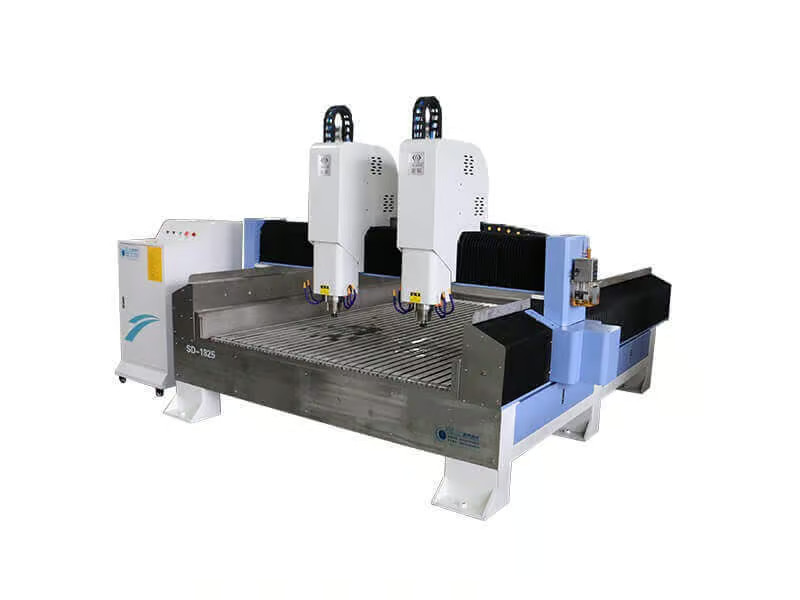 Stone Engraving Machines
 Thin Stone Veneer Saw Machine
 Horizontal Stone Slab Splitting Machine
 Stone Edge Polishing Profiling Machine
 Stone Auxiliary Equipment
In the capital-intensive arena of dimensional stone extraction, procurement departments frequently fall into a fatal accounting trap: evaluating cutting tools solely by their initial invoice price. However, according to Total Cost of Ownership (TCO) matrices published by the Society for Mining, Metallurgy & Exploration (SME), “Purchase Price Per Piece” is a deceptive metric that ignores marginal profit optimization. In chain saw operations, the only scientific standards that determine balance sheet health are Yield Per Cutting Edge and the Total Cost Per Square Meter ($/m²). When you factor in the labor and lost productivity associated with changing dull tools, cheap single-edge inserts quickly become the most expensive items in your quarry.
A newly appointed procurement director at a major Italian marble quarry recently attempted to slash the tooling budget. They replaced their premium MosCut indexable inserts with traditional, single-edge welded carbide teeth that cost 60% less per piece. While the upfront invoice looked fantastic, the month-end financial audit revealed a catastrophic drop in net profit. The cheap teeth blunted rapidly in the abrasive marble, forcing the machine operators to halt production up to 8 times a day to unbolt and replace the chain tools. During these daily stoppages, the main saw motor sat idle, heavy excavators waited uselessly, and diesel fuel was burned for zero output. The quarry lost hundreds of square meters in daily volumetric yield. Upon returning to MosCut’s 8-edge indexable PCD inserts, the upfront budget rose, but the chain saw ran continuously. The total monthly production surged by 45%, and the true comprehensive cost per square meter extracted was slashed by an incredible 50%.
The Procurement Illusion: Why Price Per Piece Lies
Evaluating mining tools strictly by their immediate invoice price is a recipe for operational bankruptcy.Traditional procurement mindset dictates that if Tool A costs $10 and Tool B costs $80, Tool A is the better buy. In the realm of superabrasives (PCD and CBN), this logic is fundamentally flawed. When you purchase a premium diamond insert, you are not paying for the small square of tungsten carbide steel; you are paying for the incredibly complex, high-pressure sintered layer of synthetic diamond molecules on top of it.
If you purchase a cheap, single-edge welded tooth, you use that edge until it dulls, and then you throw the entire piece of steel away. You are wasting raw material. True lean engineering utilizes Geometric Design to maximize the utility of that expensive superabrasive layer. By shaping the insert to provide multiple cutting edges, you amortize the high upfront manufacturing cost across numerous lifecycles without having to buy a new base piece of steel.

Decoding Geometry: The 4-Edge vs. 8-Edge Matrix
A simple change in structural geometry can multiply your tool lifecycle by eight times.🛑 Single-Edge Welded
The traditional standard. It possesses exactly one active cutting face. If the chain hits a hard nodule and chips that single face, or if it simply dulls from friction, the entire heavy steel component is instantly transformed into useless scrap. Yield utilization is 100% linear and highly inefficient.
📐 Square Indexable (4-Edge)
A massive leap in efficiency. A square PCD insert gives the operator four independent, razor-sharp corners. When edge #1 dulls, you loosen a single screw, rotate the insert 90 degrees, tighten it, and resume cutting with edge #2. You have effectively multiplied the value of the tool by four.
🎯 Octagonal Indexable (8-Edge)
The flagship MosCut geometry. Through precision micron-grinding, we engineer eight distinct, highly robust cutting edges onto a single insert. A quick 45-degree rotation instantly yields a fresh blade. Without increasing the bulk of the tool holder, you multiply the insert’s lifespan by eight.
The Mathematical ROI Formulas
Numbers don’t lie. Run these two equations on your quarry’s monthly ledger to reveal the truth.To accurately compare a cheap single-edge tooth against a premium MosCut 8-edge PCD insert, your accounting department must utilize the True Cost per Edge formula:
Example: If a single-edge tooth costs $15, its cost per edge is $15. If a MosCut 8-edge PCD insert costs $80, its true cost per edge is precisely $10 ($80 ÷ 8). The “expensive” tool is already 33% cheaper per edge.
Next, you must calculate how that cost translates to actual rock extracted:
If that single carbide edge cuts 5m² ($15 ÷ 5 = $3.00/m²), but the single PCD edge cuts 50m² ($10 ÷ 50 = $0.20/m²), the financial debate is permanently settled.
⏳ The Hidden Profit Leak: The Cost of Downtime
The direct mathematical formulas above don’t even account for the massive amount of capital you burn when the chain stops spinning. Replacing a set of dull, single-edge welded teeth requires entirely disassembling the chain or grinding off welds—a process taking 30 to 60 minutes.
If you use cheap tools and must stop 5 times a shift, you lose 4 hours of production daily. During those 4 hours: the main saw spindle is idle, your heavy loaders and cranes are parked waiting for blocks, your generator is burning diesel, and your crew is collecting hourly wages while Daily Volumetric Yield drops to zero. Indexing an 8-edge insert takes minutes, keeping your extraction machinery doing what it was financed to do: cutting stone.
The Ultimate Financial Showdown Matrix
Look at the comprehensive balance sheet over a 30-day continuous marble extraction cycle.| Extraction Metric | Cheap Single-Edge Carbide | MosCut 8-Edge PCD Insert |
|---|---|---|
| Upfront Price per Piece | $15.00 (Appears Cheap) | $80.00 (Appears Expensive) |
| Number of Available Edges | 1 | 8 |
| True Cost per Edge | $15.00 | $10.00 (33% Lower) |
| Average Yield per Edge (Marble) | 8 m² | 60 m² |
| Total Yield per Insert Lifecycle | 8 m² | 480 m² (60x greater) |
| Monthly Downtime (Tool Changes) | 45 Hours (Massive labor waste) | 4 Hours (Quick rotation) |
| True Comprehensive Cost ($/m²) | $1.87 / m² | $0.16 / m² (The Lowest TCO) |
Stop Bleeding Profit on Frequent Tool Changes
Stop draining your quarry’s profit margins on inefficient, single-edge consumables. Transition to MosCut’s 8-edge indexable superabrasive inserts and drive your true extraction cost to the absolute minimum.
Calculate Your ROI with MosCut