
 Stone Cutting Machines
 Stone Polishing Machines
 Bridge Saw Machines
 Stone Quarry Cutting Machines
 Stone Block Cutter Machine
 CNC Stone Wire Saw Machine
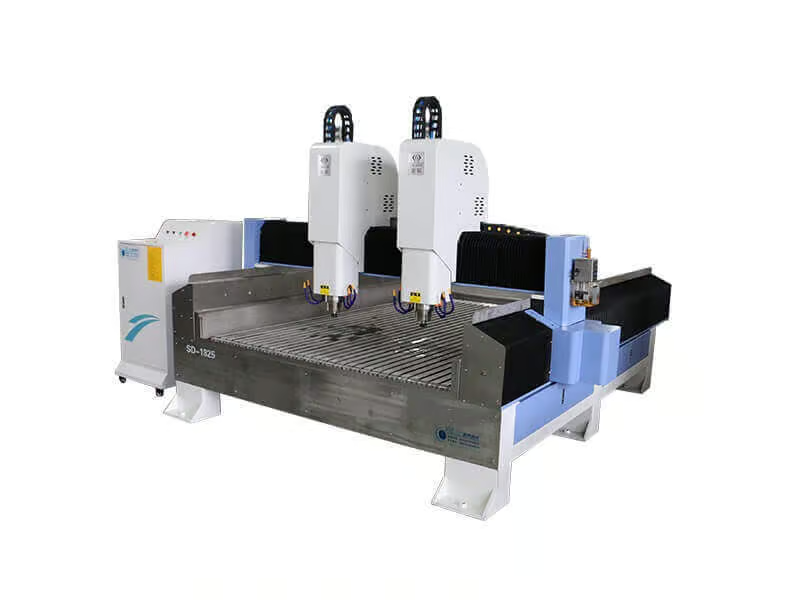 Stone Engraving Machines
 Thin Stone Veneer Saw Machine
 Horizontal Stone Slab Splitting Machine
 Stone Edge Polishing Profiling Machine
 Stone Auxiliary Equipment
In the heavy-duty stone extraction industry, one of the most misunderstood phenomena is “Blade Wobbling.” Many quarry operators mistakenly assume that a 3.0-meter steel disc that sits perfectly flat on the ground will remain flat when mounted to a machine. This ignores the extreme physics of Rotational Rigid Body Dynamics. According to metallurgical stress standards published by ASM International, when high-carbon steel is subjected to extreme peripheral thermal loads and simultaneous centrifugal force, it undergoes aggressive dimensional deformation. Because the outer cutting edge gets incredibly hot while the inner arbor remains cool, the steel expands unevenly. If the manufacturer does not artificially induce a permanent “Pre-stress” (Dynamic Tensioning) into the core before it leaves the factory, the blade will warp like a potato chip the moment it enters the rock face.
A premium architectural granite quarry in Spain learned the true cost of un-tensioned steel the hard way. They procured a batch of budget 3.3m blades for their double-blade mining machines. Within hours of operation, the blades began screaming and wobbling violently in the cut. The resulting granite blocks emerged covered in deep, wavy gouges. When these defective blocks were sent to the processing plant’s gang saws, the plant had to grind away nearly 15% of the total block volume just to make the surfaces flat again. MosCut field engineers intervened, educating the quarry owners on the absence of dynamic tensioning in their cheap blades. We replaced them with MosCut 3300mm blades, which had been precision-rolled and hammer-tensioned by our master smiths. The result was instantaneous: the cuts became laser-straight, stopping the 15% material waste and restoring the quarry’s profitability.
The Dual Threat: Centrifugal Force & Friction Heat
A 3-meter steel disc sitting quietly on the floor behaves entirely differently when spinning at 600 RPM inside solid granite.To understand blade tensioning, we must first understand the two extreme forces trying to tear the blade apart during operation:
1. Centrifugal Stretching: As a massive blade spins, centrifugal force pulls the mass of the steel outward. The outer edge (the periphery) is traveling at up to 35 meters per second, subjecting the steel to immense outward stretching tension.
2. Asymmetrical Thermal Expansion: This is the ultimate blade killer. When cutting rock, the friction at the diamond edge generates hundreds of degrees of heat. However, the center of the blade (bolted to the cool steel flange) remains at ambient temperature. Because metals expand when heated, the outer rim of the blade literally grows longer in circumference, while the inner core does not.

This physical reality is governed by the Thermal Expansion formula:
(Where the change in length $Delta L$ is dictated by the extreme change in temperature $Delta T$ at the outer rim.)
The Consequence: Because the hot outer rim becomes too long for the cool inner core to support, the outer edge becomes “floppy.” It loses its rigidity and instantly warps sideways, violently slapping against the rock walls.
The Antidote: What is Dynamic Tensioning?
To stop a blade from warping when it gets hot, we must warp it intentionally before it leaves the factory.🔨 The Counter-Stress
Tensioning is the process of intentionally stretching the inner and middle zones of the steel core while it is cold in the factory. By permanently expanding the middle of the blade, we create a predetermined counter-stress.
⚡ The Elastic Band Effect
Because the middle of the steel has been stretched out, it pulls violently inward on the outer rim. When cold, a properly tensioned blade feels like a highly stretched elastic band—the outer cutting edge is under intense compressive stress, making it exceptionally rigid.
⚖️ Thermal Equilibrium
Here is the magic: When the blade hits the rock and the outer edge heats up and tries to expand, it simply relieves the compressive stress we built into it. Instead of warping, the heat causes the blade to reach a state of perfect “Thermal Equilibrium.” At maximum RPM and heat, the blade becomes perfectly straight and stable.
The MosCut Process: CNC Rollers & Master Smiths
Perfect tension cannot be cast or molded. It must be forged through precise, methodical force.Applying the exact amount of tension to a 75Cr1 steel core requires a blend of heavy machinery and artisanal skill. Cheap blade manufacturers skip this step entirely, resulting in “dead steel” that wobbles on day one.
- CNC Roller Tensioning: At MosCut, the raw steel core is placed on a specialized hydraulic rolling machine. Heavy tungsten rollers press into specific radius lines along the middle of the blade, physically compressing and stretching the molecular structure of the steel in perfectly concentric rings.
- Manual Hammering (The Master’s Touch): Machines cannot detect localized, microscopic anomalies in the steel grain. We employ master smiths with decades of metallurgical experience. Using specialized tensioning hammers and straight-edges, they strike the steel by hand, listening to the “ring” of the metal to detect and pound out the smallest internal warping.

⚠️ Field Diagnostics: Is Your Blade Losing Tension?
Dynamic tension is not immortal. Severe overheating (running without water) or violent mechanical impacts can permanently erase the tension we built into the steel, returning it to a “dead” state. Watch for these symptoms:
- The Screaming Noise: If a blade suddenly begins emitting a very high-pitched, erratic, and deafening squeal that changes pitch, it is vibrating laterally. It has lost tension.
- Hot Flanges / Blue Burn Marks: If you see dark blue heat discoloration creeping down the steel core toward the center mounting flange, the blade has overheated and the tension is gone.
- Wavy Kerf: Look at the rock face you just cut. If the surface looks like a washboard with deep ridges instead of a flat wall, the blade is wobbling heavily. Stop the machine immediately to prevent core cracking.
The True Cost of Warped Cuts
A cheap, un-tensioned blade will cost you thousands of dollars in wasted stone at the processing plant.The Hidden Processing Penalty
The quarry is only the first step in the stone supply chain. If you use a cheap blade that wobbles, you extract blocks with wavy, uneven surfaces. When that block is sent to the processing facility to be sliced into slabs using a multi-blade gang saw or a multi-wire machine, the first and last slabs are completely ruined by those deep waves.
To fix this, the processing plant must waste hours running a calibrating grinder over the block, essentially turning 10% to 15% of your valuable, sellable granite into useless dust just to make the sides flat again. By investing slightly more in a high-tension MosCut blade, you guarantee perfectly straight, geometric blocks that maximize your total cubic meter yield and command the highest auction prices.
Demand Absolute Rigidity
Stop settling for wobbly cuts, dropped segments, and ruined stone blocks. Equip your double blade mining machines with MosCut’s CNC-tensioned, 75Cr1 steel quarry blades and cut straight every single time.
View Tension-Calibrated Saw Blades