
 Stone Cutting Machines
 Stone Polishing Machines
 Bridge Saw Machines
 Stone Quarry Cutting Machines
 Stone Block Cutter Machine
 CNC Stone Wire Saw Machine
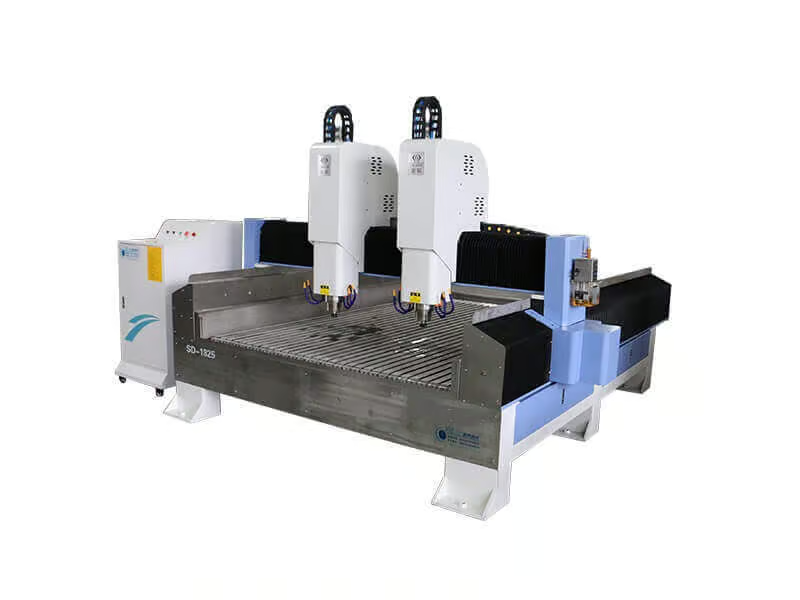 Stone Engraving Machines
 Thin Stone Veneer Saw Machine
 Horizontal Stone Slab Splitting Machine
 Stone Edge Polishing Profiling Machine
 Stone Auxiliary Equipment
Premium Saw Blades For Quarry Cutting
Manufacturing ultra-large diameter circular saw blades (ranging from 2.2m to 4.2m) is one of the most demanding metallurgical challenges in the diamond tool industry. When a 3000mm steel core spins at high RPM on a quarry face, the peripheral edge travels at tremendous speeds. According to dynamic balancing and stress standards established by the Federation of European Producers of Abrasives (FEPA), any microscopic imbalance or uneven tension in the steel core is exponentially magnified, resulting in severe lateral deflection known as “Wobbling.” This not only creates wavy, unmarketable stone blocks but also generates immense shear stress that can cause diamond segments to violently detach. MosCut quarry blades are engineered to eliminate this hazard. Through multi-stage CNC hammer tensioning and fully automated high-frequency silver brazing, our blades guarantee zero wobbling and maximum segment retention under extreme geological pressure.
A prominent sandstone and hard-limestone quarry in Egypt previously relied on budget 3.0m and 2.2m blades for their double blade mining machines. Due to the high abrasiveness of the stone and poor steel core tensioning, their cheap blades wobbled violently, leaving deep wave-marks on the block surfaces. Even worse, the erratic vibrations frequently caused segments to snap off, leading to expensive machine downtime for field re-brazing. Upon switching to MosCut’s precision-tensioned 75Cr1 steel blades—equipped with our proprietary high-abrasion Hard Bond segments—the quarry experienced a complete operational turnaround. The cuts became laser-straight, increasing their premium block yield by 20%, and segment dropping was completely eradicated, slashing their monthly consumable costs.
Solving Critical Quarry Blade Pain Points
When operating a 3-meter steel blade at high RPM, precision is survival. We engineered the flaws out of quarry cutting.Zero Blade Wobbling
Forged from authentic German 75Cr1 high-strength alloy steel. Every single core undergoes master-level CNC pre-tensioning and roller-leveling to ensure absolute rigidity and a perfectly straight cutting trajectory at high speeds.
No Segment Dropping
We utilize fully automated High-Frequency Silver Brazing technology. Our silver solder achieves 100% penetration, generating a shear strength that far exceeds industry safety standards, effortlessly resisting the violent impacts of hard rock.
Aggressive Cutting Speed
Featuring specialized segment architectures (such as M-shape, W-shape, or Stepped designs) specifically engineered for quarrying. These shapes drastically reduce initial cutting friction, allowing for extremely fast down-feed rates.
Extended Segment Life
Packed with ultra-high concentration industrial diamonds and tailored metal bond matrices. Our segments strike the perfect thermodynamic balance between continuous self-sharpening and extreme abrasive wear resistance.
Anatomy of a Giant: The 3-Meter Engineering
A large quarry blade is not just a bigger factory blade; it is a specialized instrument of extreme metallurgical engineering.
The Core: 75Cr1 spring steel provides the crucial ‘toughness’ required to resist twisting forces in the quarry.
⚙️ The Core: 75Cr1 High-Tensile Steel
A quarry blade must be hard enough to resist bending, yet tough enough to absorb massive lateral shocks without shattering. MosCut utilizes premium 75Cr1 spring steel. The secret to our zero-wobble performance lies in Dynamic Tensioning. Before any diamonds are attached, the blank steel is repeatedly hammered and rolled by specialized CNC machines. This introduces calculated internal stresses that perfectly counteract the centrifugal expansion the blade experiences when spinning at 600 RPM.

The Brazing Zone: High-frequency silver brazing protects the diamonds from thermal damage while ensuring unbreakable shear strength.
🔥 The Brazing Zone: High-Frequency Silver
Standard welding destroys diamond crystals. To attach the teeth to the core, we use an automated High-Frequency Induction brazing process with premium silver solder. The silver melts and flows instantly, creating a flawless metallurgical bond in seconds. This rapid localized heating ensures the internal structure of the diamonds is completely protected from thermal degradation, while achieving a mechanical shear strength that guarantees the segment will never tear off during heavy extraction.
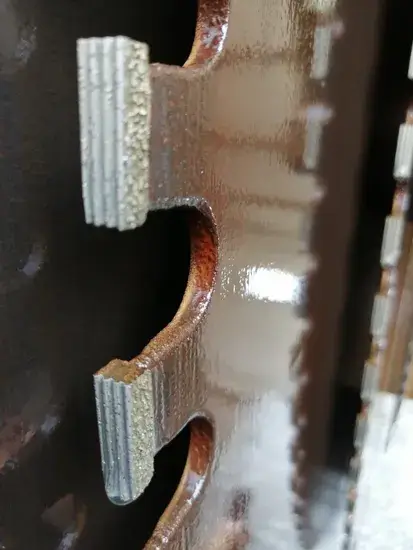
The Diamonds: The multi-layer sandwich structure guarantees the segment maintains its cutting width, preventing the steel core from getting pinched.
💎 The Diamonds: Sandwich Structure Segments
Quarry segments must cut a path wider than the massive steel core behind them; otherwise, the blade gets pinched and stuck in the rock. MosCut segments employ a highly advanced Sandwich (Multi-layer) Structure. The outer layers of the segment contain a higher concentration of diamonds and a harder metal bond than the inner layer. This ensures the sides of the segment wear down much slower than the middle, maintaining a perfect, wide cutting channel (kerf) throughout the blade’s entire lifecycle.
Segment Formulations by Rock Type
Cutting abrasive sandstone requires a completely different thermodynamic approach than cutting hard granite. We customize the chemistry for your geology.Granite Quarry Blades: Granite is incredibly dense and hard, quickly blunting diamond crystals. If the metal holding the diamonds is too hard, the blade will “glaze” over and stop cutting. Our granite segments utilize a precisely calibrated Soft Cobalt-based Bond. This allows the metal to wear away at the exact right speed, continuously shedding dull diamonds and exposing fresh, razor-sharp crystals to maintain an aggressive down-feed rate.

Granite Bond: Soft matrix ensures continuous self-sharpening in extremely hard rock.
Marble Quarry Blades: Marble is softer and more brittle, allowing for exceptionally high cutting speeds. The primary goal is a smooth, chip-free finish on the valuable blocks. Our marble blades use a specialized Medium-Soft Bronze Bond combined with highly resilient diamonds. This formulation prevents the segments from wearing out too quickly while delivering a polished, perfectly straight cut face.

Marble Bond: Optimized for blistering cutting speeds and flawless, chip-free block surfaces.
Laterite, Sandstone & Limestone Blades: These sedimentary rocks are relatively soft but contain massive amounts of loose silica (quartz sand). This creates a highly abrasive “sandpaper” effect that will quickly grind away standard tools. MosCut solves this by engineering an ultra-tough Hard Tungsten-Carbide Bond. This armor-like matrix locks the diamonds securely in place and violently resists the abrasive grinding of the slurry, drastically extending the life of the blade.

Abrasive Stone Bond: Tungsten-carbide reinforcement provides absolute resistance against abrasive silica slurry.
Technical Specifications
Select the exact diameter and segment configuration for your double blade mining machine. Note: Custom arbors (center holes) are available upon request.| Blade Diameter (mm) | Core Thickness (mm) | Segment Size (L x W x H) mm | Segment Quantity (pcs) | Standard Arbor (mm) |
|---|---|---|---|---|
| 2000 mm | 8.5 mm | 24 x 10.5 x 20 mm | 128 pcs | 100 / 130 |
| 2200 mm | 8.5 mm | 24 x 11.5 x 20 mm | 132 pcs | 100 / 130 |
| 2400 mm | 8.5 mm | 24 x 11.5 x 20 mm | 136 pcs | 100 / 130 |
| 3000 mm | 9.0 mm | 24 x 12.5 x 20 mm | 140 pcs | 100 / 130 |
| 3300 mm | 9.5 mm | 24 x 13.0 x 20 mm | 150 pcs | 100 / 130 |
| 4000 mm | 10.0 mm | 24 x 13.5 x 20 mm | 180 pcs | 130 / 150 |
| 4200 mm | 10.5 mm | 24 x 14.0 x 20 mm | 188 pcs | 130 / 150 |
The Perfect Synergy: Double Blade Quarry Cutting Machines
The Ultimate Extraction Ecosystem
MosCut large-diameter saw blades are the critical “teeth” of the world’s most efficient block extraction technology: the Double Blade Quarry Cutting Machine. These massive machines travel along rail tracks laid directly on the bedrock, utilizing two giant blades (often one larger and one smaller) to slice perfectly parallel, deep trenches into the stone.
Because the blades are guided by the rigid rails of the machine, the cut is exceptionally clean, eliminating the need for secondary squaring and drastically reducing material waste compared to traditional explosive or wire saw methods in open-pit quarries.
Explore MosCut Double Blade Quarry Machines →Standard Operating Procedure: Safe Installation & Cooling
Operating a 3000mm steel disc requires absolute discipline. Protect your crew and your blades with this 3-step protocol.🧼 Step 1: Flange Cleaning
The steel flanges that clamp the blade to the machine motor must be surgically clean. If even a 0.1mm grain of sand is caught between the flange and the blade core, that microscopic angle will be multiplied across the 1.5-meter radius, resulting in severe, destructive wobbling at the cutting edge.
🔄 Step 2: Start-Up Tension Check
After mounting the blade securely, elevate the machine so the blade is suspended in the air. Turn the motor on and let the blade spin freely (dry). Stand safely to the side and observe the edge. It should run perfectly true. Listen carefully; a high-pitched, erratic screaming noise indicates improper seating or flange issues.
🌊 Step 3: Extreme Water Flooding
A 3-meter steel disc generates immense friction heat. Standard water cooling is not enough—you need Extreme Flooding. Ensure the machine’s water jets are aggressively spraying high-volume coolant directly into the cut slot on both sides of the blade. Without water, the silver braze will melt in minutes and segments will fly off.
Machine in Action: Working Video
Watch MosCut giant saw blades effortlessly slice through solid bedrock on a double blade mining machine.Global Customer Success Stories
Delivering flawless extraction yields in the world’s most demanding open-pit quarries.
Egypt: Abrasive Limestone
Upgraded to MosCut 3000mm Hard-Bond blades to combat extreme silica abrasion, resulting in zero dropped segments and a 35% increase in total lifespan.

Brazil: Hard Granite Blocks
Utilized our perfectly tensioned 3300mm soft-bond blades to achieve laser-straight cuts, increasing premium block yield by eliminating wavy cut faces.

Kenya: Laterite Extraction
Deployed specialized stepped-segment designs to rapidly slice through dense laterite beds, doubling their daily cubic meter production rate.

India: High-Volume Production
Standardized their entire fleet of machines with MosCut 2200mm and 3000mm blade pairs, achieving unparalleled consistency and zero downtime from wobbling.
Related Insights & Maintenance Guides
Master the metallurgy of large-diameter cutting to maximize your tool life.
Why Do Saw Blade Segments Drop?
Diagnose the root causes of brazing failure, from inadequate water cooling to improper machine down-feed speeds.
Read More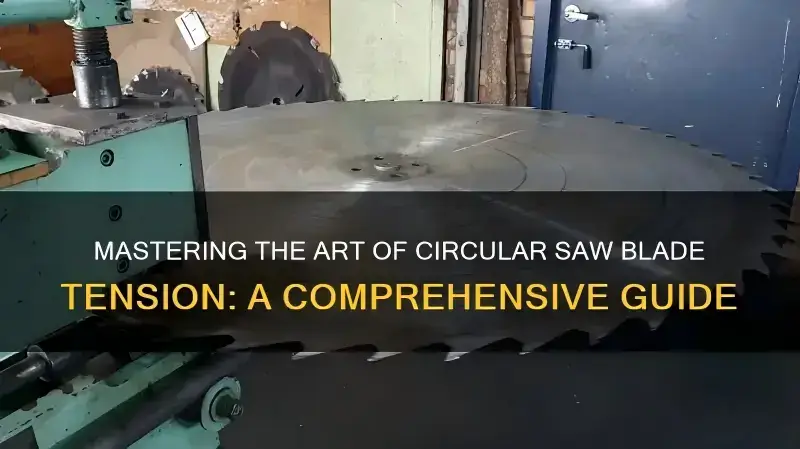
The Science of Dynamic Tensioning
Learn why hammering and pre-tensioning the steel core is the only way to prevent a 3-meter blade from warping at high RPMs.
Read More
Hard vs. Soft Bond: Choosing Segments
Stop glazing your blades. Understand exactly when to specify a soft metal matrix for granite versus a hard matrix for sandstone.
Read More
How to Fix Blade Wobbling
Is your cut wavy? Follow this troubleshooting guide to identify flange debris, core fatigue, and alignment issues.
Read MoreEquip Your Quarry with Giant Precision
Stop settling for wavy cuts, dropped segments, and machine downtime. Equip your double blade mining machines with MosCut premium, tension-calibrated large-diameter saw blades and maximize your block yield.
View All Stone Quarrying Accessories & ToolsFrequently Asked Questions
1. How deep can a 3000mm (3-meter) quarry blade cut?
The maximum cutting depth is slightly less than half the blade’s diameter, due to the central arbor and the machine’s mounting flange. A 3000mm blade typically achieves a maximum clean cutting depth of approximately 1300mm to 1350mm (1.3 to 1.35 meters).
2. If the segments wear out, can I buy replacement segments and weld them myself?
For standard factory blades, yes. However, for ultra-large 2m-4m quarry blades, field re-tipping is highly complex. It requires precise high-frequency silver brazing. If not done perfectly, the heat will warp the tensioned steel core, causing severe wobbling. We recommend utilizing professional re-tipping services or purchasing complete new blades for guaranteed safety.
3. Why are the segments shaped like an ‘M’ or have steps?
M-shaped or stepped segment designs significantly reduce the total surface area contacting the stone during the initial cut. This lowers friction, prevents the blade from skipping, and allows for a much more aggressive and faster down-feed rate right from the start of the extraction.
4. What causes the steel core of the blade to crack?
Core cracking is usually caused by excessive thermal stress (running the blade without enough water) or extreme mechanical fatigue (forcing the blade down too fast or running it while it is wobbling). Both scenarios push the 75Cr1 steel past its flexible limits, causing fatigue fractures near the segments or the arbor.
5. What is the correct cutting speed for granite vs. marble?
Speed relies on two factors: RPM (peripheral speed) and Down-feed speed. For hard granite, the blade should run at a lower peripheral speed (approx. 25-30 m/s) with a steady down-feed. For softer marble, the blade can run much faster (35-45 m/s) with a highly aggressive down-feed. Your machine’s inverter allows you to adjust these parameters.
6. How do I transport and store a 3-meter saw blade?
Giant blades are highly susceptible to warping if mishandled. They must always be transported and stored completely flat on a solid, level surface (like a wooden pallet). Never lean a large blade against a wall at an angle for extended periods, as its own immense weight will permanently bend the steel core.
7. Why did my blade cut perfectly yesterday, but is wobbling today?
If the blade hasn’t been damaged, the most common culprit is flange contamination. When the machine was stopped, dried stone slurry or a small pebble may have fallen between the blade and the mounting flange. Remove the blade, clean the flange plates meticulously, and remount it.
8. Does MosCut offer blades larger than 4200mm?
Yes, we can engineer custom blades up to 4500mm (4.5 meters) in diameter for specialized ultra-deep block extraction machines. These require custom manufacturing lead times and specific flange details from your equipment manufacturer.
9. What does ‘Sandwich Structure’ mean for the diamond segments?
A sandwich segment has three distinct vertical layers. The two outer layers use a harder metal bond and higher diamond concentration than the middle layer. This ensures the segment wears down in a concave ‘U’ shape, maintaining sharp cutting edges on the sides and preventing the steel core from ever rubbing against the stone walls.
10. Can I use a granite blade to cut sandstone?
It is not recommended. Granite blades use a ‘soft bond’ to keep the diamonds exposed. Sandstone is highly abrasive. If you use a soft granite bond on sandstone, the abrasive silica will chew away the soft metal matrix instantly, causing the diamonds to fall out prematurely and ruining the blade in record time.