
 Stone Cutting Machines
 Stone Polishing Machines
 Bridge Saw Machines
 Stone Quarry Cutting Machines
 Stone Block Cutter Machine
 CNC Stone Wire Saw Machine
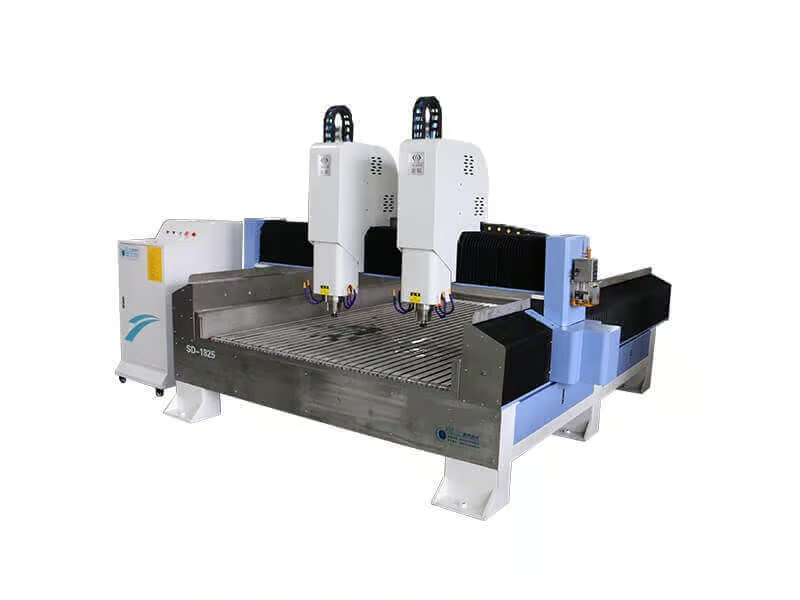 Stone Engraving Machines
 Thin Stone Veneer Saw Machine
 Horizontal Stone Slab Splitting Machine
 Stone Edge Polishing Profiling Machine
 Stone Auxiliary Equipment
In the realm of extreme industrial cutting, a dropped diamond segment on a large-diameter quarry blade is a catastrophic event. It instantly ruins the blade’s dynamic balance, destroys the cutting kerf, and presents a lethal projectile hazard to operators. To understand why this happens, one must look at the metallurgical science of “Capillary Brazing.” According to brazing and soldering standards published by the American Welding Society (AWS), the shear strength of a silver-brazed joint between a tungsten-carbide matrix (the segment) and carbon steel (the core) is entirely dependent on temperature control and flawless capillary penetration. Diamond segments are not “welded”—they are glued with molten silver. Therefore, segment detachment is almost exclusively caused by three factors: thermal overload melting the silver, lateral forces exceeding the shear strength, or cheap manufacturers using low-grade filler metals.
A major sandstone quarry in South Africa recently battled a severe segment-dropping epidemic. Operating massive 3000mm double-blade machines equipped with budget-brand blades, they experienced continuous segment blowouts deep inside the cuts. Production plummeted as workers feared standing near the machinery. MosCut technical engineers were dispatched to audit the site. The diagnosis was classic “Thermal Starvation.” The quarry’s water pumps lacked the pressure to force coolant 1.5 meters deep into the sandstone cut. The resulting friction spiked the blade temperature past 700°C, causing the silver solder to literally re-melt and fling the segments off. After upgrading their water pressure systems and switching to MosCut blades—which utilize a proprietary 50% High-Silver solder capable of withstanding extreme thermal shock—the segment loss dropped to zero, and the quarry resumed safe, high-speed extraction.
The Physics of Brazing: How Segments are Attached
Diamond segments are not welded; they are brazed. Understanding this metallurgical distinction is the key to preventing failure.You cannot use standard high-temperature welding (like MIG or TIG) to attach a diamond segment to a steel core. Standard welding requires temperatures exceeding 1,500°C. At that temperature, the industrial diamonds inside the segment would instantly carbonize, turning into useless graphite, and the segment would disintegrate.
Instead, manufacturers use High-Frequency Silver Brazing. A thin ribbon of silver-alloy solder is placed between the steel core and the segment. Using an induction coil, the area is heated to approximately 650°C to 750°C. The silver melts and uses capillary action to seep into the microscopic pores of both metals, “gluing” them together with immense strength. The critical takeaway: Because the melting point of the silver bond is relatively low (around 700°C), friction heat is the ultimate enemy of your blade.

🔥 Culprit 1: Thermal Starvation & Coolant Failure
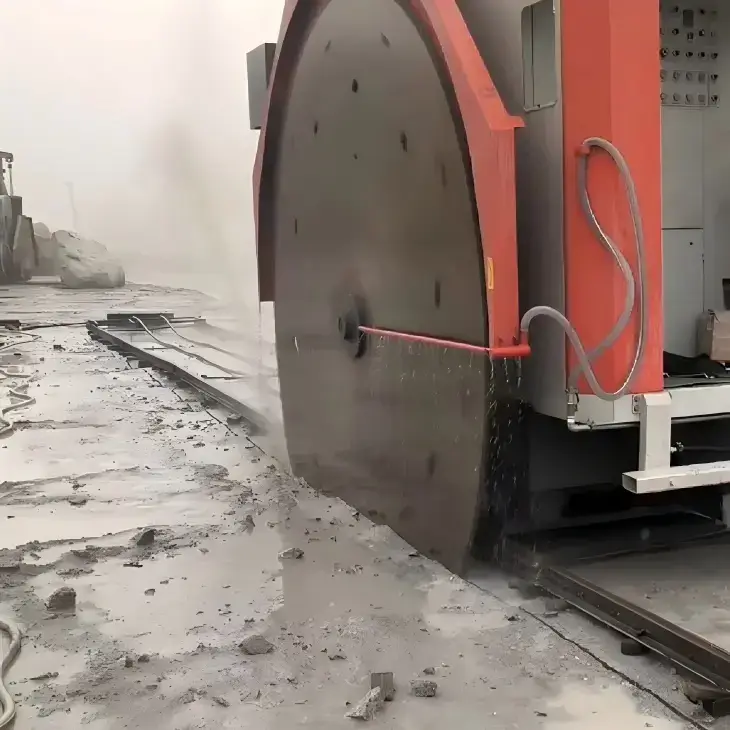
If your blade runs dry, your segments will melt off in seconds. When a 3000mm blade is cutting 1.3 meters deep into solid rock, it generates astronomical friction heat. If the water jets at the surface are weak, the coolant turns to steam before it ever reaches the bottom of the cut. This is known as “Thermal Starvation.” Without water, the temperature at the cutting edge rapidly exceeds 800°C. The silver brazing holding the segment undergoes secondary melting (re-melting). The bond liquifies, and the high-speed centrifugal force of the spinning blade instantly flings the segment into the rock wall. If you see dark blue or black burn marks on the steel teeth where the segment used to be, lack of water is your definitive killer.
Culprit 2: Lateral Shear from Blade Wobbling
Segments are engineered to withstand massive vertical pressure, not lateral side-slapping.A diamond segment is brazed to withstand immense vertical compressive force—pushing straight down into the rock. However, the brazing joint’s Lateral Shear Strength (resistance to being pushed from the side) is significantly lower.
If a large quarry blade is poorly tensioned at the factory, or if dirt is trapped under the mounting flange, the blade will suffer from “Wobbling” (deflection). As the wobbly blade spins, the segments violently slap against the left and right walls of the narrow rock cut. This brutal side-to-side impact acts like a hammer hitting the side of the segment, eventually snapping it clean off the silver joint through sheer lateral stress.
Culprit 3: Shock Loading on Hard Nodules
Slamming a blade into a quartz vein at full speed will shatter the metallurgical bond.📉 The Aggressive Down-feed
Many segment losses are pure operator error. To speed up extraction, an operator might set the machine’s down-feed (plunge) rate far too high. If the blade is forced into the rock faster than the diamonds can physically grind it away, the extreme mechanical impact overloads the tensile limit of the silver solder, shearing the segments off instantly. Always listen to the machine’s amperage load.
🪨 Hard Geological Anomalies
Quarries are not perfectly homogenous. You may be cutting soft limestone seamlessly, but suddenly the blade impacts a highly dense quartz nodule or a flint vein hidden inside the rock. This sudden, violent deceleration creates a massive kinetic “Shock-load” on the leading edge of the segments, knocking them clean off the steel core.
Manufacturer Defect: The Cheap Solder Problem
Not all brazing is created equal. Cheap blades cut corners exactly where you can’t see them.If your water is flowing, your blade isn’t wobbling, and your feed rates are perfect, yet segments still drop—you are the victim of cheap manufacturing.
Premium quarry blades require silver solder containing 35% to 50% pure silver to guarantee the necessary elasticity and heat resistance. Silver is extremely expensive. To cut costs, budget blade manufacturers use cheap copper-phosphorus solder containing 10% silver or less, or they use manual flame torches resulting in “Cold Brazing” (poor capillary penetration). These brittle, inadequate joints are ticking time bombs on a 3-meter quarry blade.
At MosCut, we eliminate this risk entirely. We utilize fully automated high-frequency induction brazing with premium, high-silver alloys, guaranteeing 100% joint penetration and a shear strength that dominates the toughest granite.
Stop Risking Your Production on Cheap Brazing
Stop putting your crew in danger and halting your extraction for blade repairs. Upgrade to MosCut’s precision-brazed, tension-leveled large diameter quarry blades and cut with absolute confidence.
View MosCut Quarry Saw Blades