
 Stone Cutting Machines
 Stone Polishing Machines
 Bridge Saw Machines
 Stone Quarry Cutting Machines
 Stone Block Cutter Machine
 CNC Stone Wire Saw Machine
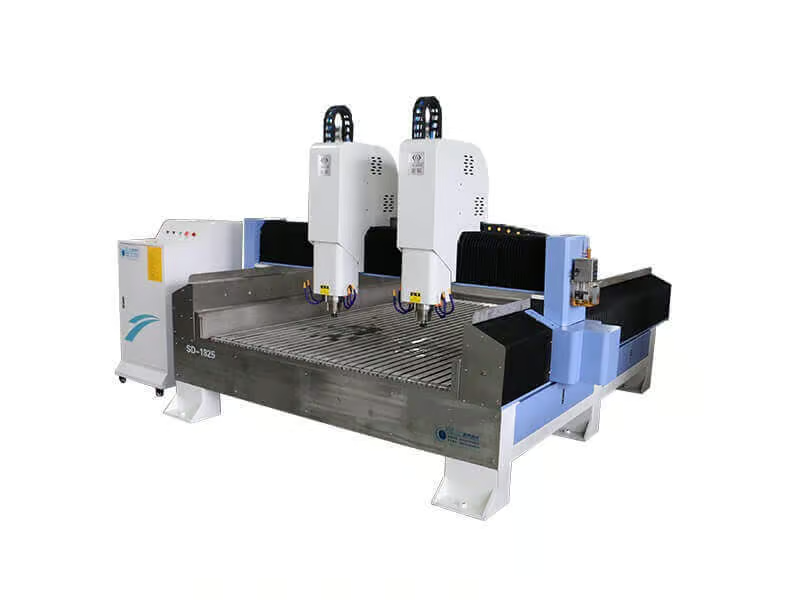 Stone Engraving Machines
 Thin Stone Veneer Saw Machine
 Horizontal Stone Slab Splitting Machine
 Stone Edge Polishing Profiling Machine
 Stone Auxiliary Equipment
In the heavy industrial sector of dimensional stone extraction, procurement departments routinely fall into a deceptive accounting trap: prioritizing the lowest immediate purchase price per meter. According to quarry management and global production benchmarking guidelines published by the Natural Stone Institute (NSI), the lifetime value and Total Cost of Ownership (TCO) of extraction tools must override initial capital expenditure. In a raw stone block cutting application, a cheap, poorly manufactured wire saw rope represents an artificial saving. The only mathematical standard that dictates a quarry’s actual balance sheet health is the True Direct Cutting Cost Per Square Meter (USD/m²), which incorporates consumable longevity and mechanical throughput speeds.
A massive, state-backed granite operation in Egypt recently underwent a severe financial contraction after attempting to slash operational budgets. The procurement manager swapped their premium consumable supplier for an unbranded alternative costing just $20 per meter. Within 30 days, their net monthly extraction yield cratered, despite the diamond wire budget appearing “cheaper.” The low-grade wire lacked diamond concentration and cut excessively slow, while breaking repeatedly. MosCut’s financial and field engineering teams intervened, conducting a rigorous TCO analysis that convinced the owner to deploy MosCut’s $40/meter premium vulcanized rubber wire. While the upfront purchase cost doubled, MosCut’s wire cut at twice the speed with zero snapping incidents, yielding 20 square meters per meter. Ultimately, the quarry’s true direct cost per square meter dropped by an astounding 45%, proving that premium engineering is the ultimate cost-saving measure.
The “Price Per Meter” Trap: Why Cheap Wire is Expensive
Buying the cheapest wire saw rope on the market is the fastest way to bankrupt a high-overhead quarry.To understand the deception of low-cost diamond wire, one must look at manufacturing compromises. To sell a wire saw rope significantly below market averages, manufacturers must use low-grade synthetic diamond grit with low concentration, inferior recycled rubber compounds, and cheap steel cable cores prone to structural stretching.
This sub-standard anatomy triggers a compounding financial penalty. Cheap wire lacks the aggressive biting force required to cut hard granite smoothly. As the blunt diamonds rub uselessly against the stone face, the machine’s Linear Cutting Speed (m²/h) plummets. In a quarry, time is an expensive asset. Slower cutting speeds mean your wire saw machine operates for twice as many hours to complete a single block cut, forcing your high-output diesel generators to consume massive amounts of fuel while your laborers rack up expensive hourly overtime.

Step 1: Calculating Wire Yield (Consumable Lifespan)
You must meticulously track exactly how many square meters of stone a single loop of wire produces before it dies.Before computing monetary metrics, a quarry engineer must calculate the tool’s physical output ratio, known as the Wire Yield. This is the volume of square meters cut divided by the actual physical length of the consumed wire loop. We express this using the baseline engineering formula:
To accurately log this data, operators must measure the length of each cut multiplied by its height (Length × Height = m²), maintaining a daily log for that specific loop until the diamond beads wear down completely to the safety limit. For example, if a 50-meter loop of wire successfully cuts 400 square meters of marble before needing to be discarded, its physical yield is precisely $400 div 50 = 8text{ m²/m}$.
Step 2: The Direct Cost Formula (The Ultimate Showdown)
This is the only metric that matters on your quarry’s bottom-line balance sheet.Once you have logged the physical yield, you can instantly calculate your true, unmasked financial consumption per square meter using the ultimate direct costing formula:
📊 The ROI Financial Showdown: Cheap vs. MosCut Premium
Let’s run the mathematical reality check using real-world quarry data comparing an unbranded competitor’s wire against MosCut’s premium hot-sintered vulcanized rubber wire cutting medium-hard granite:
- The Cheap Competitor Wire:
- Initial Purchase Price = $20.00 / meter
- Recorded Wire Yield = 8 m² / meter
- True Direct Cost: $20.00 ÷ 8 = mathbf{$2.50 text{ per m²}}$
- The MosCut Premium Diamond Wire:
- Initial Purchase Price = $40.00 / meter
- Recorded Wire Yield = 20 m² / meter
- True Direct Cost: $40.00 ÷ 20 = mathbf{$2.00 text{ per m²}}$
The Mathematical Verdict: Even though the MosCut wire required a 100% higher upfront investment, it saved the quarry owner $0.50 for every single square meter cut. In a medium-sized operation cutting 10,000 square meters per season, switching to the “more expensive” MosCut wire instantly adds $5,000 of pure profit back to the company’s bottom line.
The Hidden Costs: Downtime & Efficiency Penalties
The direct cost formula doesn’t even account for the massive amount of money lost during operational halts.⛽ Extreme Fuel & Utility Overhead
Cheap, low-concentration wires cut slowly. To slice a 50m² granite wall, a cheap wire might crawl along for 15 hours, while a premium MosCut wire completes the task in 8 hours. Slower cutting forces your diesel generator or grid system to run for 7 additional hours under heavy load. The cost of the extra diesel burned frequently exceeds the cost of the entire wire itself.
⏳ The Snapping Downtime Penalty
Inferior wires use cheap steel cores that snap routinely. Every time a wire breaks, your entire quarry team stands idle for 45 to 60 minutes while operators fish out the loose ends, strip the coating, and crimp a new joint. If a wire snaps twice a day, you are burning 2 hours of labor wages on zero productivity, while wasting expensive copper connectors.
Total Monthly ROI Comparison Matrix
Look at the comprehensive financial picture over a standard 30-day block extraction cycle.| Quarry Cost & Efficiency Metric | Cheap Competitor Wire | MosCut Premium Wire |
|---|---|---|
| Upfront Purchase Price (per meter) | $20.00 (Appears economical) | $40.00 (Appears expensive) |
| Average Cutting Speed (m²/hour) | 10 m²/h (Slow, drags out shifts) | 20 m²/h (Fast, doubles output) |
| Consumable Life Yield (per meter) | 8 square meters | 20 square meters |
| Average Wire Snaps (per 30 Days) | 14 incidents (High hazard & high delay) | 0 to 1 incident (Maximum safety) |
| Monthly Diesel Fuel Consumption | Extremely High (Due to prolonged machine runtime) | Minimized (Rapid cutting cycles save fuel) |
| True Comprehensive Cost (per m²) | $3.80 / m² (Includes hidden fuel & labor) | $2.25 / m² (The lowest true cost) |
Stop Bleeding Profit on Cheap Consumables
Stop throwing away your hard-earned profit margins on sub-standard consumables that mask their true costs. Transition to MosCut premium diamond wire saw ropes and drive your true cost per square meter to the absolute minimum.
Calculate Your MosCut ROI