
 Stone Cutting Machines
 Stone Polishing Machines
 Bridge Saw Machines
 Stone Quarry Cutting Machines
 Stone Block Cutter Machine
 CNC Stone Wire Saw Machine
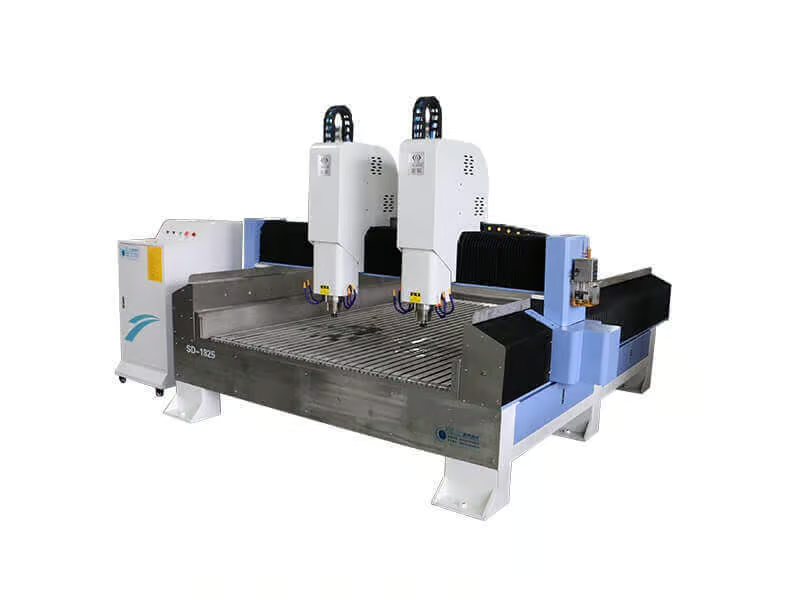 Stone Engraving Machines
 Thin Stone Veneer Saw Machine
 Horizontal Stone Slab Splitting Machine
 Stone Edge Polishing Profiling Machine
 Stone Auxiliary Equipment
In dimensional stone extraction, tool efficiency is defined by uniform material consumption. A diamond wire loop is geometrically designed to operate as a 360-degree cylindrical cutting instrument. However, if the cable fails to execute a continuous axial rotation while travelling through the rock face, it ceases to behave as a rolling wire and transforms into a rigid, static band saw. According to tribological tool wear research catalogued by the Society for Mining, Metallurgy, and Exploration (SME), this phenomenon—scientifically classified as eccentric wear or “oval flat-spotting”—is the single largest driver of artificial lifecycle degradation in flexible diamond consumables. It forces the premature discarding of thousands of meters of high-value wire saw rope simply because one face of the bead has rubbed down to the raw steel skeleton.
A massive basalt quarry in India operating a multi-wire operation found itself hemorrhaging capital due to this precise operational oversight. Their wires were snapping and failing at less than 50% of their expected square-meter output. Upon a meticulous field inspection by MosCut’s technical service team, the diagnosis was immediate and undeniable: 100% of the discarded wires exhibited severe “D-shaped” eccentric profile wear. The quarry’s splicing crew was crimping the connections blindly, without applying any axial pre-twist to the cable. By implementing MosCut’s strict Pre-Twist Standard Operating Procedure—forcing the cable to accumulate internal torsional stress before sealing the joint—the wire saw loops immediately resumed their intended axial rotation within the hard basalt cuts. Bead wear returned to a perfect cylinder, instantly doubling their wire lifespan and slashing their monthly consumable overhead by half.
Anatomy of the Problem: What is Oval Wear?
A diamond wire is designed to cut in 360 degrees. If it drags like a static blade, it dies.When a diamond wire loop is running optimally, it is doing two things simultaneously: traveling linearly through the cut at 25-35 m/s, and spinning axially on its own core. This dual-action rotation ensures that every single millimeter of the circular diamond bead makes contact with the rock face evenly over time. As a result, the beads remain perfectly round, gradually shrinking in diameter as the diamonds wear out uniformly.
Oval wear (or eccentricity) occurs when the axial rotation stops. The wire becomes locked in a single orientation. As it drags under hundreds of kilograms of pull-back tension through the narrow kerf, only one specific side of the bead grinds against the abrasive stone. The bead rapidly flattens on that side, morphing from a perfect circle into a “D-shape” or a sharp oval. Once the metal bond on that flat side wears down to the steel wire core, the core is exposed to direct rock friction, leading to an immediate, violent wire break.

💸 The Financial Bleed: The True Cost of Eccentricity
Oval bead wear is an absolute budget killer for a quarry owner. When an oval-worn wire snaps because the flat side has reached the steel core, over 50% of the diamond volume on the opposite side of the bead remains completely untouched and pristine. You are literally throwing away half of the premium diamonds you paid for into the mud. Furthermore, an oval-worn wire creates an unstable, vibrating cut. The flat spots cause the wire to catch and hop inside the slot, inducing high-frequency shock-loads that fatigue the steel cable, damage your wire saw’s guide wheels, and cause wavy, unmarketable block faces (deflection blocks).
The Antidote: The Pre-Twist Mathematical Rule
Force the wire to spin. Store torsional energy inside the steel core before you crimp the joint.How do you force a highly tensioned, straight wire to continuously spin inside a tight rock cut? The answer lies in storing mechanical memory inside the multi-strand steel core. This is achieved through the engineering technique known as Pre-Twisting.
Before the two ends of the wire are inserted into the copper connector and crimped together, the operator must hold one end stationary and manually spin the opposite end in a counter-rotational direction. This locks an intentional twist into the core. When the wire is placed under linear tension by the wire saw machine, these stored twists constantly fight to unravel, forcing the entire wire loop to continuously and smoothly spin on its axis during operation.
To ensure a perfect cylindrical wear profile, operators must follow our strict mathematical formula to calculate the exact number of twists required:

📋 Practical Splicing Example:
If your wire saw loop has a total length of 40 meters, you must calculate: $40 times 1.5 = 60 text{ twists}$ (or up to 80 twists for extremely hard granite). Twist the wire 60 times in the same direction before crimping the connector. This ensures the wire executes roughly one full axial spin for every few meters of linear travel.
Secondary Machine Culprits: Tension and Pulleys
What if you twisted the wire perfectly, but it still wears flat? Check your wire saw calibration.📉 Low Machine Pull-Back Tension
If your wire saw machine’s inverter is set to a pull-back tension that is too low, the wire will develop excessive sag and begin to “whip” violently inside the cut slot. This loose, chaotic whipping action instantly cancels out the stored torsional energy of your pre-twist, causing the wire to stop spinning and slide flat against one face of the rock. Always maintain the optimal amperage and tension specified by your machine manufacturer.
🎡 Misaligned Pulleys & Worn Rubber Liners
If the wire saw’s main flywheel or external guide pulleys are misaligned with the cutting plane, they will exert a forced lateral angle on the wire. Furthermore, if the rubber liners inside the pulley grooves are deeply worn into a sharp “V-shape,” they will physically clamp the diamond wire, locking it into a rigid position and preventing it from executing its natural pre-twisted axial rotation.
Field Inspection: How to “Read” Your Beads
Don’t wait until the wire snaps. Run your gloved hand over the wire during every operational break.Oval bead wear doesn’t happen instantly; it is a progressive disease that can be caught and cured early. MosCut engineers advise site foremen to enforce a mandatory check during every shift change or water alignment break. Turn off the machine, log out the power, and walk along the accessible loop of wire.
The Tactile Test: Wearing a heavy leather work glove, loosely clamp your hand around the wire and pull it through your grip. If the wire feels perfectly smooth and round, your pre-twist is working flawlessly. However, if you feel a distinct, repetitive “sharpness” or a flat plane along the beads, the wire has stopped spinning.
The Emergency Fix: If you detect flat-spotting early (before the bead is completely ruined), you can save the wire. Immediately cut out the copper joint. Add an additional 15 to 20 pre-twists to the loop, and re-crimp with a fresh connector. This added torsional force will overcome the friction lock, forcing the wire to spin again and safely rounding out the flat spots during the next cut.

Maximize Your Diamond Investment
Stop throwing away half of your diamond volume due to poor slicing techniques. Master the art of the pre-twist, protect your tool life, and equip your quarry with MosCut’s premium, high-tensile diamond wire saw consumables.
Explore MosCut Diamond Wire