
 Stone Cutting Machines
 Stone Polishing Machines
 Bridge Saw Machines
 Stone Quarry Cutting Machines
 Stone Block Cutter Machine
 CNC Stone Wire Saw Machine
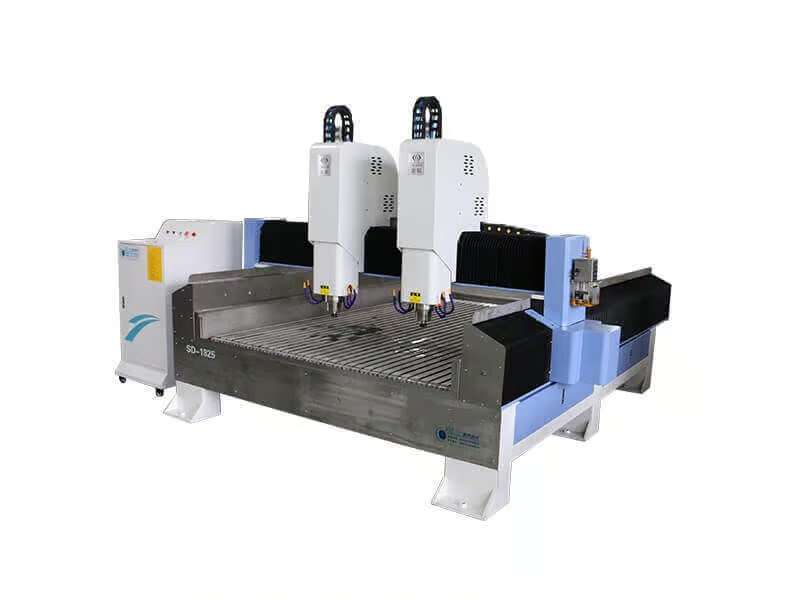 Stone Engraving Machines
 Thin Stone Veneer Saw Machine
 Horizontal Stone Slab Splitting Machine
 Stone Edge Polishing Profiling Machine
 Stone Auxiliary Equipment
Premium Diamond Wire Rope For Stone Quarry
In dimension stone extraction, diamond wire is the highest-frequency, most critical consumable. However, it is subjected to extreme thermodynamic stress. According to abrasive machining physics established by the Industrial Diamond Association (IDA), slicing through solid rock at 30 meters per second requires more than just high-purity diamonds; it demands a flawless cohesive matrix. If the injection coating fails to mechanically lock the beads to the steel core, dynamic tensile stress will cause the beads to strip, turning the wire into a lethal snapping hazard. MosCut Diamond Wire prevents this by utilizing aerospace-grade multi-strand steel cables fused with state-of-the-art vulcanized rubber and plastic injection technology, securing every bead with absolute rigidity.
A major hard-granite quarry in Brazil recently experienced the financial drain of sub-par consumables. They had been purchasing cheap, low-grade diamond wire that only yielded 8 to 10 square meters of cutting life per meter of wire. Worse, the wire frequently snapped mid-cut, halting production for hours while operators dangerously fished for the broken ends. After transitioning to MosCut’s 11mm Granite-Specific Wire—featuring our proprietary high-cobalt hot-sintered beads and High-Performance Rubber (R+S) coating—their operations transformed. Wire snapping dropped to absolute zero. Their lifespan skyrocketed to an average of 15 to 18 square meters per meter of wire, ultimately driving their overall square-meter cutting cost down by a staggering 35%.
Solving Critical Extraction Pain Points
A broken wire stops your entire quarry. Our diamond wire is engineered for zero downtime and maximum yield.Zero Wire Snapping
Built upon a foundation of European-imported, aerospace-grade multi-strand high-carbon steel cable. It possesses exceptional tensile strength to endure violent twisting and extreme pulling torque without fracturing.
Extreme Bead Retention
Utilizing advanced high-temperature, high-pressure injection molding. The vulcanized rubber or plastic deeply penetrates the microscopic gaps of the steel cable, permanently locking the diamond beads in place to prevent dangerous bead-stripping.
High-Speed Cutting
Our beads are embedded with high-concentration, premium-grade industrial diamonds fused in a proprietary metal bond matrix. This ensures the wire remains aggressively sharp, cutting rapidly without glazing or slipping.
Prolonged Lifespan
Precisely calibrated bead spacing (standard 38-40 beads/m) guarantees optimal slurry clearance and heat dissipation. Every gram of diamond actively participates in cutting, delivering unprecedented square-meter output.
Anatomy of the Wire: Engineered to the Microscopic Level
We don’t just assemble wire; we engineer a cohesive, microscopic cutting ecosystem capable of slicing mountains.
The Core: High-carbon multi-strand steel cable provides the ultimate balance of tensile strength and flexible fatigue resistance.
🔗 The Core: Aerospace Steel Cable
The backbone of our product is a heavy-duty, multi-strand steel cable (typically a 7×19 or 7×31 construction). This isn’t standard rigging wire; it is engineered specifically for dynamic, high-speed rotational fatigue. The precise weaving of the strands allows the wire to flex tightly around guide pulleys while resisting the extreme stretching forces applied by the wire saw’s flywheel.

The Teeth: Hot-sintered beads featuring a cobalt-alloy matrix that continually self-sharpens to expose fresh diamond edges.
💎 The Teeth: Sintered Diamond Beads
The cutting action relies entirely on our hot-sintered diamond beads. Depending on the target stone, we utilize advanced cobalt or iron-based alloy matrices. This metal bond is designed to wear away at the exact same rate as the diamonds blunt. This “self-sharpening” characteristic ensures that fresh, razor-sharp diamond crystals are continually exposed to the rock, maintaining a relentless cutting speed from the first meter to the last.

The Armor: Injection-molded polymer completely seals the steel core against abrasive silica slurry and prevents bead slippage.
🛡️ The Armor: Vulcanized Polymer Coating
The space between the beads is just as critical as the beads themselves. We utilize extreme-pressure injection molding to encapsulate the steel core in High-Performance Rubber (R+S) or specialized Plastic. This armor serves three vital functions: it spaces the beads perfectly, it acts as a shock absorber to cushion the violent impacts of cutting hard rock, and it creates a waterproof seal that prevents abrasive quartz slurry from grinding against the raw steel core.
Analyzing Cutting Efficiency & Lifespan
While MosCut manufactures the highest-grade wire, absolute performance on the quarry face is a symphony of multiple operational variables.A frequent question from quarry operators is: “Exactly how many square meters will this wire cut?” The truth is, diamond wire is a dynamic tool. Its final lifespan (total square meters cut) and cutting efficiency (square meters cut per hour) are dictated not just by the quality of the diamonds, but by how the wire interacts with geological realities and the operator’s machine settings. Understanding the variables below is key to maximizing your consumable ROI.
| Operational Factor | Impact on Wire Performance | Optimal Setting / Best Practice |
|---|---|---|
| 1. Stone Hardness & Abrasiveness | High Mohs hardness (Granite/Quartzite) grinds diamonds down rapidly. High silica content acts like sandpaper on the rubber coating. | Ensure you purchase Granite-specific wire. Accept that lifespan in Class 5 Granite will naturally be lower than in Marble. |
| 2. Beads per Meter | More beads (e.g., 40 vs 38) increases wire lifespan because more diamonds share the workload, but tighter spacing reduces slurry clearance speed. | Use 40 beads/m for standard granite to maximize lifespan. Use 38 beads/m if cutting speed is the absolute priority. |
| 3. Linear Wire Speed (m/s) | Running too fast on hard stone glazes (polishes) the diamonds, stopping the cut. Running too slow causes the wire to snag and snap. | Granite: 22 – 28 m/s. Marble: 30 – 38 m/s. |
| 4. Cooling Water Volume | Lack of water causes extreme friction heat. This melts the rubber coating, weakens the steel, and causes “burn marks” on the stone. | Maintain a constant, high-volume flow of water directly into the cut slot to flush slurry and keep the wire cool. |
| 5. Machine Tension (Pull-back) | Excessive tension snaps the wire. Insufficient tension causes the wire to “whip” in the cut, leading to oval (eccentric) bead wear. | Utilize an inverter-driven wire saw to maintain constant, automated tension. Manually twist the wire before jointing. |
ℹ️ Performance Disclaimer
The cutting speeds (m²/h) and lifespan metrics (m²/m) provided in our technical specifications are derived from baseline industry standards and MosCut’s controlled testing environments. Actual field results will vary. Your exact square-meter output will heavily depend on your specific quarry’s rock strata, presence of fissures, water availability, and the skill level of the wire saw operator. MosCut guarantees the structural integrity and diamond quality of our wire, but actual yield is a collaborative result of tool and technique.
Specialized Solutions by Rock Type
Using marble wire on granite is a fast track to failure. Select the precise bond and coating for your stone.For Granite: Vulcanized Rubber Coating
Granite is exceptionally hard and abrasive. Cutting it generates violent, high-frequency vibrations. Our Granite Wire features high-performance vulcanized rubber (R/R+S) injected between the beads. Rubber is highly flexible and possesses superior vibration-dampening properties, protecting the steel core from snapping while resisting the sandpaper-like grinding of granite slurry.

Rubber Coating: Ultimate flexibility and vibration absorption for hard, abrasive granite.
For Marble & Limestone: Plastic / Spring Coating
Marble is significantly softer but requires a much faster cutting speed. Because the vibration is lower, we utilize heavy-duty injected Plastic or Spring spacers. The metal bond of the diamond beads is also engineered to be softer. This allows the bond to wear away quickly enough to constantly expose new diamonds, keeping the cutting speed incredibly aggressive in softer sedimentary rock.

Plastic/Spring Coating: Engineered for aggressive, high-speed slicing through softer marble and limestone deposits.
Technical Specifications: Granite Diamond Wire
Match the exact wire specifications to your machine and target material. (Beads Type: Hot Sintered)| Diameter (mm) | Beads/Meter | Application | Wire Speed (m/s) | Cutting Speed (m²/h) | Expected Life (m²/m) |
|---|---|---|---|---|---|
| Ø 12.0 mm (Coating: High Performance Rubber R/R+S) | |||||
| 12.0 | 38 / 40 | Soft Granite | 28 – 35 | 16 – 27 | 20 – 40 |
| Medium Hard Granite | 25 – 32 | 13 – 21 | 15 – 25 | ||
| Hard Granite | 23 – 30 | 9 – 17 | 8 – 15 | ||
| Strongly Developed Granite | 25 – 30 | 11 – 16 | 15 – 25 | ||
| Ø 11.5 mm (Coating: High Performance Rubber R/R+S) | |||||
| 11.5 | 38 / 40 | Soft Granite | 28 – 35 | 16 – 27 | 20 – 40 |
| Medium Hard Granite | 25 – 32 | 13 – 21 | 15 – 25 | ||
| Hard Granite | 23 – 30 | 9 – 17 | 8 – 15 | ||
| Strongly Developed Granite | 25 – 30 | 15 – 21 | 15 – 25 | ||
The Perfect Synergy: Quarry Wire Saw Machines
Your Wire is Only as Good as Your Machine
Premium diamond wire represents a significant investment, but it cannot perform miracles if paired with an outdated or unstable machine. If a wire saw delivers erratic tension, sudden jerks, or inconsistent flywheel speeds, even the strongest aerospace steel cable will eventually snap due to shock-loading.
To maximize the lifespan of your MosCut diamond wire, it must be driven by a machine equipped with a modern Dual-Inverter Constant Tension Control System. This ensures the wire is pulled with absolute, unwavering smoothness through the stone.
Equip Your Quarry with MosCut Wire Saw Machines →
Standard Operating Procedure: Safe Splicing & Jointing
90% of wire breaks happen at the joint. Master the art of splicing to protect your investment.✂️ Step 1: Clean & Strip
Carefully cut the wire and strip away the rubber/plastic coating from both ends, exposing about 10mm to 15mm of bare steel cable. Ensure the steel is completely clean of any grease, dirt, or leftover polymer, as this will cause the copper crimp to slip.
🔄 Step 2: The Twist (Critical)
Before connecting the ends, you must apply a pre-twist to the wire. Twist the wire axially at a ratio of 1.5 to 2 full turns per meter of total wire length. This stored torsional energy forces the wire to spin continuously while cutting, ensuring the beads wear evenly 360 degrees and preventing “oval” flat-spotting.
🗜️ Step 3: Hydraulic Crimping
Insert the twisted ends into a high-strength threaded copper connector. Use a specialized hydraulic crimping tool to crush the connector tightly onto the steel core. The joint must be perfectly straight and the crimp marks evenly spaced to prevent snagging inside the cut.
Machine in Action: Working Video
Watch MosCut Diamond Wire deliver unstoppable, high-speed cutting performance on the quarry face.Global Customer Success Stories
Dominating extraction output across the world’s toughest geological environments.
Brazil: Hard Granite Extraction
Upgraded to 11.5mm Rubber-coated wire, eliminating wire snaps in Class 4 granite and extending lifespan to an average of 18 m²/m.

Italy: High-Speed Marble
Utilized our 11mm Plastic-coated wire to achieve blistering cutting speeds of over 25 m²/h, drastically increasing daily block output.
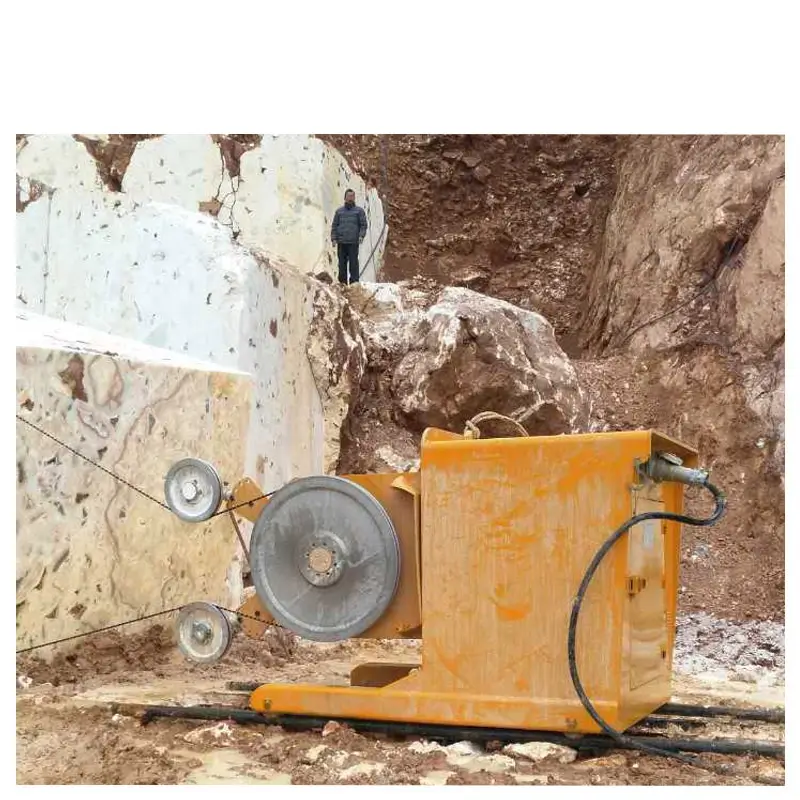
Turkey: Travertine Precision
Perfected the balance of wire tension and water cooling to yield clean, chip-free cuts in porous travertine beds.

India: Extreme Hard Basalt
Deployed specialized 40-bead/m hot-sintered wire to overcome intense abrasion, maintaining consistent sharpness where other wires glazed over.
Related Insights & Maintenance Guides
Deepen your technical knowledge to maximize the life of your diamond tools.
Why Does Your Wire Keep Snapping?
Diagnose the root causes of wire breaks, from excessive machine tension to improper splicing techniques.
Read More
Rubber vs. Plastic Coating: How to Choose
Understand the exact geological scenarios where you must use vulcanized rubber over standard injected plastic.
Read More
The Silent Killer: Oval Bead Wear (Eccentricity)
Learn how the “Pre-Twist” technique forces the wire to spin, preventing beads from grinding flat on one side.
Read More
How to Calculate Your True Cutting Cost
Stop looking at the price per meter. Learn how to calculate the actual Cost per Square Meter (m²) of extracted stone.
Read MoreMaximize Your Quarry’s Output Today
Stop settling for cheap consumables that snap under pressure and stall your operations. Maximize your square-meter yield and eliminate downtime with MosCut’s premium, vulcanized diamond wire.
View All Stone Quarrying Accessories & ToolsFrequently Asked Questions
1. How do I know when the diamond wire is completely worn out?
You must regularly measure the diameter of the diamond beads using a caliper. A standard 11.5mm wire is typically considered fully consumed and ready for replacement when the beads wear down uniformly to approximately 8.5mm to 9.0mm, at which point the cutting speed will drop drastically.
2. Is water cooling absolutely mandatory?
Yes, 100%. Cutting rock generates extreme friction and heat. Without a continuous, high-volume flow of cooling water (typically 25-50 liters per minute), the vulcanized rubber will melt, the steel core will lose its temper and snap, and the diamonds will burn out within minutes.
3. Why did my diamond beads become shiny and stop cutting?
This is called “glazing” or “polishing.” It happens when the linear wire speed is set too high for the hardness of the rock. The diamonds are rubbing rather than chipping the stone. You must slow down the wire speed (m/s) to force the metal bond to wear away and expose fresh, sharp diamonds.
4. What does “Hot Sintered” mean for the beads?
Hot sintering is an advanced manufacturing process where the diamond particles and metal alloy powder are pressed and baked at extreme temperatures and pressures simultaneously. This creates a far denser, tougher bead that holds onto its diamonds much longer than standard cold-pressed beads.
5. Can I use the same wire for both Granite and Marble?
It is highly discouraged. Granite wire uses a tough rubber coating and a hard metal bond. Using it on marble will cut too slowly. Marble wire uses plastic/springs and a softer metal bond. Using it on granite will destroy the wire almost immediately due to extreme abrasion. Always match the tool to the stone.
6. How tight should the wire be during cutting?
Wire tension (pull-back force) is controlled by the wire saw machine. It should be tight enough to form a straight, rigid cutting line without sagging, but not so tight that the machine’s ammeter spikes into the red zone. Standard tension ranges from 250kg to 350kg depending on the cut length.
7. What should I do if the wire gets stuck in the cut?
Never use the machine to forcefully yank the wire out—it will snap. Turn off the machine. If the rock has shifted and pinched the wire, you must use hydraulic splitters or pneumatic pushing bags in the top of the cut to wedge the rock slightly open and release the tension on the wire.
8. How long can a continuous loop of wire be?
For standard quarry block extraction, loops typically range from 20 to 60 meters long. Very long cuts (e.g., 100+ meters) are possible but require higher tension and drastically increase the risk of the wire whipping and snapping.
9. Why are the beads wearing out faster on one side (Oval wear)?
Oval or eccentric wear occurs when the wire is dragging through the rock without spinning on its own axis. This is caused by the operator failing to apply the mandatory “Pre-Twist” (1.5 to 2 turns per meter) before crimping the joint together.
10. Does MosCut supply the copper crimping joints with the wire?
Yes, we supply premium threaded copper/steel connectors designed specifically for our wire diameters. It is critical to use the exact matching connector size and a professional hydraulic crimper to ensure the joint can withstand high tension.