
 Stone Cutting Machines
 Stone Polishing Machines
 Bridge Saw Machines
 Stone Quarry Cutting Machines
 Stone Block Cutter Machine
 CNC Stone Wire Saw Machine
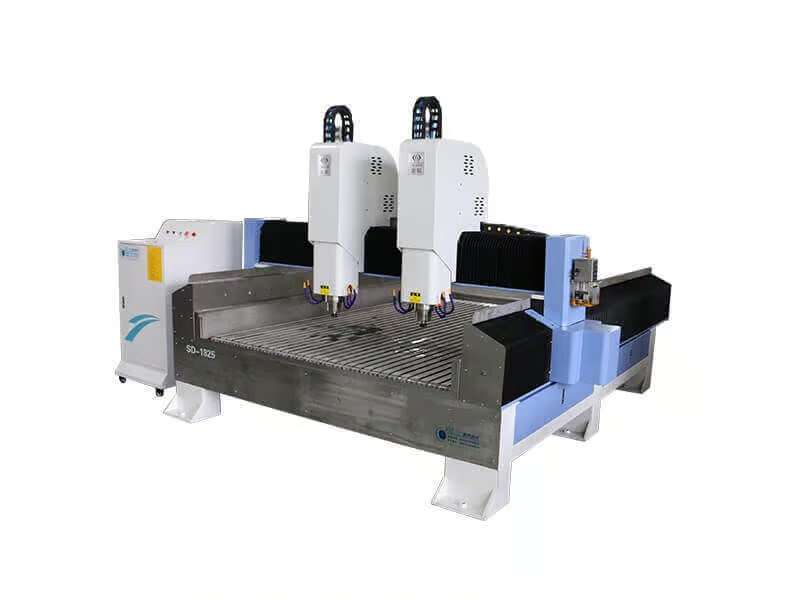 Stone Engraving Machines
 Thin Stone Veneer Saw Machine
 Horizontal Stone Slab Splitting Machine
 Stone Edge Polishing Profiling Machine
 Stone Auxiliary Equipment
In the realm of pneumatic stone extraction, purchasing a premium drilling rig without sizing the air compressor correctly is a recipe for operational failure. According to industrial fluid dynamics standards published by the Compressed Air and Gas Institute (CAGI), volumetric flow rate and pressure drop through pneumatic hosing dictate the absolute physical limits of down-hole percussion. In a Down-The-Hole (DTH) setup, the drilling rig is merely the structural skeleton; the air compressor is the beating heart. Over 90% of instances where operators complain of “slow penetration” or suffer catastrophic stuck drill rods are not mechanical failures of the rig, but a direct result of severely insufficient CFM (Air Volume).
A marble quarry operating in the Andes Mountains of Peru at an altitude of 3,500 meters experienced this exact crisis. They purchased a heavy-duty drill but utilized a small, second-hand compressor rated for sea level. The rig was operating at less than 50% of its rated speed, and drill bits were constantly getting buried under collapsed rock dust. MosCut field engineers diagnosed a severe high-altitude volumetric loss—the thin mountain air was slashing the compressor’s true output by nearly 40%. By applying an ‘Altitude Deration Factor’ and upgrading their power plant to a 15 m³/min diesel compressor, the rig instantly returned to full kinetic power, blowing out massive rock chips and eliminating stuck rods entirely.
The Pneumatic Heart: Why the Compressor Dictates Performance
The most expensive drilling rig on earth is useless if it is gasping for air. You must match the lungs to the machine.A Down-The-Hole (DTH) hammer is a voracious consumer of compressed air. Unlike electric tools, a pneumatic hammer requires air to fulfill two entirely separate, critical functions simultaneously. First, the air must actuate the internal piston to generate high-frequency impact energy. Second, after exhausting from the hammer, that exact same air must rush back up the borehole to blow heavy rock cuttings 20 meters straight up to the surface.
Many quarry owners attempt to cut capital costs by pairing a heavy-duty drill rig with a lightweight screw compressor designed for simple sandblasting. The result is ‘hammer choking’. The bit is starved of kinetic energy, failing to break the rock. Worse, the weak exhaust air cannot lift the rock chips out of the hole. The heavy dust falls back down, burying the hammer and cementing the expensive drill string permanently into the bedrock.

The Great Confusion: PSI vs. CFM
Pressure dictates how hard the hammer hits. Volume dictates how fast it hits and how clean the hole stays.Understanding the difference between PSI (Pressure) and CFM (Volume) is the most critical lesson in pneumatic quarrying.
PSI / Bar (Working Pressure): This measures the force or ‘push’ of the air. It dictates the brute strength of the piston striking the drill bit. Higher pressure means harder rock-breaking capability. Most quarry DTH drilling requires between 7 to 10 Bar (100 to 150 PSI).
CFM / m³/min (Volumetric Flow Rate): This measures the actual physical quantity (volume) of air being delivered every minute. It dictates how fast the piston cycles and is the only factor that determines whether rock dust is blown out of the hole. If your CFM is too low, having 15 Bar of pressure is useless—the hammer will hit hard once, and then stall because there isn’t enough air volume behind it to sustain the rapid firing cycle.

The Critical Math: Up-Hole Velocity
If your rock dust doesn’t reach the surface, it forms a concrete plug. Velocity is your only defense.To prevent drill rods from getting stuck, fluid dynamics dictate that the air rushing back up the hole toward the surface (the annulus) must travel at a specific speed known as Up-Hole Velocity. For dense rock cuttings like granite or wet limestone, this velocity must generally be maintained between 15 m/s to 20 m/s (roughly 3,000 to 4,000 ft/min).
The mathematical formula to determine the required air volume is calculated as follows:
Where:
$V$ = Up-Hole Velocity (m/s)
$Q$ = Compressor Output Volume (m³/min)
$D$ = Drill Bit Diameter (mm)
$d$ = Drill Rod Outer Diameter (mm)
The takeaway: Because the diameters are squared in the formula, increasing your drill bit size (e.g., from 90mm to 115mm) without upgrading to a thicker drill rod exponentially increases the empty space in the hole. The up-hole velocity drops instantly. Upgrading bit size always requires upgrading compressor CFM to compensate.
Altitude and Temperature: The Invisible Thieves
Compressors breathe air. If the air is thin or hot, your machine loses its muscle.Air compressors do not make air; they simply pack the ambient atmospheric air into a tighter space. Therefore, if you operate a quarry high in the mountains, the air is naturally thinner (lower atmospheric density). The compressor takes in less oxygen and less air mass per intake stroke, resulting in a severe drop in the actual CFM delivered to the drill.
When purchasing an air compressor for high-altitude quarries, operators must calculate a mandatory redundancy margin based on the altitude deration table below:
| Quarry Altitude (Meters above Sea Level) | Approximate Air Density / Output Efficiency | Required CFM Sizing Compensation |
|---|---|---|
| 0 m (Sea Level) | 100% Efficiency | Standard specification matches manual |
| 1,000 m (3,300 ft) | ~89% Efficiency | Oversize compressor by +10% to +15% |
| 2,000 m (6,600 ft) | ~79% Efficiency | Oversize compressor by +20% to +25% |
| 3,000 m (9,800 ft) | ~70% Efficiency | Oversize compressor by +30% to +35% |
The Choke Point: Hose Diameters and Leaks
A massive compressor is worthless if you force all that air through a garden hose.You can purchase a premium 15 m³/min compressor, but if you connect it to the drill rig using an undersized hose, you will suffer massive Friction Pressure Drop. Air moving rapidly through a narrow pipe creates internal friction. A narrow hose essentially acts as a choke collar on your pneumatic supply.
Always use heavy-duty, steel-braided air hoses that perfectly match the internal diameter (I.D.) of the drill rig’s main inlet manifold (typically 1.5 inches to 2.0 inches for heavy DTH drilling). Furthermore, pneumatic leaks are expensive. A pinhole leak in a connector joint under 10 Bar of pressure will bleed out a massive amount of CFM before the air ever reaches the hammer. Use proper heavy-duty claw couplings and safety whip-checks to ensure 100% sealed delivery.

Build a Flawless Drilling Ecosystem
Don’t let a mismatched pneumatic setup ruin your extraction schedule. Guarantee your drill has the power it needs to conquer any rock face.
Explore MosCut DTH Drills