
 Stone Cutting Machines
 Stone Polishing Machines
 Bridge Saw Machines
 Stone Quarry Cutting Machines
 Stone Block Cutter Machine
 CNC Stone Wire Saw Machine
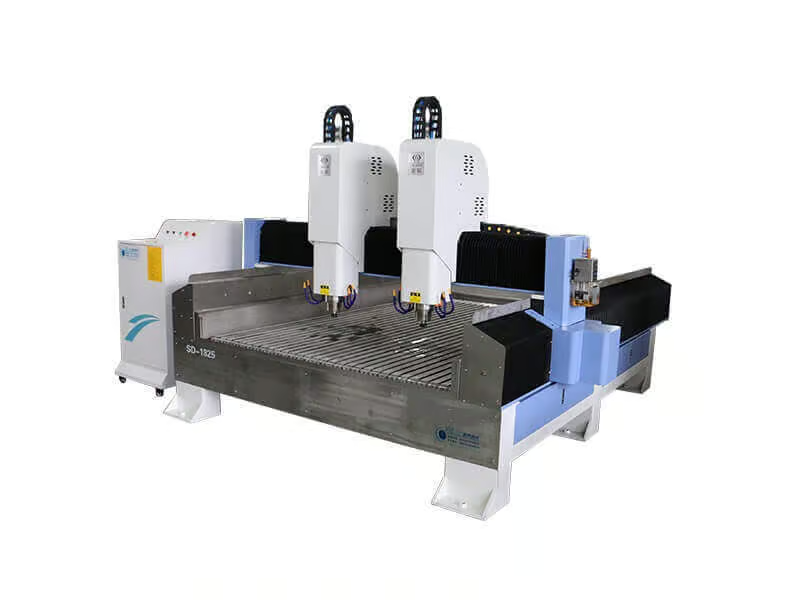 Stone Engraving Machines
 Thin Stone Veneer Saw Machine
 Horizontal Stone Slab Splitting Machine
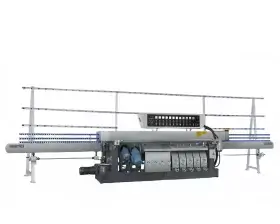 Stone Edge Polishing Profiling Machine
 Stone Auxiliary Equipment
In the fiercely competitive landscape of stone countertop fabrication, workshop owners often find themselves trapped in a dangerous accounting illusion. When auditing operational overhead, the baseline manual stone edge polishing cost is frequently dismissed as a minor, flexible line item—the mere cost of cheap hourly labor. However, stringent occupational health frameworks enforced by authorities like OSHA regarding crystalline silica dust exposure and Hand-Arm Vibration Syndrome (HAVS) have transformed hand-polishing into a massive legal liability. More importantly, from a pure physics standpoint, the human arm is an inherently flawed linear actuator. Over an 8-hour shift, muscle fatigue prevents the constant downward pressure required to satisfy elite architectural edge quality standards, bleeding your profits into a hidden drain.
A high-end kitchen surface studio in London, UK, recently confronted the bankruptcy-level consequences of this hidden drain. Having secured a highly lucrative contract to supply 120 custom quartzite kitchen islands for a luxury residential high-rise, they elected to rush the job using five veteran stonemasons armed with manual wet routers. During the initial site inspection, the project’s quality surveyor placed a precision machinist straightedge against the polished profiles. The verdict was catastrophic: the manual tracking had introduced subtle, rhythmic dips, causing the premium slab lines to devolve into irregular “wavy edges.” The entire first batch was rejected on the spot, triggering severe contractual penalties. Facing financial ruin, the facility executed an emergency order for a MosCut automatic edge polisher. Leveraging the absolute structural rigidity of the machine’s traveling chassis, they completely eliminated human tracking errors, successfully delivering laser-straight profiles and salvaging their commercial reputation.
🚨 The Illusion of “Cheap Labor”
Many fabricators believe that hiring an additional hand-polisher is more economical than investing in heavy capital machinery. This thought process completely ignores the concept of bottlenecked throughput. A highly skilled stonemason can manually profile and polish approximately 15 to 20 linear meters of dense granite per day. In stark contrast, an entry-level automated line matches that entire daily output in less than an hour. When you pass up major commercial bids or delay kitchen installations because your hand-polishing station is severely backed up, your real loss in facility cash flow completely dwarfs the monthly lease payment of an automated machine asset.
Quality Control: The “Wavy Edge” Epidemic
Why the biomechanics of the human shoulder make flawless linear consistency a mathematical impossibility.When an operator holds a manual hand grinder, the tool references the stone via a semi-flexible backing pad. As the worker breathes, shifts their stance, or moves along the length of a 3-meter slab, their center of gravity continuously fluctuates. This variance directly translates into irregular pressure spikes.
On soft marbles or high-resin quartz materials, holding the tool in place for even one additional second gouges a microscopic dip into the edge. When bright overhead kitchen pendant lights strike these hand-polished surfaces, the reflected light band warps and distorts—instantly exposing a cheap, non-linear finish that discerning architects will reject immediately.
To definitively prevent wavy stone edges, you must replace human skeletal movement with mechanical guidance. MosCut automatic edge machines utilize heavy-duty pneumatic cylinder compensation. Regardless of minor variations in slab thickness or progressive wheel wear, the air cylinders maintain a mathematically uniform, unwavering force vector, delivering absolute linear consistency across any length.

The Hidden Bleed: Abrasive and Material Waste
Auditing the compounding cost of uneven pad wear and ruined premium slabs.🔄 Asymmetric Pad Wear and Financial Waste
To cut effectively with a hand-held tool, laborers instinctively lean into the tool, tilting the grinder at a slight angle to force the abrasive diamonds into the stone. This localized forcing causes rapid, asymmetric “edge gouging” on the expensive diamond resin pads. The outer rim of the water pad wears down to the bare plastic core within days, while the middle remains completely unused. Fabricators operating purely manual lines routinely throw away up to 40% of their annual abrasive consumable budget due to this systematic, uneven wear pattern.
🔥 The Catastrophe of Quartz Edge Resin Burn
Modern engineered quartz and sintered stones are highly sensitive to thermal stress. Quartz contains up to 10% polymer binding resins. When a manual laborer slows down their traveling speed along the edge, the friction from the high-RPM pad generates an instant thermal spike. This localized heat scorches the polymers, inducing an irreversible chemical breakdown known as quartz edge resin burn. The stone turns a cloudy, dull white color. Because resin burn cannot be polished out, the entire expensive, pre-routed kitchen slab is ruined and must be discarded, completely erasing the profit margin of the entire project.
The OSHA Factor: Safety Mandates and Labor Crises
Unmasking the true regulatory and recruitment costs behind traditional stonemasonry.The modern workforce has shifted dramatically away from heavy, hazardous manufacturing roles. Forcing workers to spend 10 hours a day bent over wet, vibrating stone benches wrapped in a cloud of noise and hazardous slurry leads to a continuous cycle of high employee turnover and costly retraining. More critically, long-term exposure to the intense vibration of hand grinders induces Hand-Arm Vibration Syndrome (HAVS), a permanent neurological condition causing severe vascular damage (vibrational white finger). In modern economies, a single worker compensation claim or a punitive safety citation from OSHA regarding inadequate respirable silica mitigation can levy fines that exceed the total stone edge polishing machine ROI cost, proving that manual processing is an unsustainable liability.
The Automation ROI Formula: The Hard Mathematics of Scaling
Stop relying on gut feeling; let production mathematics dictate your capital asset expenditures.To help fabricators evaluate their true path to profitability, MosCut engineers utilize a standardized, multi-variable financial payback equation to calculate the precise timeline required to completely recover machine capital cost:
When you transition to a MosCut automated line, the financial variables shift instantly. By reallocating two manual polishers to higher-value cutting or installation tasks ($Monthly Labor Savings$), compressing your slab breakage and resin burn rate to zero ($Monthly Scrap Reduction$), and unlocking the ability to accept high-volume multi-unit commercial bids ($Added Capacity Profit$), the math becomes clear. The overwhelming majority of medium-scale shops processing premium granite, marble, and quartz surfaces achieve total capital payback within 6 to 9 months of machine commissioning.
Shatter the Hand-Polishing Production Bottleneck
Stop bleeding valuable profit margins on inconsistent hand labor, wasted abrasives, and rejected stone. Automate your countertop fabrication, enforce impeccable linear profiles, and maximize your workshop’s daily output with MosCut’s leading automatic technology.
Explore MosCut Automatic Edge Polishers