
 Stone Cutting Machines
 Stone Polishing Machines
 Bridge Saw Machines
 Stone Quarry Cutting Machines
 Stone Block Cutter Machine
 CNC Stone Wire Saw Machine
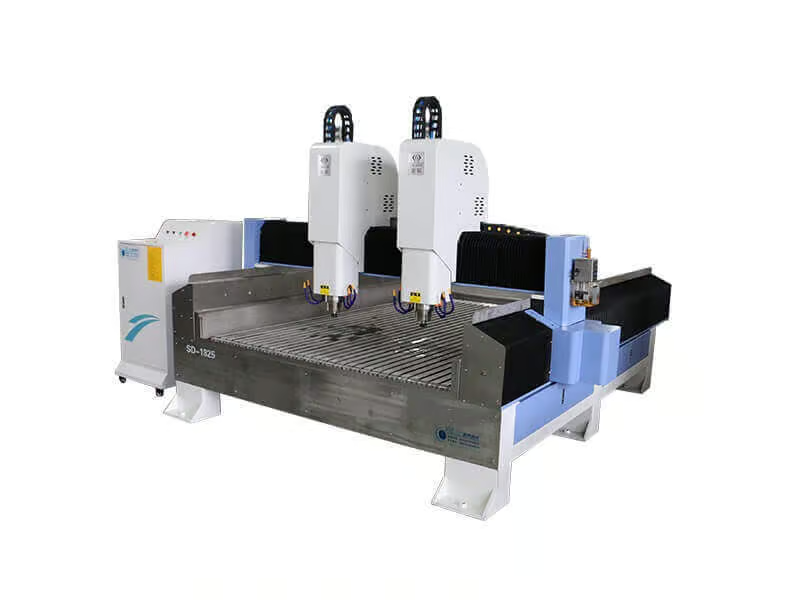 Stone Engraving Machines
 Thin Stone Veneer Saw Machine
 Horizontal Stone Slab Splitting Machine
 Stone Edge Polishing Profiling Machine
 Stone Auxiliary Equipment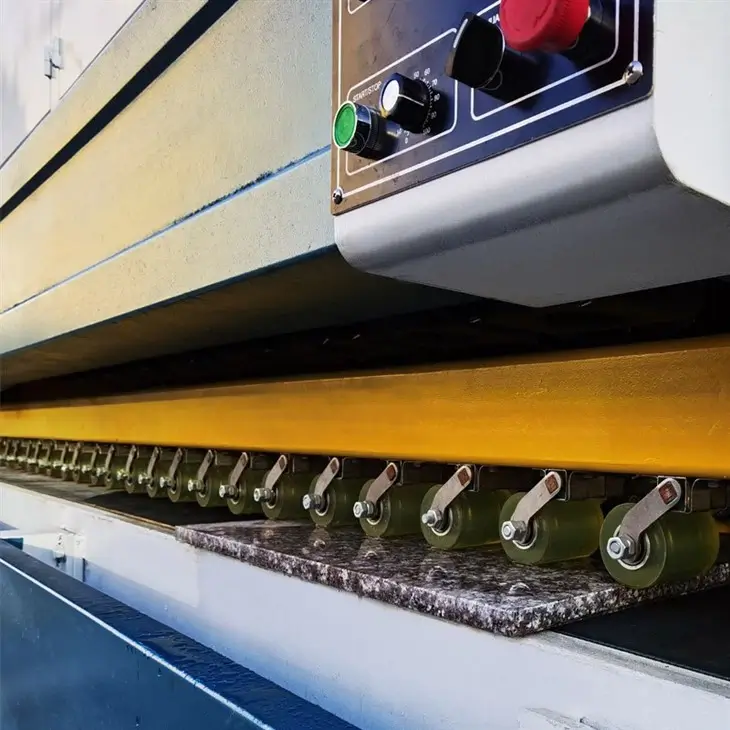
In the high-volume manufacturing of modern kitchen surfaces, engineered quartz has firmly established itself as the dominant global standard. However, processing this material introduces a severe technical vulnerability that routinely bankrupts fabrication margins: a catastrophic breakdown known as a resin scorched stone edge. Chemically, engineered stone is a polymer matrix composite consisting of roughly 90% crystalline quartz aggregates bound together by 10% polyester resins. Under the intense friction of automatic edge polishing wheels, localized temperatures can instantly breach the thermal thresholds of these binding polymers. This thermal shock causes the resin matrix to gasify and separate from the mineral nodes, creating microscopic optical gaps that manifest to the naked eye as a permanent, cloudy phenomenon known as a quartz edge turning white.
A mega-scale commercial countertop contractor in California, USA, specializing in multi-family housing high-rises, recently fell victim to this thermodynamic bottleneck. Having deployed a cheap, entry-level linear polisher utilizing primitive spring-loaded heads, their line experienced systemic edge whitening while executing complex quartz countertop edge profiling on deep charcoal gray slabs. The friction spikes completely carbonized the inner profile polymer chains, rendering an entire production run of 200 kitchen island pieces completely unsellable and resulting in over $45,000 in raw material loss. Desperate to restore compliance, they upgraded their factory floor to a heavy-duty MosCut multi-head line equipped with digital pneumatic edge polisher heads. By floating the resin abrasive pads under precise, compressed micro-pressure vectors, they totally eliminated friction spikes, restoring a consistent 92+ degree gloss meter finish and easily passing strict West Coast construction audits.
🚨 The Chemistry of Whiteness: Decoding Thermal Degradation
A common, fatal error made by uncertified machine operators is assuming that a white cloud appearing on a quartz edge is simply a minor scratch that can be forced out. This misunderstanding leads to absolute material destruction. Once polymer resins are scorched by unmanaged friction heat, their molecular bonds are broken irreversibly. If the operator responds by blindly tightening the mechanical spindle pressure or slowing down the conveyor to “polish the white out,” they multiply the thermal load. The chemical degradation spreads like a cancer deeper into the quartz core, rendering the slab completely unrepairable. The only solution is executing a preemptive mechanical strategy that eliminates friction spikes entirely.
The Pressure Paradigm: Pneumatic vs. Spring-Loaded Heads
When processing heat-sensitive engineered stone, rigid mechanical forcing is your worst operational enemy.Traditional, low-cost linear edge machines rely on heavy mechanical springs to force the spinning abrasive discs against the moving stone. While springs are functional for dense, thermal-insensitive granites, they are highly destructive to engineered composites. Under Hooke’s Law, a spring’s resistance spikes sharply as it compresses. Slabs are never perfectly uniform; they possess micro-millimeter thickness tolerances, and their leading edges act as a blunt wall as they hit the wheel.
When a spring-loaded wheel encounters these slight variations, the spring is forcefully compressed, inducing a violent mechanical friction spike. That split-second spike creates concentrated thermal energy that instantly bakes the quartz polymers, leaving a trailing white streak of scorched resin across the slab entry boundary.
MosCut eliminates this engineering flaw by outfitting our linear lines with advanced pneumatic air cylinders. Compressed air acts as a flexible, adaptive fluid cushion. The polishing spindle floats dynamically over the contour of the stone. Whether the wheel hits a rough slab edge or experiences progressive abrasive pad wear, the pneumatic matrix absorbs the shock instantly, maintaining an unyielding, uniform force vector (such as 1.5 Bar) that entirely suppresses localized friction heat.

The Hydro-Cooling Shield: Calibrating Fluid Mechanics
Cooling water must be weaponized as a high-velocity fluid barrier to actively intercept kinetic heat.🎯 1. Point-of-Impact Targeting
Simply flooding the surface of the slab with water is completely useless. The high rotation of the polishing pad creates a centrifugal wind barrier that deflects topical water. MosCut’s stainless nozzle configurations are engineered to inject targeted streams at a strict 45-degree angle, forcing high-volume coolant directly into the microscopic point-of-impact where the abrasive matrix meets the quartz line.
🌊 2. Micro-Slurry High Pressure Flushing
As resin-bonded pads grind the composite, they generate an ultra-fine, highly dense stone powder slurry. If this slurry is not instantaneously evacuated, it gets trapped between the wheel face and the stone, acting as a frictional paste that induces rapid secondary dry-grinding heat. We enforce a consistent 3.5 Bar minimum water line pressure to forcefully blast this thermal slurry out of the kerf.
🔒 3. Interlocked Pressure Shutdown
A single second of water starvation in a multi-head machine will instantly destroy thousands of dollars in quartz material. MosCut integrates digital flow-rate and hydraulic pressure sensors into the main PLC cabinet. If the shop’s water pump drops pressure by even 0.5 Bar, the electronic interlock system kills the conveyor feed and drops the spindles within 0.2 seconds, making dry-grinding impossible.
Tooling Bond Optimization: Metal vs. Resin Matrix
To secure supreme engineered stone fabrication quality, you must align your wheel composite matrix with the progress of the grind.
The selection of your diamond tool binding material dictates the baseline thermal load of your factory line. A professional multi-head sequence for engineered quartz demands a strict, dual-phase asymmetrical tooling strategy:
The Profiling Stages: The initial, aggressive stock removal heads must utilize high-tensile Metal-Bonded diamond wheels. Metal binders possess exceptional thermal conductivity, allowing the heavy friction heat of shaping a full bullnose or ogee to be instantly pulled away from the stone core and dissipated via the high-pressure hydro-jets.
The Polishing Stages: The final gloss-enhancing spindles (Grit 500 to 3000) rely on Resin-Bonded polyurethane pads. Because these pads are themselves made of polymers, they are highly prone to melting and “gluing” to the quartz resin. Operators must calibrate the MosCut digital regulators to scale back the pneumatic down-force to a micro-pressure threshold of 1.2 to 1.5 Bar on the final heads, achieving a glass-like shine through smooth micro-friction rather than brute force.
Eradicate Edge Whitening and Maximize Your Yield
Stop losing high-value quartz slabs and wasting hard-earned labor hours on resin-burned mistakes. Upgrade your fabrication shop floor with MosCut’s pneumatically-controlled, hydro-cooled automatic edge profiling and polishing machinery and deliver pristine, burn-free mirror finishes consistently.
View All Automatic Edge Profiling Machines