
 Stone Cutting Machines
 Stone Polishing Machines
 Bridge Saw Machines
 Stone Quarry Cutting Machines
 Stone Block Cutter Machine
 CNC Stone Wire Saw Machine
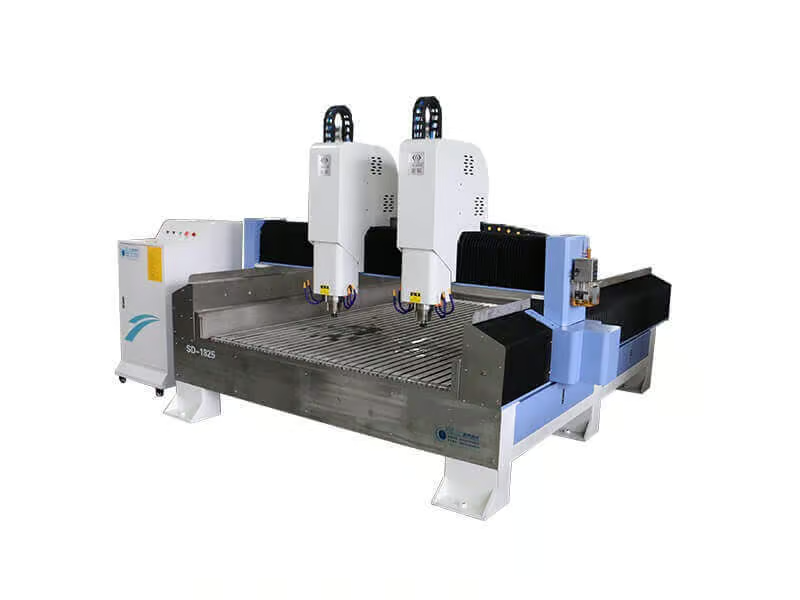 Stone Engraving Machines
 Thin Stone Veneer Saw Machine
 Horizontal Stone Slab Splitting Machine
 Stone Edge Polishing Profiling Machine
 Stone Auxiliary Equipment
In the highly profitable mass manufacturing of natural thin stone siding, corner finish quality is the definitive metric that separates elite production facilities from struggling workshops. According to brittle fracture mechanics benchmarks established under ASTM International standards for determining elastic modulations in non-metallic minerals, natural stone undergoes intense subterranean stress redistribution when attacked by high-speed superabrasives. If a veneer saw lacks structural rigidity or suffers from conveyor micro-stuttering, localized lateral tensile stresses will inevitably initiate subsurface micro-cracks. At the exact millisecond the diamond matrix exits the stone envelope, these micro-cracks propagate uncontrollably, culminating in macroscopic edge blowouts that instantly ruin right-angle stone veneer joints.
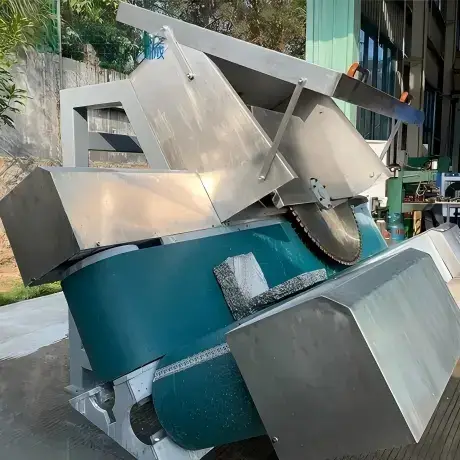
A high-volume granite ledgestone siding supplier located in Whistler, Canada, recently faced an operational crisis stemming directly from this failure mechanism. Processing highly dense, abrasive Canadian granite blocks on low-weight, flexible machinery, their line suffered from a crushing 40% corner blowout rate. The frequent edge fractures forced them to employ three full-time workers dedicated solely to topically repairing broken corners with tinted polyester resins—a bottleneck that led to severe aesthetic rejections from strict North American resort inspectors. Seeking an engineering remedy, they deployed a heavy-duty MosCut Thin Stone Veneer Saw integrated with an adaptive inverter feed array. By synchronizing blade RPM with a multi-stage feeding curve, they suppressed subsurface stress waves entirely, compressing their edge chipping rate to below 0.5% and permanently eliminating manual repair overhead.
The Physics of Rupture: Why Stone Edges Chip on Exit
The stone matrix doesn’t fracture when the blade enters the core; it explodes when the diamond segments exit structural constraint.🛡️ In-Feed Geometric Constraint
When a diamond blade initially bites into an irregular piece of quarry rubble, the tool is completely encapsulated by a dense, unmined mass of solid rock. This surrounding rock provides perfect physical backing, enforcing a state of triaxial compressive stress. Under this massive support network, the microscopic mineral crystals are firmly held in place, making it physically impossible for wide chunks of stone to break away or chip along the entry path.

💥 Exit Out-of-Constraint Blowouts
The disaster occurs at the exact exit plane—the boundary where the horizontal and vertical blades meet at the innermost apex of an L-corner, or when a blade cuts completely out of the back of a flat panel. At this critical split-second, the solid stone backing vanishes. As the high-speed blade sweeps out of the kerf, its aggressive dragging motion applies high-tensile pulling force to a thin, unsupported wall of stone. Deprived of a backing constraint, the fragile mineral matrix gives way to brittle shear failure, blasting away chunks of the edge and leaving an jagged, unsellable profile.
⚖️ The Parameter Equilibrium: RPM vs. Feed Rate
Forcing a diamond segment through an abrasive quartzite matrix without balancing your chip-load profile is a form of financial suicide. The primary mechanical catalyst behind severe edge fracturing is an excessive “Chip-Load per Diamond Tooth”—meaning individual diamond grains are forced to dig too deep into the rock matrix on each rotation.
The mathematical limits of chip thickness are governed by the following structural kinetics equation:
The Operational Threat: If a workshop supervisor aggressively cranks up the conveyor belt speed ($v_f$) to hit high daily quotas while running the main spindle motor at an inadequate RPM ($N$), the maximum chip thickness ($h_{max}$) surges beyond the natural shear capacity of the stone. The diamond segments stop grinding cleanly and start violently bludgeoning the rock, leading to extreme mechanical vibration, scorched tool cores, and massive, widespread corner shatter.
The Hydro-Dynamic Shield: Water Coolant Mechanics
Cooling water is not merely for dust suppression on the shop floor; it acts as a critical mechanical lubricating wedge.Failing to route ample water volume directly into the intersection of an orthogonal cutting line is a costly mistake. The friction between synthetic diamonds and dense silica minerals generates instant localized thermal spikes peaking above $800^circtext{C}$. Without an immediate deluge of water, different mineral crystals inside the rock (such as calcite grains vs. quartz nodes) undergo violent, uneven thermal expansion. This sudden thermal shock fractures the crystal boundaries before the blade even finishes passing through, pre-conditioning the edge to crumble upon exit.
Slurry Hydro-Expulsion: Furthermore, cooling water must be delivered via dual-nozzle arrays at a minimum pressure of 3 Bar, targeted precisely at the orthogonal intersection point. This creates a high-velocity fluid sweep that violently ejects abrasive stone slurry out of the narrow cut. If water pressure drops, this thick slurry becomes trapped inside the tight kerf, turning into an abrasive paste that subjects the newly sliced, pristine Right-Angle corner lines to destructive secondary grinding, eroding the crisp edge into a dull, chipped serration.

The MosCut Standard SOP for Chip-Free Right-Angle Veneer
Execute this three-part manufacturing protocol to enforce sub-millimeter edge perfection across every shift.📉 1. Multi-Stage Adaptive Feeding
Never feed stone at a constant velocity. Program the MosCut inverter to initiate a “Two-Stage Feed Profile.” As the raw stone first meets the blade, and as it reaches the critical exit zone, the conveyor automatically backs down to a gentle 600mm/min. Once safely inside the deep, supported core of the cut, it accelerates to 2000mm/min, protecting boundaries while maintaining throughput.
📐 2. Micro-Overlap Apex Indexing
Strictly enforce the intersection parameters detailed in our calibration manuals. The vertical circular blade must be digitally adjusted via the lead-screw tracks to descend exactly 0.5mm to 1.0mm beyond the horizontal blade’s maximum apex plane. This micro-overlap completely severs the stone veneer from the block core without creating deep structural stress cuts.
💎 3. Proactive Segment Dressing
A dull blade is the primary initiator of edge chipping. When the PLC cabinet logs a continuous 10% rise in main motor amperage, the diamond segments have become glazed and blunt. Operators must immediately cease production and run a soft, highly abrasive sandstone or firebrick dressing block through the blades to strip away the worn matrix and expose fresh, razor-sharp diamonds.
Eradicate Corner Scrap and Maximize Your Yield
The era of treating corner stone blowouts as an unavoidable cost of masonry production is officially over. Arm your processing line with MosCut’s ultra-rigid, self-adaptive orthogonal thin stone veneer saws and start delivering pristine, architectural-grade assets today.
View the Thin Stone Veneer Saw Machine Line