
 Stone Cutting Machines
 Stone Polishing Machines
 Bridge Saw Machines
 Stone Quarry Cutting Machines
 Stone Block Cutter Machine
 CNC Stone Wire Saw Machine
 Stone Engraving Machines
 Thin Stone Veneer Saw Machine
 Horizontal Stone Slab Splitting Machine
 Stone Edge Polishing Profiling Machine
 Stone Auxiliary Equipment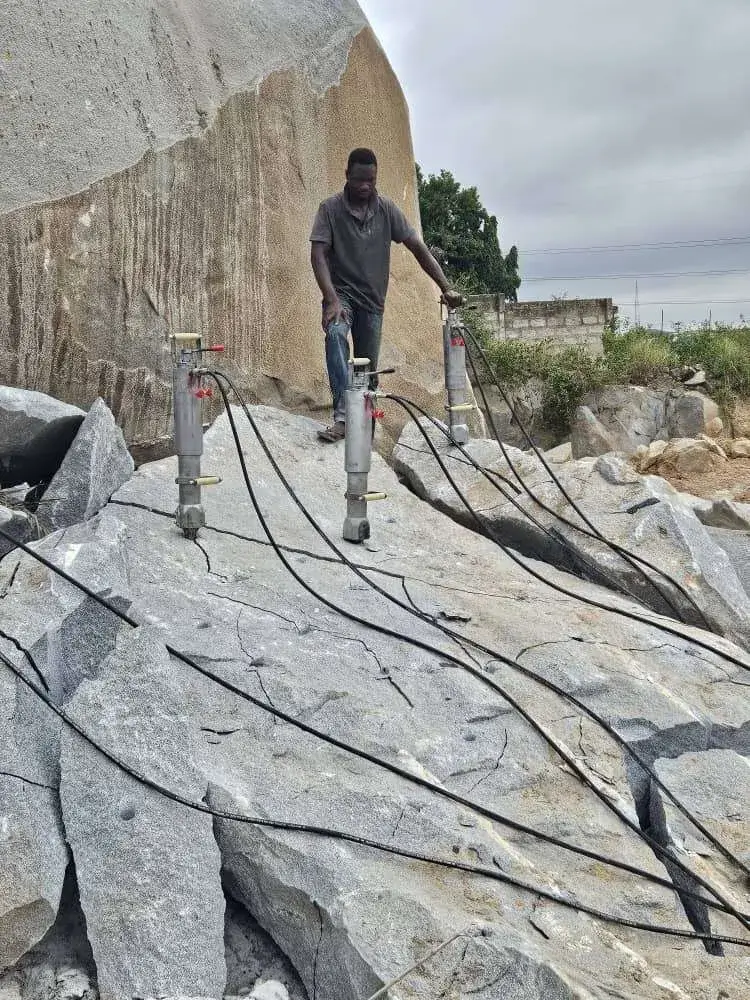
Purchasing a premium hydraulic rock splitter capable of generating 1000 tons of force is only half the battle. The true secret to efficient, non-explosive demolition lies entirely in the preparation: the drilling parameters. According to engineering protocols published by the International Society for Rock Mechanics (ISRM) regarding “Static Expansion Fracturing,” failing to adhere to the physical laws of Volumetric Expansion will result in catastrophic tool failure. If an operator ignores the “Free Face” rule or drills holes that are improperly spaced, the massive hydraulic thrust generated by the machine will be completely absorbed by the earth’s natural solid tension, permanently bending or snapping the heavy-duty steel wedges.
A marble quarry operator in the Middle East recently experienced this exact failure. Attempting to save money on DTH drill bits, they arbitrarily increased their hole spacing from the recommended 400mm to an excessive 800mm. When they activated their hydraulic pump, the rock refused to yield. The hydraulic pressure maxed out, and because the rock did not break, the pressure trapped the feathers. Three expensive splitting cylinders became permanently “rooted” inside the solid marble. After MosCut engineers intervened via remote consultation, they instructed the crew to recalculate the rock’s hardness ($K$ factor) and drill several uncharged “relief holes” nearby. This reduced the localized tension, allowing the rock to finally crack and safely releasing the trapped cylinders.
The Golden Rule: Creating a Free Face
Rock cannot expand into other rock. Before you drill, you must identify where the broken stone will physically move.The single most important concept in hydraulic splitting is Volumetric Expansion. When you force a steel wedge into a hole, the rock must be pushed outward. If you drill a hole directly in the center of a massive, flat bedrock floor where the stone is surrounded on all four sides by infinite mass, the rock has nowhere to go. Activating a splitter here will only crush the rock powder inside the hole; it will never create a crack.
You must always identify or create a Free Face—an open edge, a cliff face, a pre-cut trench, or an existing quarry bench. Your first row of drilled holes must be positioned parallel to this free face. When the splitter expands, it pushes the rock mass directly toward that empty space, easily tearing it away from the main bedrock.

Hole Diameter: Zero Tolerance
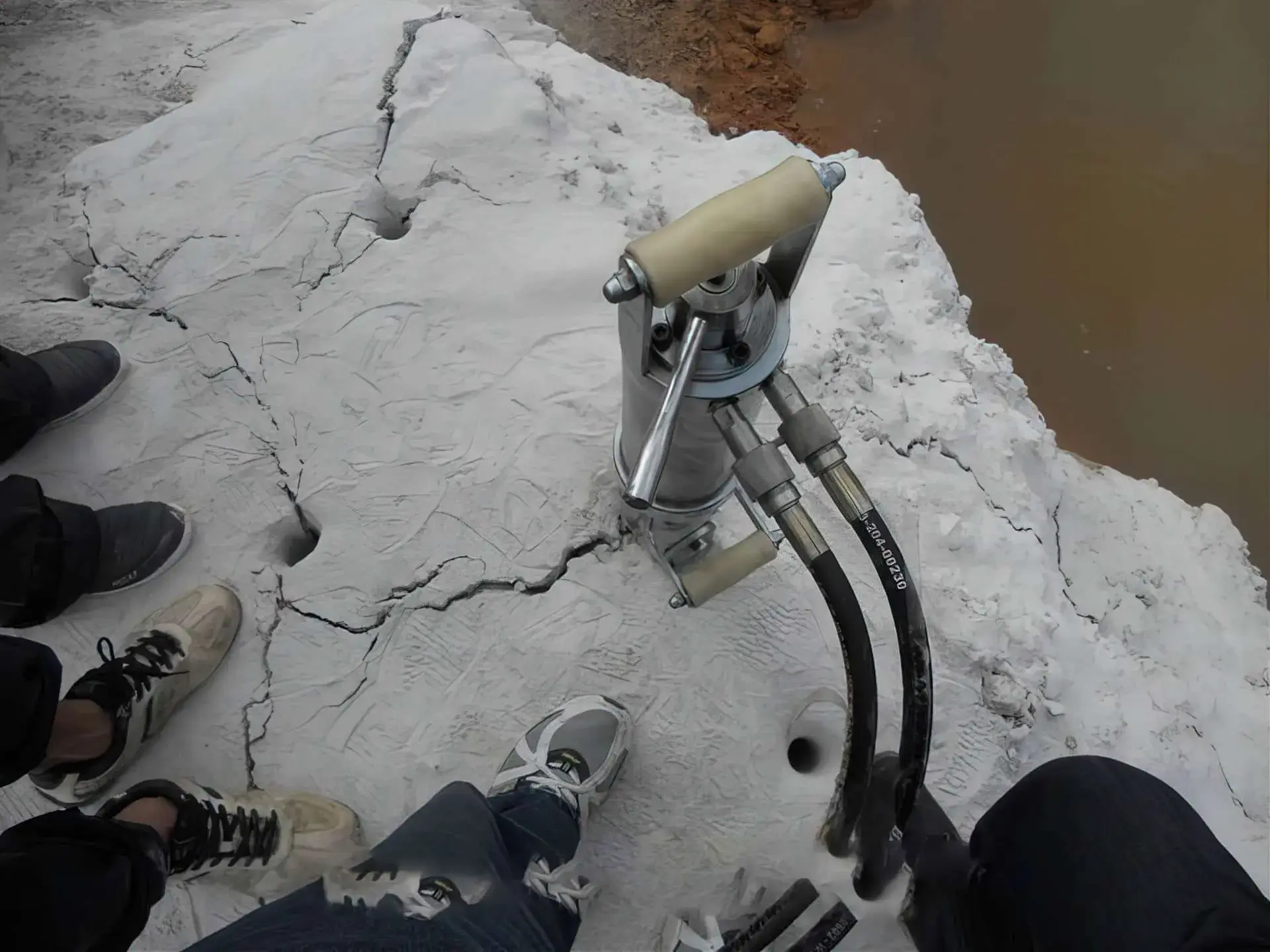
A hole that is 2mm too wide will rob you of 50% of your splitting power.The diameter of your drill bit is an absolute, non-negotiable metric. Let’s assume you are using a MosCut BL46 cylinder, which strictly requires a 46mm to 50mm hole.
If the hole is too small (e.g., 42mm): The operator will have to use a sledgehammer to force the splitting gun into the hole. Because the feathers are already crushed tightly against the central wedge, there is zero travel distance left for the hydraulic piston. When you turn on the pump, the oil pressure spikes instantly, potentially blowing out your hydraulic hoses.
If the hole is too large (e.g., 55mm): This is the most common and fatal mistake. When the pump is activated, the central wedge will travel all the way to its maximum downward limit just to push the feathers out to touch the rock wall. The cylinder reaches its physical expansion limit without ever applying any actual breaking pressure to the stone. Always use the exact drill bit specified in the manual.
Hole Depth: The Active Wedge Zone
The wedge must exert pressure evenly across its entire length. Shallow holes create catastrophic bending stress.A hydraulic cylinder’s splitting power is distributed evenly across the lengthy outer faces of the two feathers. If a hole is drilled too shallow, the bottom tip of the central wedge will strike the solid bottom of the rock hole before it has finished expanding.
When this happens, the massive downward hydraulic thrust concentrates entirely on the very tip of the wedge. This creates immense, uneven lateral stress, which will physically bend or snap the forged alloy central wedge. To prevent this, operators must follow the Minimum Depth Rule:
Your drilled hole depth ($D_{hole}$) must always be at least 50mm deeper than the active length of the wedge ($L_{wedge}$). This extra 50mm provides a safe “clearance zone” to accommodate rock dust, water, and the final downward protrusion of the central wedge.
The Hole Spacing Matrix
Distance dictates success. Use this practical matrix to calculate your exact drilling grid based on geological hardness.How far apart should you drill your holes? The harder and denser the rock, the closer the holes must be to overcome the material’s tensile strength. Use the following baseline matrix when setting up your MosCut splitters (assuming use of heavy-duty BL46 cylinders):
| Geological Material | Distance Between Holes (Spacing) | Distance from Free Face (Burden) |
|---|---|---|
| Extreme Hard (Granite / Quartzite) | 300mm – 400mm | 400mm – 500mm |
| Medium Hard (Marble / Hard Limestone) | 400mm – 500mm | 500mm – 600mm |
| Soft / Porous (Sandstone / Travertine) | 500mm – 600mm | 600mm – 700mm |
| Standard Concrete (Non-Reinforced) | 500mm – 600mm | 500mm – 600mm |
| Heavily Reinforced Concrete (Bridge Piers) | 300mm – 400mm | 300mm – 400mm |
⚠️ Drilling Alignment and Straightness
Crooked holes break straight steel. Your DTH driller is the true pilot of your splitting operation. When drilling a row of holes, they must be perfectly aligned in a straight line to create a “resonance” of tension that rips the rock evenly. More importantly, the holes must be perfectly vertical (plumb). If a hole is curved or angled, inserting a perfectly straight, rigid steel splitting cylinder into it will cause point-loading. Under 60 MPa of pressure, this uneven side-loading will easily tear the strongest aerospace-grade steel apart. Never force a splitter into a crooked hole.
Maximize Your Splitting Efficiency
Pair your new drilling knowledge with the world’s most durable and powerful rock demolition equipment. Protect your investments and eliminate downtime with MosCut.
View MosCut Hydraulic Splitters