
 Stone Cutting Machines
 Stone Polishing Machines
 Bridge Saw Machines
 Stone Quarry Cutting Machines
 Stone Block Cutter Machine
 CNC Stone Wire Saw Machine
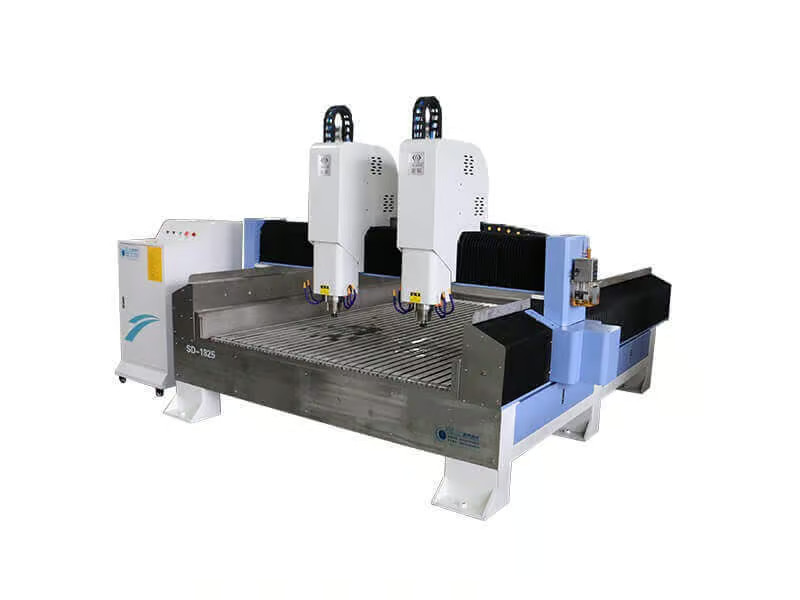 Stone Engraving Machines
 Thin Stone Veneer Saw Machine
 Horizontal Stone Slab Splitting Machine
 Stone Edge Polishing Profiling Machine
 Stone Auxiliary Equipment
The global market for monuments, memorials, and cultural heritage stonework is experiencing steady, high-margin growth. As demand for personalized, heavy-duty stonework increases, workshops are realizing that standard countertop equipment falls drastically short. According to demographic and cultural heritage reports from the United Nations Department of Economic and Social Affairs (UN DESA), shifting global demographics are driving long-term demand for durable memorial architecture. In this lucrative niche, the ability to process extremely thick, heavy, and irregularly shaped stone blocks is the core engine of factory profitability, making industrial-grade manual polishing machinery an absolute necessity.
This reality was sharply felt by a family-owned monument fabrication workshop in Warsaw, Poland. For years, they struggled to process 400mm thick granite memorial bases because their standard automated bridge polisher simply lacked the Z-axis clearance to fit the stone underneath. Their workers were forced to use handheld angle grinders—a method that was incredibly slow, inconsistent, and physically dangerous. By upgrading their facility with a MosCut manual stone polisher featuring a massive 800mm vertical hoisting stroke, they completely revolutionized their workflow. The new machinery allowed them to safely secure and polish these ultra-thick blocks, increasing their finishing speed by 300% and achieving a flawless, weather-resistant mirror gloss that handheld tools could never replicate.
Overcoming the Thickness Barrier in Stone Fabrication
Standard automated bridge polishers and continuous lines are strictly engineered for flat 2cm or 3cm kitchen countertops. When tasked with a 30cm or 40cm thick memorial base, they simply lack the vertical clearance to operate.
The Power of a Massive Vertical Hoisting Stroke
To process monuments, a machine must adapt to the stone, not the other way around. The SF series radial arm polisher features an exceptional motorized vertical hoisting stroke—typically ranging from 0 to 800mm. This massive Z-axis clearance allows operators to easily fit massive granite blocks, stepped memorial bases, and thick headstones under the polishing spindle. The synchronized electric lift ensures that adjusting the height takes only seconds, entirely eliminating the physical strain of manual cranking.
Securing Heavy Blocks on a Reinforced Iron Worktable
A 400mm thick block of solid granite weighs significantly more than standard slabs. Standard automated conveyor belts can buckle or stall under this extreme localized weight. The manual polisher sidesteps this issue entirely by utilizing a heavy-duty, reinforced cast-iron worktable. This base provides a perfectly level, immovable foundation that safely absorbs the massive weight of memorial blocks, preventing any microscopic shifting during the high-friction polishing process.
Achieving a Weather-Resistant Mirror Finish on Dense Granite
Monuments are placed outdoors and must withstand decades of harsh weathering, UV rays, and acid rain. Achieving a flawless, high Gloss Unit (GU) mirror finish is not just about aesthetics; it physically seals the microscopic pores of the stone to prevent water erosion.

High-Torque Performance for Hard Quartz Crystals
Memorials are predominantly crafted from dense volcanic rocks like black granite, which contain extremely hard quartz crystals. Polishing these materials requires immense downward force and rotational power. Equipped with a high-performance 5.5kw main motor, the manual polisher generates the sustained industrial torque necessary to break down and polish these tough minerals without the spindle stalling or overheating under heavy load.
The Optimal Diamond Resin Sequence for Memorials
Because monuments require a weather-sealing gloss, the abrasive sequence must be strictly adhered to. Operators should start with aggressive metal-bonded diamonds to flatten the sawn block, then transition through a complete set of resin-bonded pads (from 50 up to 3000 grit). The manual machine’s central water feed ensures constant cooling during this intense process, preventing the resin pads from melting and leaving burn marks on the dark granite.
Tactile Precision for Intricate Memorial Shapes
Tombstones are rarely just flat rectangular blocks. They frequently feature curved top profiles, chamfered architectural edges, stepped bases, and intricate cross designs that require a human touch to navigate correctly.
Navigating Complex Curves and Architectural Chamfers
Automated machines rely on straight X and Y axes, making it incredibly difficult and time-consuming to program them for curved monument tops or deep architectural chamfers. The radial arm of the manual polisher moves freely in a 360-degree fluid arc. This allows the craftsman to manually sweep the polishing head along the exact curves of the memorial, ensuring an even, brilliant polish on non-linear surfaces without any complex CNC programming.
Preventing Edge Chipping on Irregular Geometries
When polishing the irregular edges of a tombstone, rigid automated pressure can easily cause the abrasive pad to catch and chip the sharp corners of the stone. By utilizing the manual control handle, the operator receives direct tactile feedback. They can instinctively lighten the downward pressure as the polishing head approaches the edge of the block, protecting the fragile corners while still maintaining a perfect surface polish.
Ready to Elevate Your Memorial Production?
Do not turn away highly lucrative monument and headstone orders because of your current machinery’s height limitations. Equip your workshop with the heavy-duty vertical power required for thick slab fabrication.
Power Through Thick Granite with MosCut
Explore our heavy-duty manual stone polishing machines featuring up to 800mm of vertical hoisting stroke. Engineered for the demanding weights and precise finishes of the global monument industry.
View Machine Specs & Lifting CapacityTop 10 Frequently Asked Questions About Monument Polishing
Review the most common technical questions from fabricators looking to process ultra-thick granite blocks, memorials, and headstones using manual radial arm equipment.