
 Stone Cutting Machines
 Stone Polishing Machines
 Bridge Saw Machines
 Stone Quarry Cutting Machines
 Stone Block Cutter Machine
 CNC Stone Wire Saw Machine
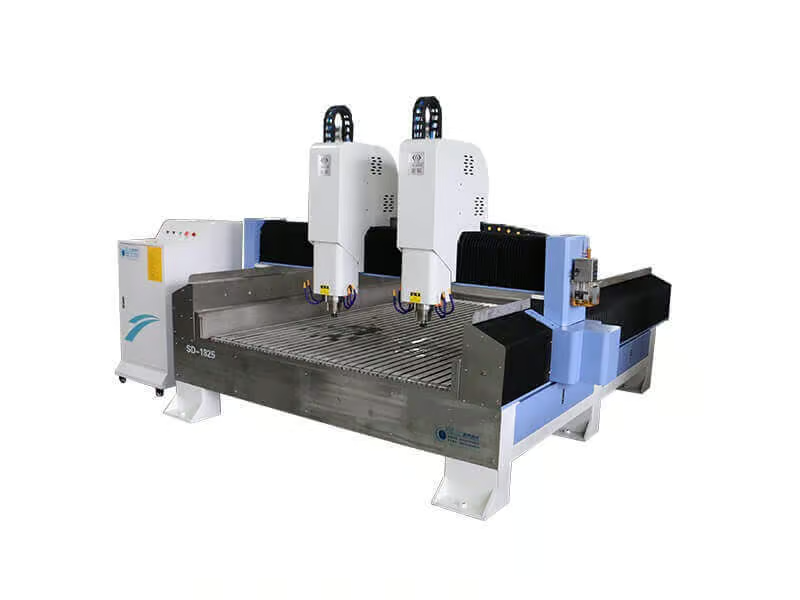 Stone Engraving Machines
 Thin Stone Veneer Saw Machine
 Horizontal Stone Slab Splitting Machine
 Stone Edge Polishing Profiling Machine
 Stone Auxiliary Equipment
In the evolving landscape of global manufacturing, the rise of “Flexible Manufacturing” is forcing stone fabricators to reconsider the balance between pure speed and operational adaptability. While automation is often seen as the ultimate goal, small and medium-sized enterprises (SMEs) are finding that a hybrid approach is more resilient to market fluctuations. According to a recent industrial insight report by the International Labour Organization (ILO), manufacturing firms that utilize a combination of human intervention and robust basic machinery possess 35% more adaptability to fluctuating market demands than fully automated facilities. In stone fabrication, this means finding the perfect harmony between high-volume lines and manual precision.
Take the case of a high-end architectural stone supplier in Cape Town, South Africa. To handle their growing export orders, they invested millions in a fully automated continuous polishing line. However, they soon encountered a critical production bottleneck: the machine struggled to process the small-format marble strips (300*600mm) requested by high-end designers. The automated sensors often failed to detect the small pieces, leading to conveyor jams and surface inconsistencies. By integrating two MosCut manual radial arm polishers as a specialized finishing station, they successfully cleared the backlog. The manual machines provided the stability and focus required for these small-format high-end pieces, doubling their bespoke delivery speed while saving their automated line for bulk large-slab jobs.
Evaluating Production Volume and Factory Throughput
The first metric to analyze is your daily production volume. The choice between manual and automatic systems fundamentally comes down to how many identical square meters you need to process per shift versus how much variety you handle.
When Continuous Automatic Lines Make Sense
Automated line polishers are designed for massive throughput. If your factory processes hundreds of standard-sized 2cm slabs of the same granite type every single day for large commercial projects, the speed of an automated line is unbeatable. However, this speed comes at the cost of high energy usage and a rigid setup that takes time to adjust for different materials.
Why High-Mix Demands Manual Precision
If your workshop handles a variety of stone types—from delicate marble to tough quartz—and produces custom sizes for residential kitchens or bathroom vanities, the MosCut manual polisher offers superior flexibility. You can switch between different grits and stone types in minutes without recalibrating complex software systems, ensuring your workshop remains profitable even on small, high-detail orders.
Small-Format Slab Handling: Where Manual Excels
A common technical failure of fully automated continuous lines is their inability to handle small-format pieces reliably. The manual radial arm remains the superior choice for specialized tile and strip finishing.
The 300*600mm Challenge
Standard automated lines often use sensors and pressure rollers designed for large slabs. When a smaller piece, such as a 300*600mm strip or a custom fireplace hearth, enters the line, it can easily shift on the conveyor belt or fail to trigger the polishing heads correctly. This results in uneven edges or, worse, shattered stone. Because a manual polisher secures the stone on a sturdy iron worktable, the operator has complete control over the surface contact, making it the safest and most efficient way to achieve a mirror gloss on small-format high-end marble.

Analyzing the True Total Cost of Ownership (TCO)
The sticker price is only the beginning. A true financial comparison must include installation, power consumption, maintenance, and the cost of technical downtime.
Hidden Costs of Automation
Automatic machines require specialized technicians for repairs and often demand expensive proprietary spare parts and software updates. In contrast, the mechanical simplicity of a manual polisher means nearly all maintenance can be done in-house. Furthermore, the power consumption of a single 5.5kw MosCut motor is a fraction of what a multi-head automated bridge requires, drastically lowering your monthly utility overhead.
Side-by-Side Comparison: Manual vs. Automatic
Use this comprehensive comparison table to evaluate which polishing technology aligns best with your current factory floor space and long-term production goals.
| Feature Dimension | Manual Radial Arm (MosCut) | Automatic Line/Bridge Polisher |
|---|---|---|
| Initial Investment | Extremely Low (High ROI) | High to Very High |
| Small Format Handling | Excellent (300*600mm tiles) | Poor (Prone to jams/cracking) |
| Setup Flexibility | Instant adjustment | Requires software/sensor setup |
| Maintenance Needs | Basic Daily Lubrication | Specialized Technicians Required |
| Floor Space Required | Compact (3.2m x 0.7m) | Massive (Linear meters) |
| Energy Efficiency | Low Power Consumption | High Energy Demand |
The Hybrid Workshop: Combining Forces for Maximum Efficiency
The most successful modern stone factories create a hybrid floor plan, using automatic lines for bulk jobs and manual stations for bespoke, high-value finishing.
Optimizing Logistics with Manual Stations
By placing manual polishing stations near your CNC bridge saws, you can quickly finish custom surfaces and small-format strips without disrupting the workflow of your main production line. This “Cellular Manufacturing” approach ensures that no matter what the designer asks for, your factory has the tools to deliver. The compact footprint of a manual polisher makes it easy to integrate into existing layouts without major construction.
Ready to Make the Right Machinery Investment?
Selecting the right polishing equipment is critical to your factory’s success. Whether you need the flexibility of manual control or the speed of automation, MosCut has the solution.
Discover the Full MosCut Polishing Lineup
Explore our wide range of stone processing equipment, from heavy-duty manual radial arms to high-efficiency automated systems. Find the perfect balance for your production needs today.
Explore All Polishing MachinesTop 10 Frequently Asked Questions About Machine Selection
We address the most common comparative questions asked by workshop owners when deciding between manual radial arm machines and automated systems.