
 Stone Cutting Machines
 Stone Polishing Machines
 Bridge Saw Machines
 Stone Quarry Cutting Machines
 Stone Block Cutter Machine
 CNC Stone Wire Saw Machine
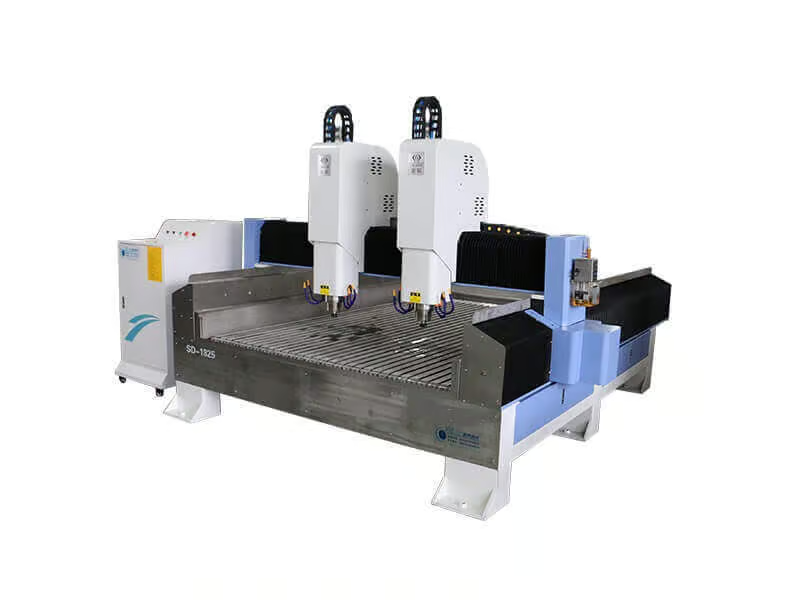 Stone Engraving Machines
 Thin Stone Veneer Saw Machine
 Horizontal Stone Slab Splitting Machine
 Stone Edge Polishing Profiling Machine
 Stone Auxiliary Equipment
In modern luxury residential design, the “Waterfall Island”—where the countertop surface cascades vertically down the sides to the floor—has become an architectural standard. Executing this design requires a flawless 45 degree mitered stone edge on both the top horizontal slab and the vertical drop piece. The physics of a seamless epoxy joint are merciless. To achieve an invisible seam, the two 45-degree chamfered edges must mate with absolute flatness. If the cut is 44.5 degrees, or if the edge has microscopic wavy deviations, the two pieces will not sit flush. The resulting gap must be filled with colored epoxy, leaving a highly visible, thick “glue line” that instantly ruins the aesthetic value of the expensive stone and flags the work as amateur.
A specialized fabrication facility in Sydney, Australia, focusing on ultra-luxury porcelain and sintered stone, faced a severe crisis with this exact geometry. Porcelain is exceptionally hard, yet incredibly brittle. When attempting to cut the 45-degree chamfers using a standard bridge saw, the blade deflection caused a disastrous 30% chipping rate along the fragile knife-edge. Even when glued, the chips had to be manually filled, costing hours of tedious labor per island. The shop pivoted to a MosCut Single-Head Automatic Router. By utilizing the machine’s rigid linear track and milling the 45-degree chamfer rather than slicing it, they completely eliminated micro-vibrations. Chipping was reduced to 0%, and the flawless geometry slashed their epoxy assembly time in half, delighting their high-end developer clients.
🚨 The Unforgiving Geometry of a Seamless Joint
Many fabricators operate under the dangerous assumption that any roughly 45-degree angle can simply be “glued and filled” later. A visible glue line is the ultimate signature of amateur fabrication. Creating a perfect “Laminated Drop Edge” or waterfall side requires a pristine “knife-edge” margin. If an operator uses a handheld angle grinder to cut the bevel, the natural tremor of the human arm creates a wavy surface. When the two wavy surfaces are pushed together, they touch at the peaks but leave massive gaps in the valleys. You cannot cheat the physics of flat mating surfaces; they must be mechanically calibrated.
Why Manual Saws and Basic Bridge Saws Fail
Blade deflection and micro-vibrations are the mortal enemies of brittle materials.Most small shops attempt to cut their 45-degree miters by tilting the blade of a standard bridge saw or using a handheld track saw. This process introduces two fatal flaws into the stone:
1. Blade Deflection: When a thin circular diamond blade is tilted to 45 degrees and forced through 3cm of dense quartz, lateral resistance causes the thin steel core of the blade to bend slightly. This deflection causes the cut angle to curve, meaning the resulting edge is no longer a true, flat 45-degree plane.
2. Micro-Vibrations: Bridge saw motors—especially older or entry-level models—generate significant vibration when cutting at an angle. For brittle materials like sintered stone or porcelain, these high-frequency vibrations hammer against the fragile razor edge of the miter, causing a continuous string of micro-chips (the “bitten apple” effect) along the visible seam line.

The Single-Head Advantage: Milling the Perfect Chamfer
Replace volatile cutting dynamics with ultra-rigid linear milling.The MosCut Single-Head Router solves the waterfall dilemma by changing the physics of the process entirely. Instead of using a thin, flexible saw blade to “slice” completely through the stone, the single-head machine uses a thick, heavy-duty diamond profiling wheel (or a tilted spindle) to mill the excess material away layer by layer.
Because the stone slab is pneumatically locked to the massive cast-iron worktable, and the spindle travels along an ultra-rigid steel track, all deflection and vibration are entirely eradicated. The router bit executes a heavy, stable sweep across the edge, leaving a laser-straight, flawlessly flat 45-degree chamfer. When you bring two of these milled edges together, they lock perfectly flush, reducing the required epoxy line to the thickness of a human hair.

Adapting to the Material: Sintered, Quartz, and Granite
Different mineral densities require tailored abrasive strategies to maintain the knife-edge.🪨 Sintered Stone & Porcelain
These modern materials are incredibly dense but highly brittle. You cannot use aggressive, segmented diamond bits. To prevent catastrophic chipping, you must equip a fine-grit, continuous-rim diamond chamfering wheel and reduce the machine’s linear feed rate, ensuring a gentle, smooth stock removal.
✨ Engineered Quartz
Quartz contains up to 10% polymer resin. Milling a wide 45-degree face creates massive surface friction. If the heat spikes, the resin will scorch and turn a cloudy white, ruining the epoxy bond. You must run the single-head’s hydro-cooling jets at maximum 3.5 Bar pressure directly onto the cutting zone.
🌋 Natural Granite & Quartzite
Natural quartzites are among the hardest stones on earth. Milling a 45-degree miter demands extreme mechanical torque. You must utilize aggressive, segmented metal-bonded diamond bits to chew through the dense minerals, relying on the single-head’s heavy 4.75kw motor to prevent stalling.
Master the Art of Seamless Lamination
Don’t let chipped mitered edges and thick, ugly glue lines destroy your reputation with luxury developers. Achieve architect-grade, seamless waterfall joints effortlessly by harnessing the absolute mechanical rigidity of the MosCut Single-Head Edge Polisher.
View Single-Head Machine Specs