
 Stone Cutting Machines
 Stone Polishing Machines
 Bridge Saw Machines
 Stone Quarry Cutting Machines
 Stone Block Cutter Machine
 CNC Stone Wire Saw Machine
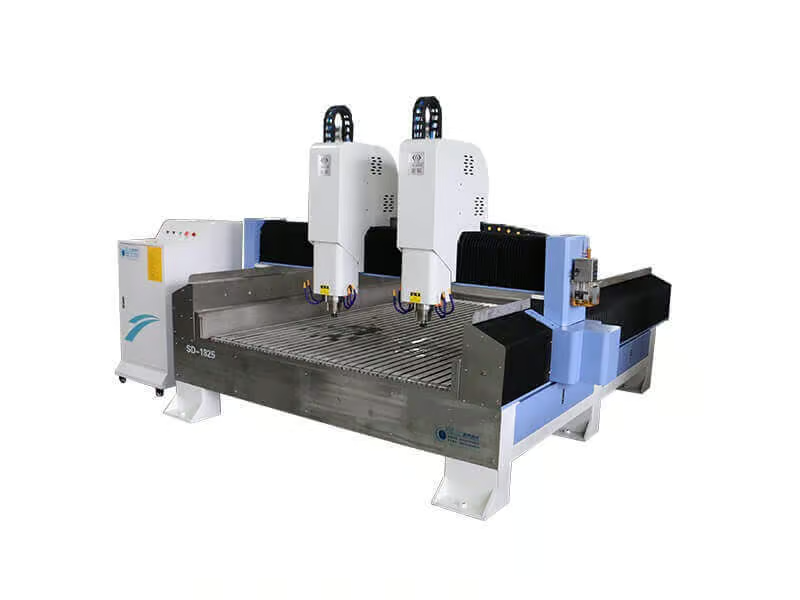 Stone Engraving Machines
 Thin Stone Veneer Saw Machine
 Horizontal Stone Slab Splitting Machine
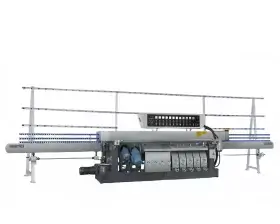 Stone Edge Polishing Profiling Machine
 Stone Auxiliary Equipment
In the competitive world of stone countertop manufacturing, the barrier to entry is heavily dictated by equipment capability. For a micro-manufacturing facility—often a 2 to 5 person crew operating out of a small industrial unit—the scaling bottleneck is brutal. Relying purely on manual wet-polishing exposes small business owners to severe OSHA compliance risks regarding respirable silica dust and debilitating noise. More importantly, it completely caps your daily revenue potential. Manual labor simply cannot guarantee the absolute linear flatness required for high-end residential jobs; a human arm will eventually create “wavy edges” that luxury developers and architects will outright reject. To transition from a low-margin repair shop to a high-margin custom fabricator, you must automate your small stone fabrication shop.
A startup countertop business in Texas, founded by three veteran stonemasons, recently broke through this exact ceiling. In their first year, unable to afford a massive multi-head production line, they relied on hand-held angle grinders. Due to inconsistent edge quality and high labor fatigue, they suffered continuous rejections from local high-end cabinet makers and nearly went bankrupt. Their operational pivot was investing in a MosCut Single-Head Automatic Router. By leveraging a remarkably low capital entry point, they acquired “machine-grade” absolute linear precision. The automated track eliminated their wavy edges instantly, allowing them to secure lucrative kitchen island contracts in wealthy suburban neighborhoods. Within just 4 months, the machine generated enough surplus cash flow to pay for itself completely, establishing a permanent foundation for their business growth.
🚨 The Trap of “Cheap” Manual Labor
Many startup owners fall into a dangerous cognitive trap: “My own time is free, and buying a machine costs money.” You are not saving money by grinding stone by hand; you are capping your daily revenue potential. Let’s do the workshop math. Manually profiling and polishing a 3-meter granite straight edge—including swapping wet pads and trying to fix pressure dips—can take an operator 1.5 hours. The MosCut Single-Head Router does the same job in roughly 30 minutes. When you reclaim that lost hour to go bid on new commercial projects, or to perform high-value epoxy seaming, the value you generate exponentially dwarfs the cost of the machine. Hand-polishing also burns through diamond pads unevenly and risks scorching expensive artificial quartz, creating hidden material losses that bleed your startup dry.
The Financial Pivot: Low Risk, High Reward
Automate your workflow without crippling your early-stage cash flow.For a startup, cash flow is oxygen. Standard 14-head horizontal polishing lines command prices ranging from tens to hundreds of thousands of dollars. Taking on that kind of heavy debt can instantly crush a new business before it even secures its first major commercial contract.
The Single-Head Router is the ultimate financial pivot. It strips away the massive capital cost of multiple spindles while retaining the core component that actually matters for quality: the rigid, heavy-duty linear tracking rail. Instead of the stone moving past 14 heads, a single head travels past the stationary stone, with the operator swapping the diamond grits. This architectural choice lowers the machine’s price to an incredibly affordable tier, making it the highest ROI (Return on Investment) equipment a small shop can purchase to transition away from manual labor safely.

Breaking the Output Ceiling: Precision Opens Doors
Upgrade your product catalog instantly to win lucrative high-end bids.🏛️ Unlocking Architectural Profiles
Hand-grinding a perfect French Ogee or Dupont edge is nearly impossible, even for veterans. The human hand naturally rounds off sharp architectural corners. By equipping the MosCut single-head machine with a metal-bonded profiling router bit, your shop instantly acquires the capability to carve complex, flawless architectural profiles. You can now confidently bid on luxury custom homes that demand intricate masonry styling.
📐 The “Mitered Edge” Advantage
Modern kitchen trends heavily favor “Waterfall Islands” featuring 45-degree mitered drop edges. Attempting to cut a 45-degree chamfer with a handheld circular saw results in micro-chipping and wavy joints that look terrible when glued. The single-head polisher can be configured to execute a perfect 45-degree linear cut, giving your startup the exact same seamless epoxy joint capabilities as a million-dollar fabrication plant.
Space & Installation: The Garage Studio Reality
If you have 4 meters of wall space, you have room for an automated production line.Startups rarely have the luxury of expansive warehouse floors. Many operate out of small industrial bays, converted garages, or shared spaces where installing a massive flatbed machine is physically impossible.
The MosCut Single-Head Polisher is a masterpiece of spatial efficiency. With an overall footprint of roughly 3.8 meters in length and 1.5 meters in width, it is exceptionally compact. Because the slab remains stationary, the machine can be pushed directly against a workshop wall. Installation is equally agile—requiring minimal foundation prep, standard industrial power, and basic water hookups. A shop can have the machine delivered in the morning and be running production by the afternoon, ensuring zero disruption to your current cash flow.

Start Running Your Shop Like a Modern CEO
Stop acting like a manual laborer and start scaling your fabrication business. Automate your edge polishing, eliminate quality rejections, and maximize your margins with the highly affordable MosCut Single-Head Polisher.
View Single-Head Polisher Specifications