
 Stone Cutting Machines
 Stone Polishing Machines
 Bridge Saw Machines
 CNC Stone Wire Saw Machine
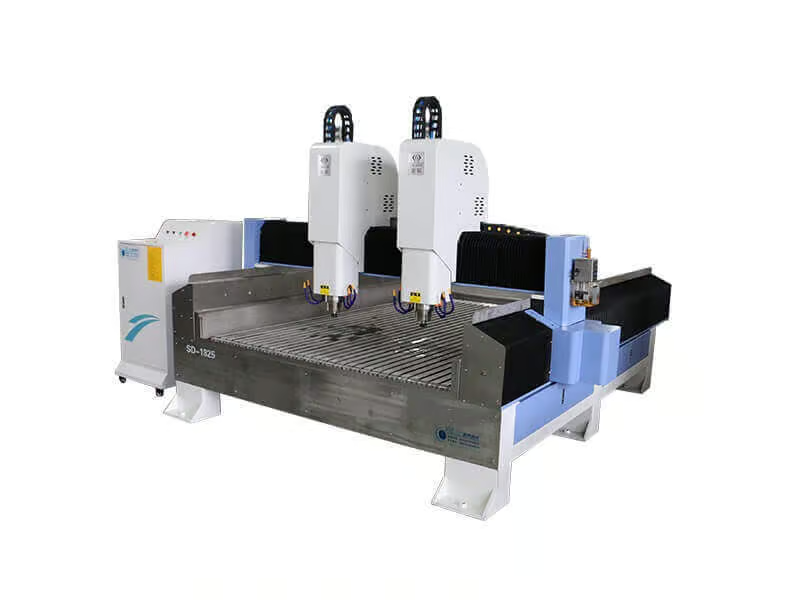 Stone Engraving Machines
 Stone Veneer Saw
 Stone Quarry Machines
 Stone Band Saw Machines
 Stone Edging Beveling Machine
 Other Stone Machines
 Stone Diamond Tools
 Stone Slab Cutting
 Stone Slab Surface Edge Polishing
 Stone Block Slicing
 Stone Quarry Mining
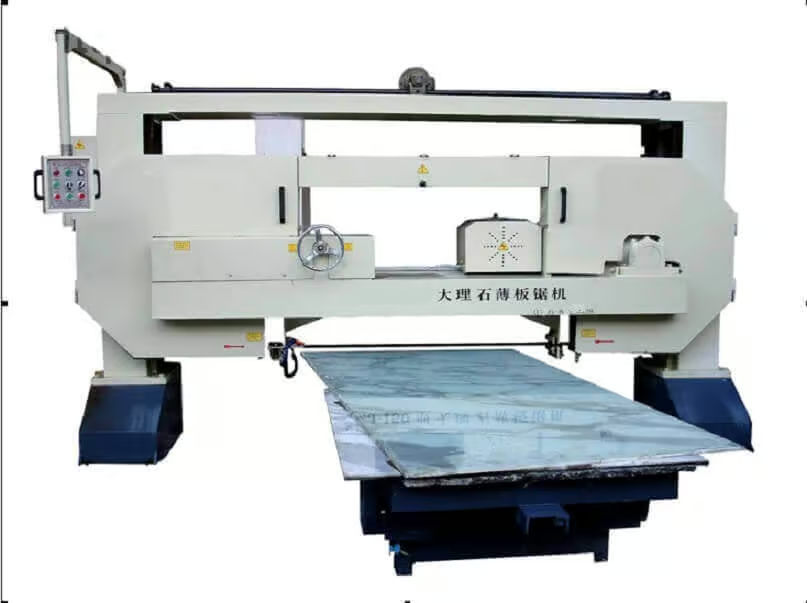 Stone Horizontal Splitting
 Stone Engraving Applications
 CNC Stone Cutting
 Countertop Cutting Polishing
 Other Applications
Choosing the right structural design for your CNC saw is more than just a technical decision—it is a financial one. According to statistics from the MOSCUT after-sales deployment team, based on 80 recent installations in 2025, the traditional gantry-style machine requires a concrete foundation that costs the customer an average of $8,000 to $12,000 in construction fees and causes up to 14 days of factory downtime.
Last year, a countertop fabrication shop in New Jersey faced a sudden relocation due to a lease expiration. If they had been using an old-fashioned gantry saw, they would have had to smash their expensive concrete walls and start from scratch at the new facility. Fortunately, they owned a MOSCUT 4-Axis Monoblock. They simply used a forklift to load the entire machine onto a truck. Within 48 hours of arriving at the new plant, the machine was leveled, powered up, and back in full production. That is the absolute freedom and ROI provided by a “Foundation-Free” design.

What Does “Monoblock” Actually Mean?
In the world of stone machinery, “Monoblock” represents a significant evolution in machine tool engineering. It refers to a unified, self-supporting chassis that integrates all critical components into a single unit.
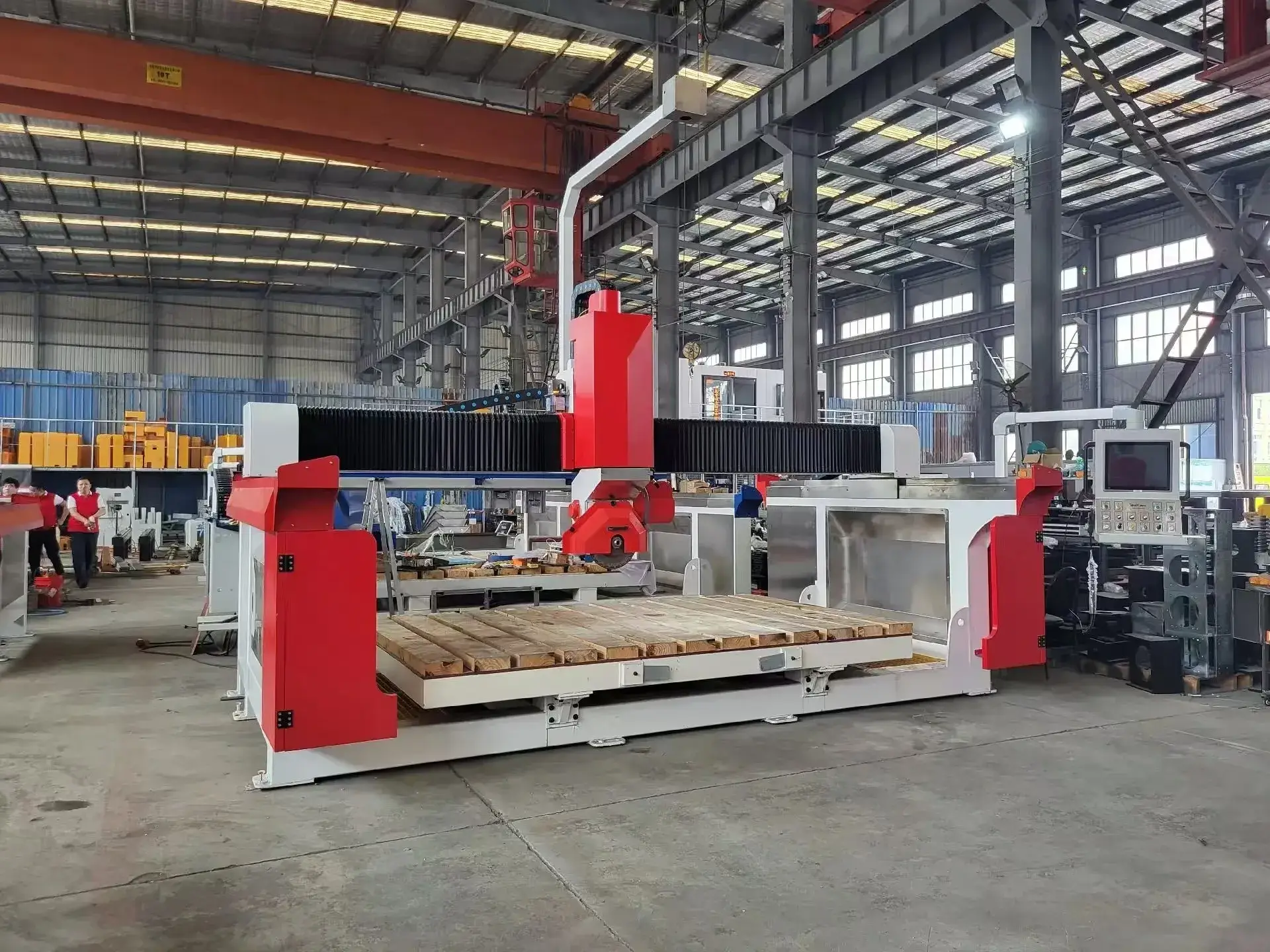
The Unified Steel Chassis
Unlike traditional saws that arrive as a collection of separate beams and rails, a monoblock bridge saw is built on a heavy-duty, reinforced steel chassis. The side support beams, the bridge (Y-axis), and the tilting worktable are all precision-bolted and welded into one square, rigid frame. This ensures that the alignment of the blade to the table is factory-calibrated and remains perfect throughout the life of the machine.

Monoblock vs. Traditional Gantry Saws
Traditional gantry saws do not have their own “legs.” They rely on the customer to build two parallel concrete or brick walls inside the factory to support the bridge. This makes the machine a permanent fixture of the building. If you ever need to move a gantry saw by even five feet to improve your workflow, you have to call a construction crew to pour new foundations—a massive and costly headache.
The Financial and Operational Benefits
Buying a bridge saw is an investment, and you must calculate the “hidden” setup costs. Monoblock machines offer an immediate financial advantage from the day the shipping container arrives at your door.

Zero Concrete Construction Costs
With a monoblock saw, your construction budget is zero. You save thousands on cement, rebar, and professional contractor fees. Furthermore, you avoid the massive dust pollution and mess associated with indoor masonry work, keeping your existing production area clean and operational while the new machine is being set up.
Rapid Plug-and-Play Installation
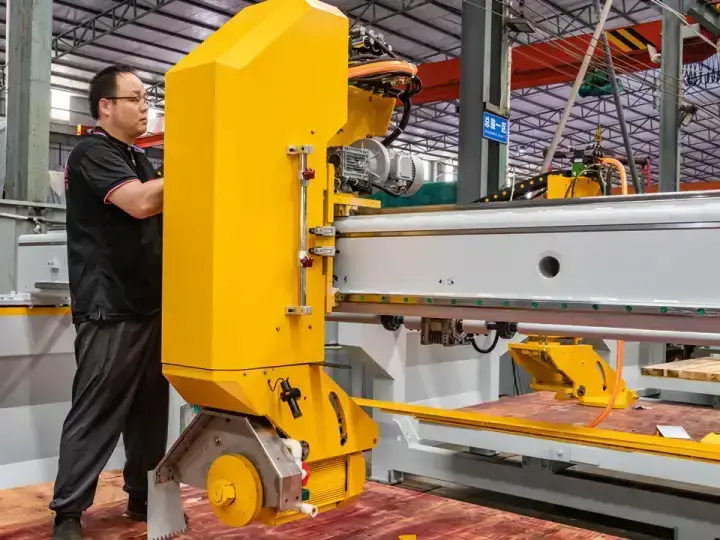
Time is money. A gantry saw setup can take 2-3 weeks including the time needed for the concrete to cure properly. A monoblock saw is placed on a flat factory floor, leveled using high-strength anchor bolts, and connected to power and water. Most of our clients are cutting stone within 3 to 5 days of delivery, allowing for an incredibly fast return on investment.
Exploring Different Monoblock Structural Designs
Not all monoblock machines are created equal. Depending on your material handling equipment, there are two primary chassis designs to consider for your workflow.

The Closed-Frame with Integrated Table
The most common design features a full rectangular bottom frame where the hydraulic tilting table is mounted internally. This provides the highest level of structural rigidity and precision. Because the table and the bridge rails are physically tied together by the bottom frame, the machine maintains perfect squareness even under the high-torque forces of fast CNC cutting.

The Open-Front Layout
Some specialized monoblocks feature an “Open-Front” design where the front horizontal beam is removed. This allows a forklift to drive directly between the two side beams to load a slab. This is an excellent choice for shops that do not have an overhead crane and rely exclusively on forklifts for heavy material movement.
Is a Monoblock Rigid Enough for High-Speed CNC Work?
There is an old-school myth that only a machine anchored to a massive concrete wall can be stable. Modern engineering and high-precision casting have completely debunked this misconception.

Heavy-Duty Cast Iron and Steel Alloys
A premium monoblock saw like the HTQ350E weighs over 3,700 kg (approx. 8,200 lbs). The weight is concentrated in high-density cast iron components and thick-walled steel tubes. This massive self-weight ensures the machine stays “dead” on the floor, providing a rock-solid foundation for high-speed diamond blade rotation.
Vibration Dampening for Sintered Stone
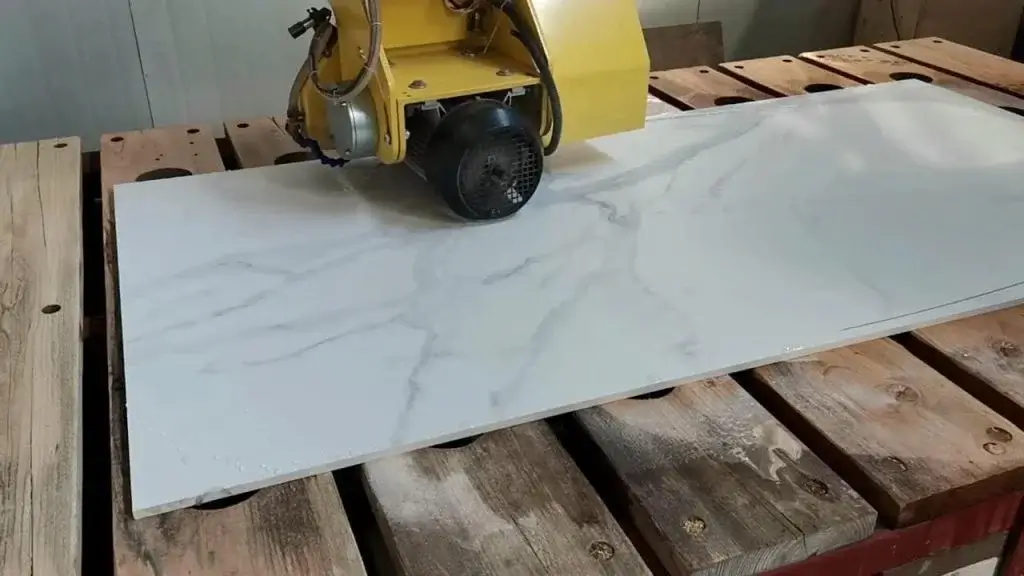
Cutting ultra-hard sintered stones like Dekton or Neolith requires absolute stability to prevent microscopic vibrations that cause edge chipping. The unified monoblock frame acts as a natural vibration dampener. Because the rails and the table move in perfect sync, the cutting edge remains clean and chip-free, even at higher feed rates.
Future-Proof Your Factory Relocation
Investing in a monoblock bridge saw is a strategic move for any growing stone business. By eliminating the high costs and permanence of concrete foundations, you gain the flexibility to optimize your shop floor as your business expands. Whether you are moving to a larger facility or simply rearranging your production line for better flow, the monoblock design ensures your technology moves with you.
Upgrade to a Foundation-Free 4-Axis CNC
Tired of construction delays? Explore the MOSCUT HTQ350E 4-Axis Monoblock. High-speed precision, 360° rotation, and a simple plug-and-play setup.
View Monoblock DetailsBrowse All Bridge Saw Machines
Top 10 FAQ: Monoblock Bridge Saws
1. Does my factory floor need to be reinforced for a monoblock saw?
Generally, a standard industrial concrete floor (at least 6 inches thick and reinforced) is more than sufficient. The machine’s weight is distributed across its large steel chassis, so it doesn’t require deep footings like a gantry saw does.
2. How do I level the machine if my floor is slightly uneven?
All MOSCUT monoblock saws come with heavy-duty adjustable leveling bolts. During installation, our technicians use high-precision levels to ensure the bridge and table are perfectly horizontal, regardless of minor floor imperfections.
3. Can a monoblock machine fit into a standard shipping container?
Yes. We design our monoblock frames to be disassembled into a few primary components that fit perfectly into 20ft or 40ft High-Cube containers, minimizing international shipping costs for our global clients.
4. What size forklift do I need to unload a monoblock saw?
Since the machine weighs roughly 3.7 to 4 tons, we recommend a forklift with at least a 5-ton lifting capacity to safely unload and position the machine in your shop.
5. Is a monoblock saw as accurate as a gantry saw?
In most cases, it is more accurate. Because the bridge rails are factory-mounted onto a precision-welded steel frame, there is zero risk of the rails shifting over time due to concrete settling or wall movement.
6. How long does it take to move a monoblock saw to a new location?
Moving a monoblock saw within the same factory usually takes just half a day with a large forklift. Moving it to a new factory across town can be done in 48 hours, including leveling and recalibration.
7. Will the steel frame rust over time in a wet environment?
We use sand-blasted steel treated with industrial-grade anti-corrosion epoxy primers and high-build polyurethane topcoats. As long as you perform basic cleaning, the frame is designed to last for decades in a wet stone-cutting environment.
8. Can I add a rotating table to a monoblock machine?
Most monoblock designs favor a tilting-only table for maximum stability. Since the 4-axis head already rotates 360°, a rotating table is unnecessary and would only add unnecessary cost and a mechanical point of failure.
9. What are the electrical requirements for installation?
Standard 3-phase industrial power is required. We customize the machine’s internal transformers to match your local voltage (e.g., 220V, 380V, 415V, or 480V 3-Phase).
10. Do monoblock saws require frequent recalibration?
No. One of the biggest advantages of the unified frame is that once it is leveled and calibrated at installation, it stays that way. Gantry saws are more prone to falling out of alignment if their concrete walls experience any ground heave.