
 Stone Cutting Machines
 Stone Polishing Machines
 Bridge Saw Machines
 Stone Quarry Cutting Machines
 Stone Block Cutter Machine
 CNC Stone Wire Saw Machine
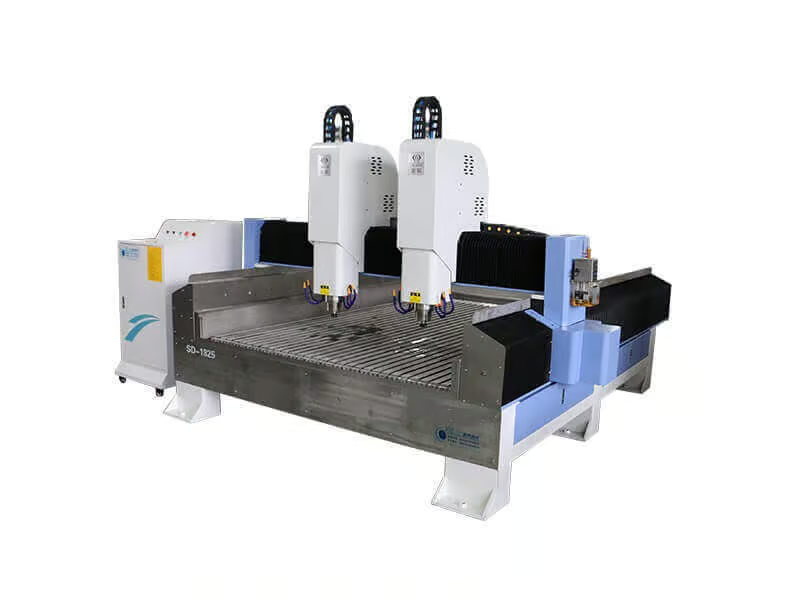 Stone Engraving Machines
 Thin Stone Veneer Saw Machine
 Horizontal Stone Slab Splitting Machine
 Stone Edge Polishing Profiling Machine
 Stone Auxiliary Equipment
In the heavy industrial ecosystem of stone quarrying, there is a dangerous tendency to blame the consumable—the PCD or Carbide insert—whenever cutting performance drops. However, mechanical kinetic studies published in alignment with International Organization for Standardization (ISO) geometric tolerances dictate that a cutting tool is only as stable as the chassis guiding it. A quarry chain saw arm is subjected to hundreds of tons of lateral pressure. If the guide bar or internal wear strips develop an expansion gap of just 1.5 millimeters due to abrasive friction, the entire heavy-duty chain will suffer from “Lateral Whiplash.” This violent, high-frequency sideways slapping motion inside the rock cut is the silent killer of superabrasive inserts, systematically snapping PCD edges before they even begin to wear natively.
A century-old marble extraction site in Carrara, Italy, recently halted operations after experiencing a 100% failure rate on their premium PCD chain inserts. The inserts were shattering after less than 10 square meters of cutting. Assuming a batch defect, they cycled through three different tooling brands with identical, disastrous results. Upon dispatching a MosCut field engineer, the true culprit was immediately identified: the machine’s primary guide bar had not been serviced in two years. The internal alloy rails had ground down into a deep “V-shape,” allowing the chain links to roll and twist under load. The machine was violently shaking the diamond inserts to death. After replacing the worn chassis with MosCut’s precision-hardened guide rails and recalibrating the hydraulic chain tension, the machine achieved laser-like stability. The PCD insert lifespan immediately returned to the benchmark of over 150 square meters, proving that chassis integrity is the foundation of cutting economics.
The Anatomy of a Rigid Jaw
A chain saw insert is only as stable as the titanium-steel arm supporting it.Before you diagnose your machine, you must understand the three core sacrificial components that make up the “Jaw” of your chain saw:
🦾 1. The Guide Bar (Arm)
The massive central steel structure that penetrates the rock. It features a continuous deep groove (channel) along its edge where the chain travels. If the walls of this groove wear thin, the chain leans sideways, ruining the cut angle.
🛡️ 2. The Wear Strips
High-friction sacrificial metal or composite strips bolted inside the guide bar channel. They are designed to take the abrasive beating of the chain so the expensive main arm doesn’t have to. They must be replaced periodically.
⚙️ 3. The Drive Sprocket
The heavily toothed gear wheel located at the motor head. It pulls the chain through the rock. As the sprocket teeth wear down into a “hook” shape, they cause the chain to jerk violently, sending shockwaves to the cutting inserts.
🚨 The Slurry Hazard: Liquid Sand-Blasting
Marble and limestone may be relatively soft, but when mixed with high-volume cooling water, the stone dust transforms into a thick, highly concentrated abrasive paste known as Slurry. As the chain travels at 1.5 to 2.5 meters per second, it drags this slurry deep into the tight mechanical clearances between the chain links and the guide bar.
Without constant high-pressure lubrication to flush it out, this trapped paste acts as an aggressive “Liquid Sand-Blaster.” It quietly grinds away the hardened steel of your guide rails hour by hour. This is the primary reason why an arm that was tight last month is suddenly loose and vibrating today.
Chain Tensioning Physics: Too Loose vs. Too Tight
Calibrating the hydraulic tension cylinder is a delicate balancing act of thermodynamics and kinetic energy.📉 The Destruction of Loose Chains
If the hydraulic tensioner is under-pressurized, the chain develops slack. At high RPM, centrifugal force throws the loose chain outward at the tip of the arm, creating a severe “Whipping Effect.” The chain slaps violently against the rock walls. This lateral trauma snaps the brittle PCD cutting inserts and causes deep gouges in the guide bar’s nose sprocket.
📈 The Destruction of Tight Chains
Over-pressurizing the tension cylinder is equally fatal. A chain stretched too tight exerts immense physical clamping force against the wear strips. The friction heat inside the rock cut instantly spikes past 500°C. This extreme heat burns away the lubricating oil, causing the chain to completely seize (“bite”) into the arm, often snapping the massive steel chain links in half.
The Auto-Lubrication SOP
Never run a giant metal chain dry inside abrasive rock dust. Lubrication is the lifeline of your guide bar.🛢️ Step 1: Viscosity Selection
Do not use cheap recycled motor oil. Chain saw machines require specialized high-tack, water-resistant, Extreme Pressure (EP) chain oil (or biodegradable equivalents). The oil must be sticky enough to adhere to the fast-moving chain without instantly washing off in the cooling water.
🚿 Step 2: Nozzle Unclogging
The guide bar features tiny internal capillary tubes that inject oil directly onto the wear strips. These microscopic nozzles are easily plugged by hardened stone mud. Make it a daily pre-shift routine to manually pump the auto-luber and visually confirm oil is weeping from all ports.
🔄 Step 3: Post-Shift Dry Running
At the end of the shift, turn off the cooling water but leave the oil pump running on maximum. Raise the arm out of the cut and let the chain run “dry” in the air for 3 minutes. Centrifugal force, combined with fresh oil, will violently flush out the corrosive slurry trapped inside the links.
Daily Mechanical Tolerance Checklist
Run these micron-level verifications before dropping the arm into the bench.| Component | Measurement Method | Max Tolerance | Failure Symptom |
|---|---|---|---|
| Guide Bar Channel | Vernier Caliper width check | Original width + 1.5mm | Chain leans sideways; crooked cuts; PCD side-chipping. |
| Chain Pitch Elongation | Measure 10 links center-to-center | > 2% stretch | Chain won’t engage sprocket cleanly; severe jerking. |
| Drive Sprocket Teeth | Visual inspection / profile gauge | Deep hook or sharp point | Loud popping noise; broken chain links; tension loss. |
| Wear Strips | Depth gauge check | Flush with steel bar edge | Chain bottoming out; heavy friction; overheating. |
Stop Destroying Premium Inserts on a Worn-Out Chassis
Your cutting tools are only as good as the machine driving them. Optimize your machine anatomy with MosCut’s precision-engineered replacement chains, guide bars, and superabrasive teeth to maximize your quarry uptime.
Equip Your Machine with MosCut